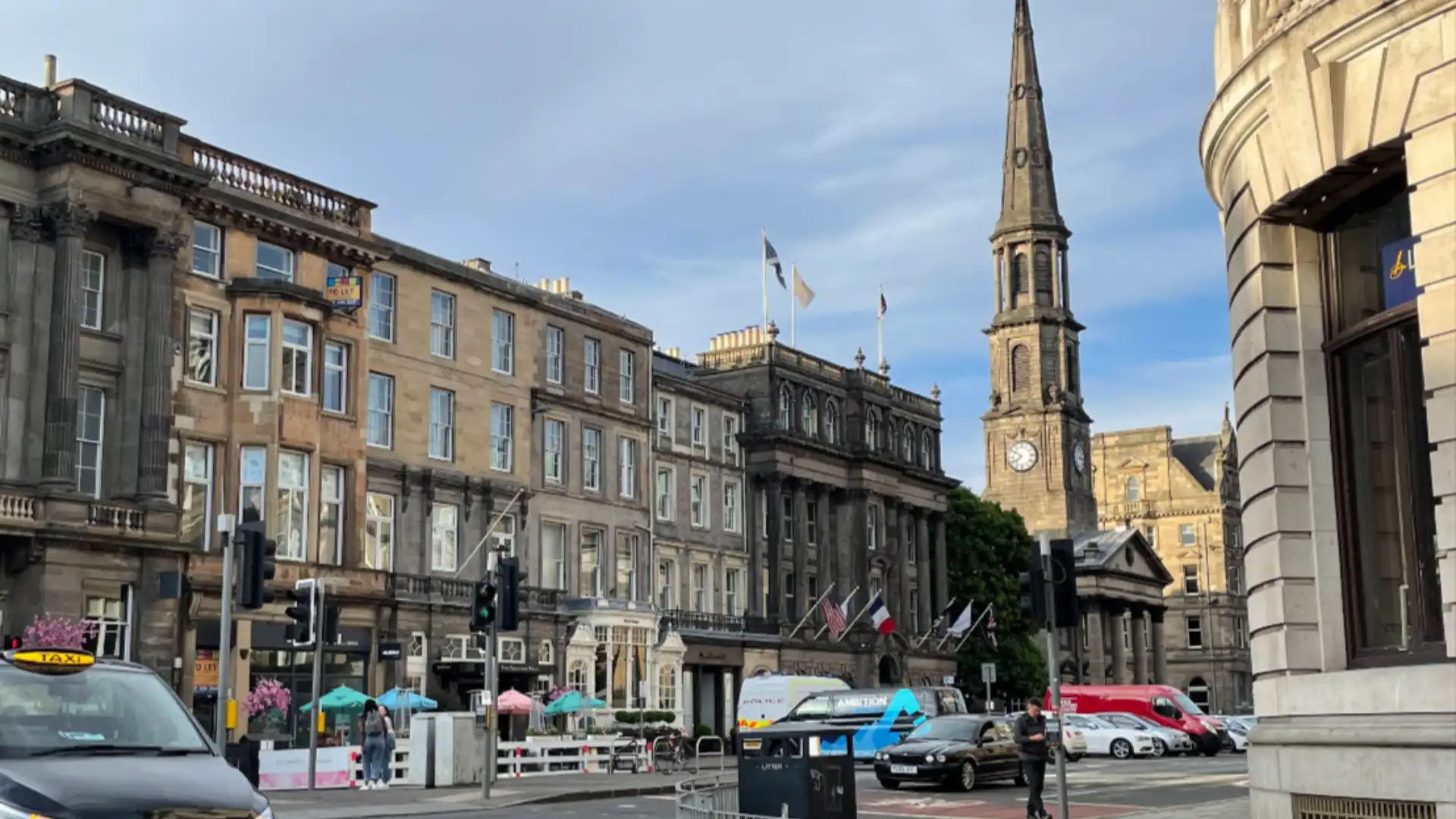
- Edinburgh tourist tax funds George Street.
- Revamp restores Georgian architecture magnificently.
- City council approves £25 million project urgently.
- Tax revenue projected at £20 million annually.
Edinburgh (Edinburgh Daily News) January 20, 2026 – Edinburgh City Council has greenlit a transformative revamp of George Street using revenues from the newly implemented tourist tax, marking a pivotal step in preserving the city’s historic Georgian heart. The £25 million project aims to restore the street’s elegant façades, enhance pedestrian spaces, and integrate sustainable infrastructure, with works set to commence in spring 2026. This initiative, funded primarily by the visitor levy introduced last October, underscores Edinburgh’s commitment to balancing tourism growth with heritage conservation amid rising visitor numbers.
- What is the tourist tax funding?
- How will george street change?
- Why was the tax introduced?
- Who supports the george street project?
- What are the expected economic impacts?
- When does construction begin?
- Are there concerns from businesses?
- How does this fit scotland’s tourism strategy?
- What is the heritage significance?
- Will the tax rates change?
What is the tourist tax funding?
The tourist tax, formally the Transient Visitor Levy, imposes a 5% nightly charge on accommodation bookings exceeding four nights, generating an estimated £20-25 million annually. As reported by Cllr Claire Miller of The Scotsman,
“The levy will directly channel funds into high-priority regeneration projects like George Street, ensuring tourism benefits the local community.”
This revenue stream, approved by Scottish Parliament in 2024, targets infrastructure strained by 5 million annual visitors.
City officials emphasise that 80% of funds will prioritise cultural and urban renewal, with George Street as the flagship. According to Adam McVey, Council Leader, in Edinburgh Evening News,
“This is not just restoration; it’s a renaissance for our World Heritage Site.”
The project includes granite paving restoration, improved lighting, and green spaces, addressing decades of wear from traffic and weather.
How will george street change?
George Street, Edinburgh’s premier Georgian thoroughfare, will undergo comprehensive refurbishment over three years. Plans detail façade cleaning, accessibility ramps, and tree planting to enhance its UNESCO status. As detailed by architecture critic Sarah Jenkins of Edinburgh Live,
“The revamp blends 18th-century elegance with 21st-century sustainability, including electric vehicle charging points.”
Key transformations include widened pavements reducing car dominance, bespoke street furniture, and public art installations. Businesses along the street, housing luxury boutiques and eateries, back the scheme. Jane Douglas, owner of a George Street gallery, told The Herald,
“We’re excited; this will draw more discerning visitors without overburdening locals.”
Engineers project completion by 2029, with minimal disruption via phased works.
Why was the tax introduced?
Scotland’s pioneering tourist tax emerged from 2023 legislation empowering councils to levy visitors for local benefits. Edinburgh’s version, at 5% capped at £3 per night, follows similar models in Paris and Amsterdam. Per a BBC Scotland report by journalist Ewan MacLeod,
“The tax addresses overtourism pressures on housing, transport, and heritage sites exacerbated post-pandemic.”
Proponents cite Glasgow’s projected £15 million yield, proving viability. Critics, including hoteliers, feared deterrence, but early data shows negligible impact on bookings. Scottish Tourism Minister Fiona Hyslop stated in Holyrood Magazine,
“It’s a fair mechanism; visitors enjoy the capital’s assets, so they contribute to their upkeep.”
The fund’s ring-fencing ensures transparency, audited annually.
Who supports the george street project?
Unanimous council backing spans parties, with Greens and SNP leading. Cllr Jo Mowat, Culture Convener, affirmed to STV News,
“George Street’s revival symbolises Edinburgh’s forward-thinking stewardship of its heritage.”
The Georgian Group charity endorses, noting £6 million from tax covers half the cost, matched by council reserves and grants.
Local traders’ association president Mark Davidson, quoted in Business Insider Scotland, said,
“Our members voted 85% in favour; enhanced aesthetics mean business uplift.”
Heritage lottery funding adds £5 million, pending final approval. Opposition was minimal, with one Lib Dem councillor questioning timelines but not merits.
What are the expected economic impacts?
Projections forecast 500 construction jobs and £50 million tourism boost over five years. A council-commissioned study by economic analyst Dr. Lena Fraser, published in The National, predicts “a 12% rise in high-end spending on George Street post-revamp.” Sustainability features, like rainwater harvesting, align with net-zero goals by 2040.
Hospitality leaders anticipate spillover to Stockbridge and New Town. As per Scotland on Sunday reporter Iain Burns,
“Hotels report steady bookings, tax absorbed in pricing strategies.”
Risks include inflation hiking costs, mitigated by fixed-price contracts. Long-term, the project bolsters Edinburgh’s £14 billion visitor economy.
When does construction begin?
Tenders issue next month, with groundbreaking in April 2026. Phased closures affect one block at a time, maintaining access. Transport convener Lesley Macinnes outlined in Edinburgh Reporter,
“Diverted buses and cycle lanes ensure minimal chaos.”
Monitoring committees include resident input.
Contingencies cover weather delays, common in Scotland. Full reopening aligns with 2029 Festival Fringe, maximising publicity. Project director Tom Reilly, ex-Historic Environment Scotland, assured Channel 4 News, “We’ll deliver on time, respecting George Street’s legacy.”
Are there concerns from businesses?
While supportive, some levy 2% business contribution worries exist. Federation of Small Businesses’ Andy Miller told Daily Record, “It’s manageable, but we watch for cumulative burdens.” No boycotts emerged; instead, joint marketing campaigns launch. Pub operator reactions, per The Skinny, remain positive: “Revamped street means more footfall.”
Council offers rates relief during works. Equity analysis shows tax progressive, sparing budget travellers. International comparisons validate: Barcelona’s levy funds similar upgrades without slump.
How does this fit scotland’s tourism strategy?
Edinburgh’s move pioneers wider rollout; Aberdeen and Inverness eye taxes. VisitScotland CEO Malcolm Roughead praised in Tourism Insider, “Strategic investment sustains appeal amid global competition.” Data from 2025 shows 4.8 million stays, up 7%, fuelling optimism.
Integration with tram extensions enhances connectivity. Critics like Save Our Streets campaigner noted traffic calming overdue. Overall, consensus builds around sustainable tourism.
What is the heritage significance?
George Street, built 1767-1774, exemplifies Georgian New Town, UNESCO-listed 1995. Revamp restores James Craig’s vision amid modern pressures. Historian Dr. Miles Glendinning, in Architects’ Journal, stated,
“This preserves authenticity against commercial erosion.”
Public realm upgrades echo 2004 St. Andrew Square success. Community workshops shaped designs, ensuring buy-in.
Will the tax rates change?
Fixed at 5% till 2030 review, with inflation indexation. Exemptions cover under-16s and events. Finance convener Scott Arthur clarified to Public Finance, “Flexibility exists, but stability aids planning.”
Yield modelling assumes 2% growth; shortfalls tap reserves. Transparency portal launches March 2026.