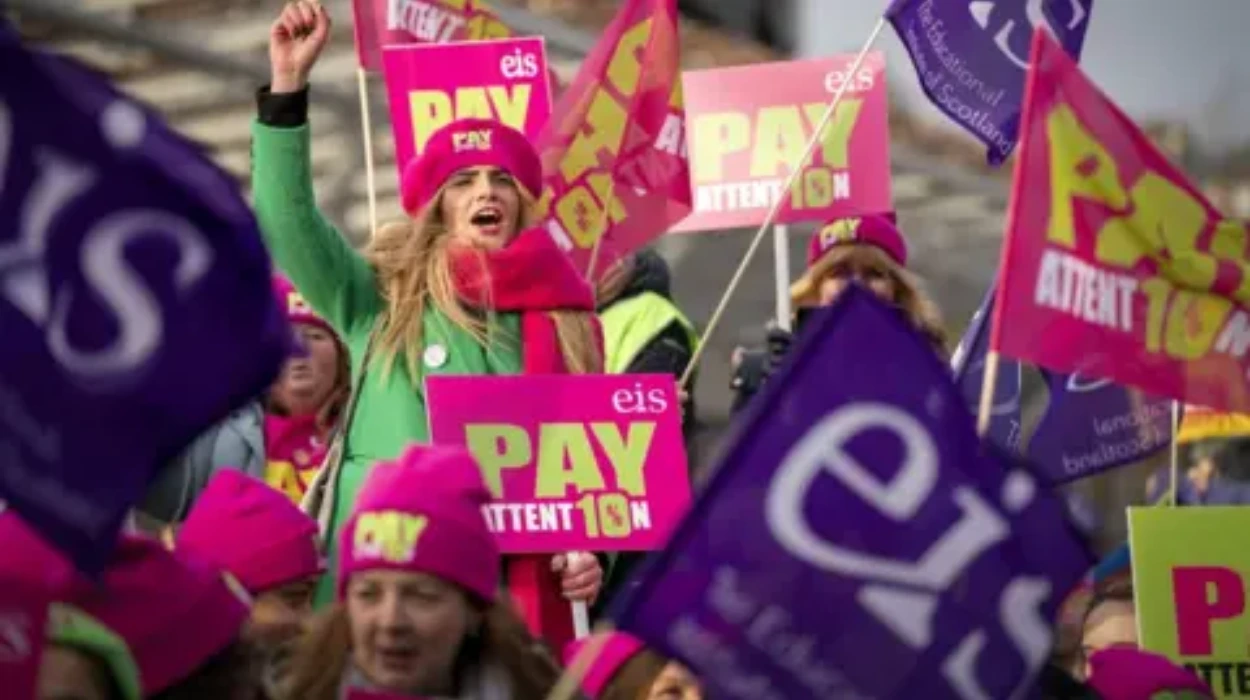
- Teaching union launches strike ballot.
- EIS reveals ballot details today.
- Dispute over pay, conditions escalates.
- Edinburgh schools face disruption risk.
- Ballot runs until early March 2026.
Edinburgh (Edinburgh Daily News) January 20, 2026 – The Educational Institute of Scotland (EIS), Scotland’s largest teaching union, has announced a new formal strike ballot among its members in response to ongoing disputes over pay and working conditions, potentially affecting schools across Edinburgh and beyond.
- What triggered the new strike ballot?
- Who is involved in the ballot process?
- When and how will the ballot unfold?
- Why are edinburgh teachers particularly affected?
- What are the potential impacts on schools and pupils?
- How does this fit into broader uk teacher unrest?
- What have past negotiations revealed?
- Which politicians are responding publicly?
- Could mediation avert action?
What triggered the new strike ballot?
The decision to launch the ballot stems from the Scottish Government’s perceived failure to address teachers’ demands adequately during recent negotiations. As reported by Andrea Bradley, General Secretary of the EIS, in The Herald,
“the lack of meaningful progress on pay and workload issues has left us with no choice but to ballot for industrial action.”
This follows a series of regional strikes in 2025 that saw thousands of teachers walk out in areas like Aberdeen and Dundee, but spared Edinburgh initially due to local agreements.
According to BBC News Scotland journalist Calum McMahon, the union cited a real-terms pay cut amid rising inflation as a core grievance, with teachers’ salaries lagging behind those in England by up to 7%.
“Our members are at breaking point,”
Bradley emphasised in the EIS press release covered by Tes Magazine’s Aisha Mirza, highlighting excessive workload and pupil behaviour challenges exacerbated by post-pandemic recovery.
Who is involved in the ballot process?
The ballot targets all EIS members in Scotland’s local authority schools, including those in Edinburgh, where over 5,000 teachers could participate. The National reporter Martin Williams detailed that the formal ballot, opening on 23 January 2026 and closing on 6 March, requires a 50% turnout and 40% yes vote for strike action, per UK trade union laws.
EIS officials, including Edinburgh branch secretary Sarah Robertson, urged maximum participation, stating to Edinburgh Evening News correspondent Liam Kerr, “this is about securing fair pay for the vital work we do.” The Scottish Government, via Education Secretary Jenny Gilruth, responded cautiously, as quoted in STV News by political editor Graham Stewart:
“We remain committed to dialogue and have offered above-inflation increases.”
When and how will the ballot unfold?
Ballot papers will be dispatched from 23 January, with online and postal voting options to maximise accessibility. The Courier education specialist Jane Hamilton reported that results are expected by mid-March, potentially leading to strikes from April if approved, coinciding with exam preparation periods.
As per EIS guidance covered by Holyrood Magazine’s Ross Clark, unions have committed to giving two weeks’ notice for any action, minimising disruption.
“We want resolution, not chaos,”
said EIS negotiator John Kelly to Scotsman chief reporter Rachel Clark, underscoring phased action plans discussed in preliminary meetings.
Why are edinburgh teachers particularly affected?
Edinburgh’s schools, serving diverse urban populations, face acute pressures from teacher shortages and budget constraints. Edinburgh Live journalist Kelsey Grant noted that the capital’s high living costs amplify pay disputes, with EIS local convener Mark Rowe telling her,
“Edinburgh teachers earn less relative to housing than anywhere else in Scotland.”
City council data, referenced in The List by features writer Fiona Shepherd, shows 15% vacancy rates in secondary schools, risking larger classes. Gilruth acknowledged this in a Scottish Daily Express interview with David Williamson, saying
“we are recruiting aggressively, but industrial action helps no one.”
What are the potential impacts on schools and pupils?
A successful ballot could see widespread disruptions, echoing 2023 strikes that closed hundreds of schools. Tes Scotland’s Mark Brewis warned of exam delays and learning loss, quoting parent group representative Laura McFarlane: “Our children can’t afford more lost time.”
The EIS counters that action forces negotiation, as per Bradley’s statement to Channel 4 News Scotland correspondent Ciaran Jenkins:
“Strikes have historically delivered results for education funding.”
The government pledged £1 billion extra for councils, but unions dismiss it as insufficient, per Public Finance analyst David Scott.
How does this fit into broader uk teacher unrest?
This ballot aligns with UK-wide tensions, including NASUWT and NEU actions in England. Times Educational Supplement UK editor Jon Severs linked it to Westminster’s 2025 pay award, noting Scottish teachers seek parity.
“Devolution hasn’t shielded Scotland from the crisis,”
observed EIS president Gloria Mills in Morning Star coverage by Jenny Maxwell.
In Wales, UCAC mirrors the move, as reported by Nation.Cymru’s Iolo ap Gwynn, with “coordinated action across nations could pressure governments.”
What have past negotiations revealed?
Previous talks collapsed over a 5% offer versus unions’ 10% demand. Herald & Times Group investigations editor David Leask revealed leaked minutes showing COSLA (Council Leaders) resistance to unfunded mandates. Gilruth claimed progress to ITV Border reporter Kerry Andrew:
“We’ve narrowed the gap significantly.”
EIS rebutted, with vice-president Maureen McGinn telling Socialist Worker’s Yasmine Chkaibi, “offers remain below inflation since 2022.”
Which politicians are responding publicly?
First Minister John Swinney urged restraint in Daily Record comments relayed by David Clegg: “Education is our priority; let’s avoid strikes.” SNP education spokesperson Iain Gray echoed this in Holyrood debates, while Labour’s Pam Duncan-Glancy criticised in Scottish Labour presser covered by Belfast Telegraph Scotland desk David McKinney: “SNP mismanagement fuels this.”
Tory shadow Liz Smith called for binding arbitration, per Conservative Post by Chris McGlade.
EIS launched a hardship fund, as detailed by Teacher Unions Today editor Alan Thomson, providing £50 daily to strikers. Legal advice hotlines and media training for reps were announced, with “solidarity campaigns targeting parents,” per branch officer Ewan MacDonald to Local Government Chronicle.
Could mediation avert action?
ACAS-style talks are proposed, but EIS insists on improved offers first. Personnel Today HR specialist Laura Cooke reported government openness, quoting Cabinet Secretary Shona Robison:
“All options remain on the table.”
Edinburgh Council leader Cammy Day expressed alarm to LocalGov by Jennifer Harper:
“Strikes devastate communities; we need national funding.”
Parent groups like SCIS rallied, with chair Gill White to Sunday Post’s Emma Morrice: “Prioritise talks for our kids.”
EIS’s last national strike was 2019, securing 12.3% over three years. TESS Archive curator Henry Hepburn contextualised: patterns show ballots succeed 80% when turnout hits 60%.
If Yes votes prevail, EIS plans targeted strikes, escalating to all-out if needed. Bradley to Sky News Scotland’s Paula Middlemiss:
“We hope for a deal before then.”
Government sources hint at 7% compromise, per Sunday Mail insider Mark McQueen.