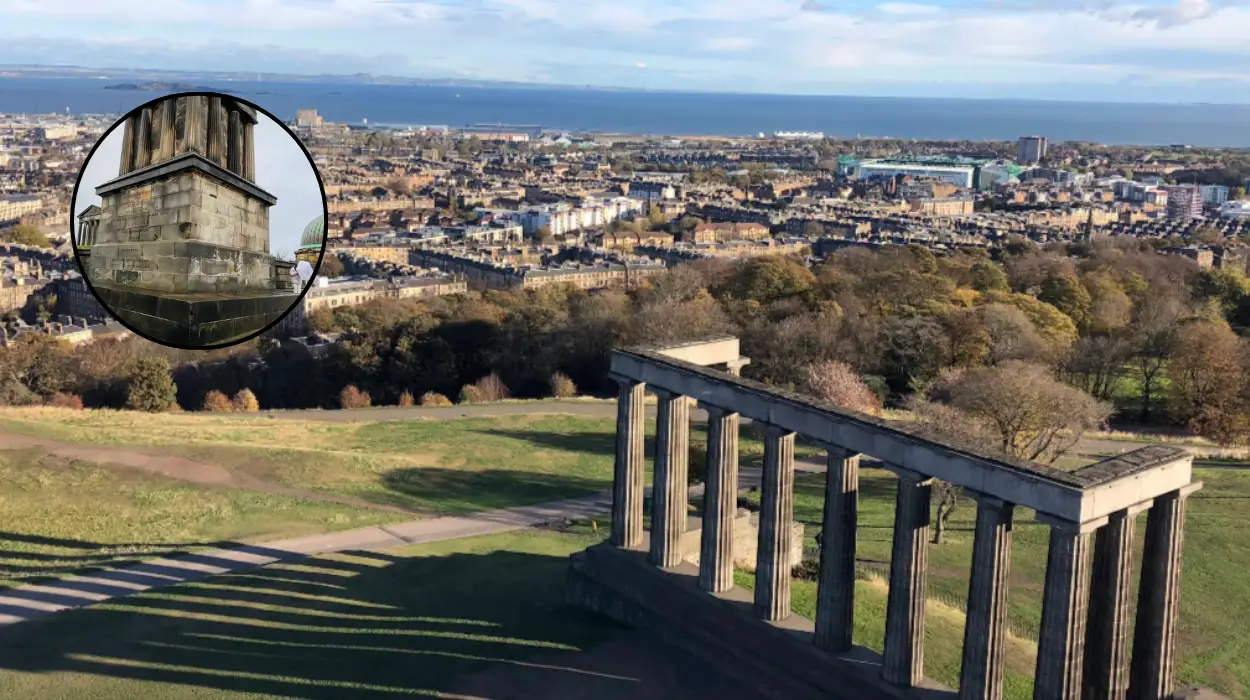
Calton Hill stands as one of Edinburgh’s most treasured landmarks, offering panoramic vistas and a cluster of historic monuments that define the city’s skyline. This volcanic hill, rising just beyond Princes Street, draws visitors year-round for its blend of natural beauty, architectural splendor, and cultural significance.
- Geological Origins of Calton Hill
- A Journey Through Calton Hill’s Etymology and Early History
- Iconic Monuments Crowning Calton Hill
- Old Calton Burial Ground: A Poignant Historical Site
- Architectural Marvels and Surrounding Structures
- Unrivaled Panoramic Views from the Summit
- How to Reach and Explore Calton Hill
- Vibrant Events and Cultural Celebrations
- Calton Hill in Modern Edinburgh: Conservation and Legacy
Geological Origins of Calton Hill
Calton Hill’s dramatic presence owes much to its ancient volcanic roots, formed around 335 million years ago during the Lower Carboniferous period. Composed primarily of lava flows from the Arthur’s Seat volcano, the hill was shaped by geological faults that displaced its structure and later sculpted by glacial ice into the distinctive crag-and-tail formation seen today.
This process created steep cliffs on the western face facing the city, contrasting with gentler slopes on the eastern side, a classic example of glacial erosion that mirrors nearby Salisbury Crags. The hill rises to 108 meters (355 feet), its tough igneous rocks transitioning sharply across faults into softer Carboniferous sandstones, visible along paths from Regent Street.
Edinburgh’s geology enthusiasts often trace these layers during walks, noting how the lava beds and ash deposits from Arthur’s Seat extend here, underscoring Calton Hill’s integral role in the city’s volcanic landscape.
A Journey Through Calton Hill’s Etymology and Early History
The name Calton Hill evolved from early references like “Cragingalt” in a 1456 charter by James II, possibly deriving from Old Welsh or Brittonic terms meaning “crag on the hill” or “place of the small wood.” By 1591, South Leith Parish records mentioned “Caldtoun,” reflecting its position as a distinct village quarter before formal incorporation into Edinburgh in 1856.
Prehistoric evidence suggests a hillfort atop the summit, while medieval use included quarrying at the eastern Quarry Holes and as a natural amphitheater for tournaments, sports, and open-air theater under James II’s military policies. In 1518, Carmelite Friars established a monastery at Greenside, later repurposed as a leper hospital post-Reformation, with strict regulations enforced until its abandonment.
The 1559 Siege of Leith saw cannons positioned on “Craigingalt” to bombard French forces, marking early military significance. Ownership shifted through families like the Logans and Elphinstones, with the western side sold to Edinburgh in 1725, fostering trade via the Incorporated Trades of Calton society.
Iconic Monuments Crowning Calton Hill
Calton Hill’s summit hosts an eclectic array of neoclassical monuments, earning Edinburgh the title “Athens of the North” in the 19th century. The unfinished National Monument, modeled on Athens’ Parthenon, began construction in 1826 to honor Napoleonic War dead but halted in 1829 due to funding shortages, leaving 12 columns as a poignant reminder of ambition.
Nearby, the Nelson Monument, a 32-meter tower designed by Robert Burn between 1807 and 1816, commemorates Admiral Horatio Nelson’s Trafalgar victory and death. Its telescope-like form rises from a castellated base, with 143 steps leading to a viewing gallery; a time ball added in 1853 signals 1 pm daily, synchronized with Edinburgh Castle’s One O’Clock Gun for Leith ships.
The Dugald Stewart Monument, a elegant column by William Henry Playfair, honors the philosopher, while the City Observatory (1818) and Observatory House (1776) highlight astronomical pursuits. The Political Martyrs’ Monument in Old Calton Burial Ground remembers 1793 reformers transported to Australia, and David Hume’s simple tomb lies nearby.
Old Calton Burial Ground: A Poignant Historical Site
Nestled on Calton Hill’s southwestern slope, Old Calton Burial Ground, established in 1718, serves as a serene repository of Edinburgh’s past. Philosopher David Hume’s unmarked tomb, per his wishes, features only birth (1711) and death (1776) years on a Roman-style monument, drawing admirers of Enlightenment thought.
Hamilton’s Obelisk honors political martyrs, and the site includes remnants of the former Calton Jail, like the Governor’s House by Archibald Elliot. Skeletons unearthed in 2009 near Leith Walk linked to the old leper hospital underscore its layered history, now a peaceful contrast to urban bustle.
Architectural Marvels and Surrounding Structures
William Henry Playfair’s influence permeates Calton Hill, with elegant terraces like Royal, Regent, and Carlton encircling the slopes since 1819. Royal Terrace, once dubbed “Whisky Row” for Leith traders, boasts grand townhouses, some now hotels, offering Firth of Forth views.
Regent Bridge (1815), engineered by Robert Stevenson, spans a deep gorge to Princes Street, its eastern end embedded in the hill. St Andrew’s House, headquarters of the Scottish Government, occupies the former jail site on southern slopes, with prison walls still visible.
The old Royal High School (1829) adds to the skyline, while Rock House below housed pioneering photographers Robert Adamson and David Octavius Hill in the 1840s.
Unrivaled Panoramic Views from the Summit
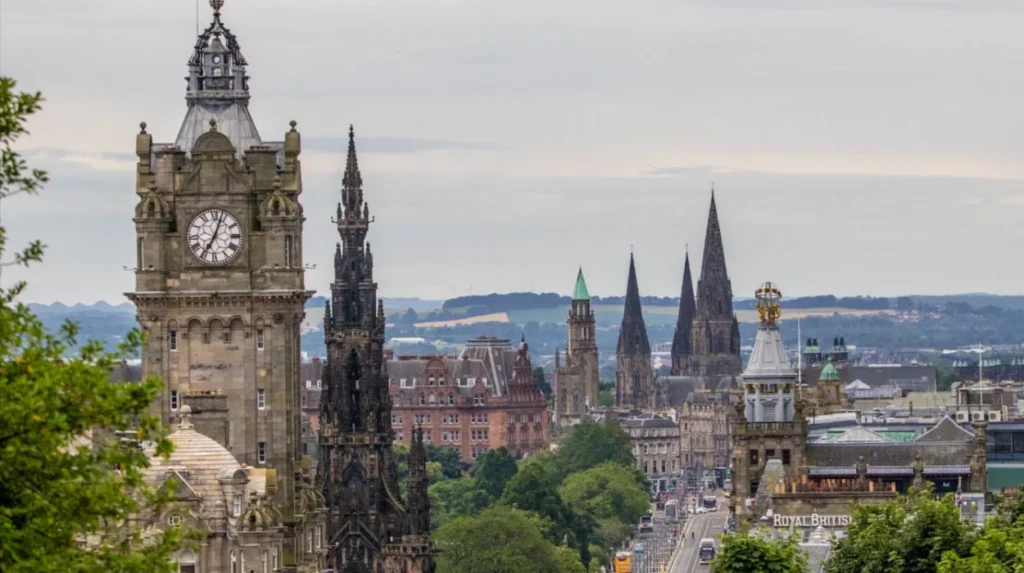
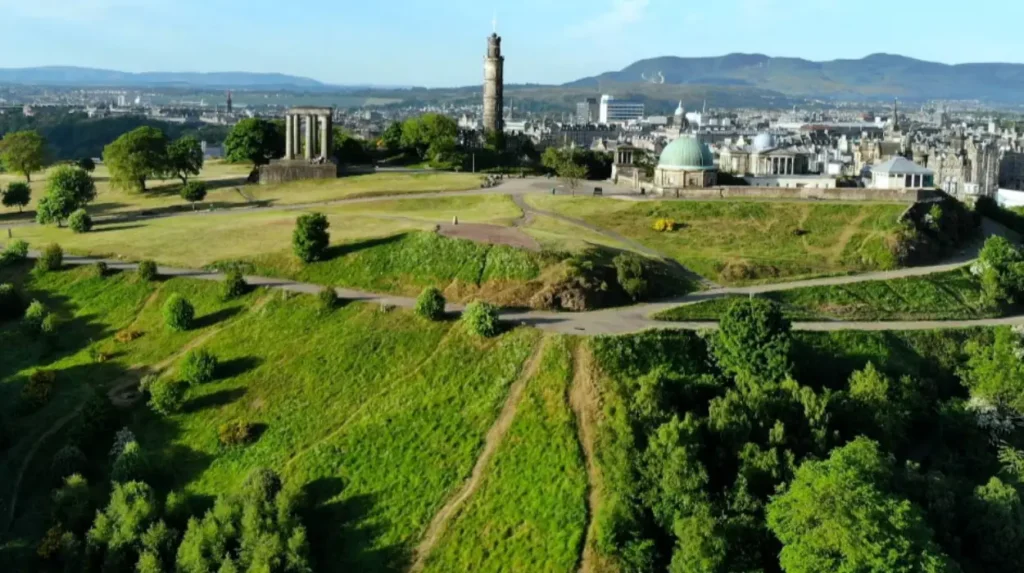
Ascending Calton Hill rewards with sweeping vistas encapsulating Edinburgh’s essence, from Edinburgh Castle and Old Town to Arthur’s Seat and Holyrood Palace. Northern gazes extend to Leith, the Firth of Forth, and Fife hills, especially striking at sunrise or sunset.
Artist Robert Barker invented the panorama in 1787 from the City Observatory tower, capturing 360-degree city views that influenced global art. Today, these perspectives feature in paintings, photos, and films like Sunshine on Leith and Greyfriars Bobby.
Regent Gardens cover much of the summit, managed privately for tranquility amid the monuments.
How to Reach and Explore Calton Hill
Reaching Calton Hill is straightforward, with a 5-10 minute walk from Waverley Station via Princes Street’s east end turning onto Regent Road. Paths include ramps or steps, accessible for bikes, prams, or wheelchairs, with well-maintained gravel trails circling the flat summit.
Public transport options abound: buses along Princes Street drop nearby, or it’s a short stroll from the New Town. Parking is limited, encouraging eco-friendly access; combine with nearby Holyrood Park for extended rambles through volcanic terrains.
Vibrant Events and Cultural Celebrations
Calton Hill pulses with life during annual events, headlined by the Beltane Fire Festival on April 30, a modern Celtic revival drawing 12,000 with fire dances, acrobatics, and the May Queen procession celebrating summer’s arrival.
Samhuinn Fire Festival in late October and Dussehra in early October add multicultural flair. Its open spaces suit these immersive spectacles, blending ancient rituals with contemporary theater against stunning backdrops.
Calton Hill in Modern Edinburgh: Conservation and Legacy
Protected within Edinburgh’s UNESCO World Heritage Site, Calton Hill benefits from efforts like the 2024 Calton Hill Conservation Trust, aiming to enhance cleanliness and safety. Recent restorations, such as the Nelson Monument’s 2009 overhaul, preserve its structures.
Politically symbolic, it hosted devolution vigils and the 2004 Declaration for Scottish independence, while St Andrew’s House underscores governmental ties. Despite past issues with antisocial behavior, vigilant management maintains its appeal.
Its enduring draw lies in balancing nature, history, and views, inspiring locals and tourists alike in Scotland’s capital.