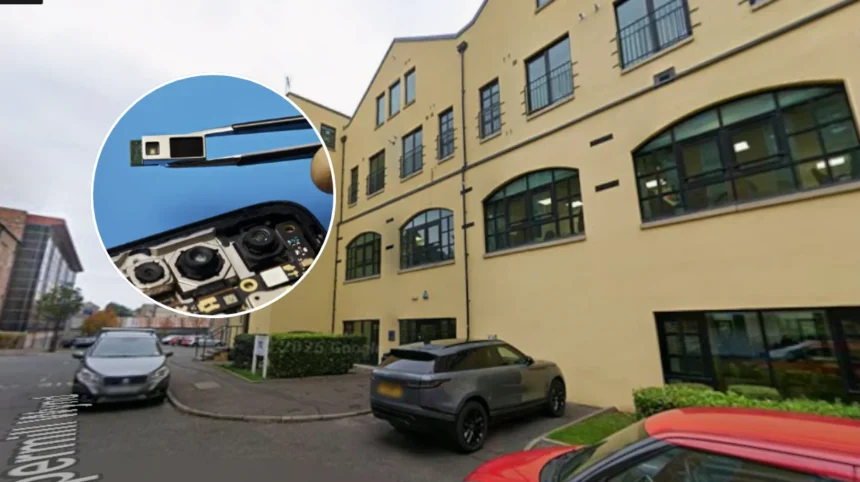
Key Points
- Edinburgh-based technology firm PureLiFi has entered administration after running out of cash.
- All 42 employees at the company’s head office in Leith were made redundant immediately.
- Insolvency firm BTG Advisory appointed Thomas McKay and Michelle Elliot as joint administrators.
- Founded in 2012 as a University of Edinburgh spin-out, the company raised more than £35 million, including £15 million from the Scottish National Investment Bank.
- The collapse followed a shift toward in-house hardware manufacturing and a failure to secure further development capital.
- Administrators are now working to sell company assets, focusing on its patent portfolio and intellectual property.
EDINBURGH (Edinburgh Daily) September 2, 2026 – As reported by Terry Murden of Daily Business, the Edinburgh-headquartered wireless pioneer PureLiFi entered administration after experiencing severe cash flow depletion at the end of Q2 2026. Joint administrators Thomas McKay and Michelle Elliot of BTG Advisory were appointed to manage the insolvency process after the company failed to secure critical follow-on development funding required to sustain operations.
As reported by Martin Williams of The Herald, Thomas McKay, managing partner of BTG in Scotland and Northern Ireland, stated that “the firm had received significant investment from numerous sources over the years, and despite creating products and generating revenue with some groundbreaking proprietary wireless technology, the business simply ran out of money before it could cross into profitability”.
As reported by Terry Murden of Daily Business, Thomas McKay further explained the structural cause of the collapse, stating that “a strategic shift into manufacturing its own hardware, rather than licensing its globally patented technology to third-party manufacturers, was more costly than initially anticipated”. McKay noted that “by the end of Q2 2026 the business had simply run out of cash flow and was seeking sources of additional investment needed to cover losses until the business crossed into profitability”. He added that “with no further investment forthcoming, the directors were left with no alternative than to appoint administrators to stop the company’s debts rising, and sadly that has led to the immediate redundancy of all 42 employees at the business”.
How Will the Redundancies and Asset Sales Be Managed?
As reported by The National, all 42 staff members employed at the firm’s head office in Leith, Edinburgh, have been made redundant with immediate effect.
As reported by Terry Murden of Daily Business, Thomas McKay of BTG Advisory stated that “our team is working closely with those affected to help them access the financial entitlements and support available to them, including assistance from Partnership Action for Continuing Employment (PACE) and the Redundancy Payments Service”.
Regarding the remainder of the administration process, as reported by Terry Murden of Daily Business, Thomas McKay outlined the priority for administrators, stating that “in addition to ensuring these employees receive the guidance and advice they need during this process, our priority is to identify any business assets and realise maximum value from their sale, especially the valuable intellectual property assets built up over the years of development, to the benefit of creditors”.
What Is the Background of PureLiFi and its Institutional Backing?
PureLiFi was spun out from the University of Edinburgh in 2012 by Professor Harald Haas, who coined the term ‘LiFi’ during a 2011 TED Global talk. The core technology utilises visible light, infrared, and ultraviolet spectrums rather than radio frequencies (Wi-Fi) to transmit high-speed, secure data through LED lighting and dedicated optical modules.
Over its 14-year history, PureLiFi was widely viewed as one of Scotland’s most promising deep-tech commercial ventures. The firm amassed an extensive global patent portfolio and established commercial links with device makers, international defence operators, and telecommunication partners. Across its lifetime, PureLiFi secured more than £35 million in private equity and venture capital funding from a wide array of over a dozen global investors.
Major financial backers included the state-backed Scottish National Investment Bank (SNIB), which initially committed £10 million in July 2022 to support product design and scale commercial operations. As reported by Martin Williams of The Herald, the Scottish National Investment Bank confirmed its total commitment to PureLiFi stood at £15 million, of which £14.7 million had been drawn down. The Herald reported that SNIB had already “made a provision for the potential failure of the company in its recent annual report and accounts as part of its unrealised losses”.
The business transitioned from a pure research-and-licensing shop into an original equipment provider, producing components such as the Light Antenna ONE module and tactical defense solutions like the Kitefin system. However, the substantial capital requirements needed to build out hardware supply chains and scale inventory ultimately overwhelmed the company’s balance sheet before mass-market adoption could yield sustainable profitability.
Prediction: How This Development Can Affect the Tech Sector and Stakeholders
Prediction
The sudden collapse of PureLiFi is expected to have notable ripple effects across Scotland’s technology ecosystem, institutional investors, and the broader optical wireless market:
1. Impact on the Local Tech Workforce and Talent Pool
The immediate loss of 42 highly specialised hardware engineers, optical researchers, and commercial staff in Leith represents a sharp shock to Edinburgh’s tech sector. However, given the global demand for advanced photonics, wireless engineering, and semiconductor expertise, it is anticipated that rival telecom entities and regional research hubs will rapidly absorb a significant portion of this redundant talent pool.
2. Scrutiny Over Public and Development Capital
The write-off of nearly £15 million in public funds by the Scottish National Investment Bank will likely invite increased political and economic scrutiny regarding how state-backed patient capital is allocated to capital-intensive hardware firms. Public investment institutions may adjust their risk frameworks, pivoting away from capital-heavy hardware manufacturing ventures in favour of less capital-intensive software or licensing models.
3. Future of Commercial LiFi and Intellectual Property
The liquidation of PureLiFi’s asset base will likely lead to a competitive auction for its patent portfolio. Large international semiconductor manufacturers or global telecommunication firms are likely to acquire these patents at a discount. While PureLiFi as an independent entity has ceased operations, its foundational light-communication IP will almost certainly re-emerge inside consumer electronics or specialized military hardware under new corporate ownership.