Key Points
- The Ross Fountain in West Princes Street Gardens is running in full flow below Castle Rock.
- The Category A-listed 19th-century structure consists of 122 French cast-iron parts brought into Scotland through the Port of Leith.
- French sculptor Jean-Baptiste Klagmann designed the fountain, which was cast at the Antoine Durenne ironworks in Sommevoire and includes figures representing science, arts, poetry, and industry, as well as cherubs and mermaids.
- Local gunmaker Daniel Ross bought the fountain for £2,000 at the 1862 International Exhibition in London, gifted it to the City of Edinburgh, and saw it open in 1872.
- A £1.9 million restoration by the Ross Development Trust, Edinburgh World Heritage, and the City of Edinburgh Council returned the fountain to full operation in July 2018 after years of disrepair.
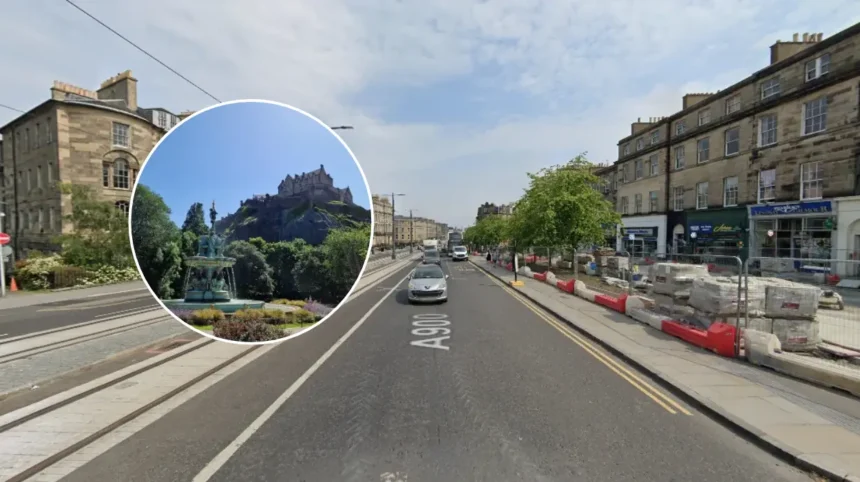
Edinburgh (Edinburgh Daily) October 28, 2026 – In West Princes Street Gardens, the Ross Fountain has attracted local residents, morning commuters, and international visitors as its water display runs in full flow directly beneath the shadow of Edinburgh Castle.
- Key Points
- How Does the Cast-Iron Masterpiece Function and What Features Are Visible?
- What Is the Historic Origin of the Ross Fountain?
- How Was the Comprehensive £1.9 Million Restoration Achieved?
- What Is the Background of the Ross Fountain Development?
- What Is the Future Outlook for Edinburgh Residents and Visitors?
The Category A-listed structure, finished in its distinctive teal, bronze, and gold palette, stands as one of the city’s most recognisable Victorian civic monuments.
The visual contrast between the cascading water features, the detailed cast-iron ornamental work, and the ancient volcanic crag of Castle Rock continues to provide a central focus within the UNESCO World Heritage site.
As reported by Phyllis Stephen of The Edinburgh Reporter, civic leaders and restoration teams have consistently highlighted the significance of maintaining this historic installation in full working order to preserve the cultural landscape of the capital.
How Does the Cast-Iron Masterpiece Function and What Features Are Visible?
The fountain’s design features four female figures positioned around its central column, symbolizing science, the arts, poetry, and industry.
Surmounting these main figures are sculpted cherubs, mermaids, water nymphs, and animal motifs, all intricately cast to route water through multiple tiers before collecting in the surrounding lower basin.
As reported by Ian Swanson of the Edinburgh Evening News, heritage experts noted that the water circulation system relies on modern, energy-efficient mechanical pumps housed within a subterranean plant room beneath West Princes Street Gardens.
These updated internal mechanisms ensure continuous flow while preserving the fragile 19th-century cast-iron shell against internal corrosion and water erosion.
“The fountain was shipped from France to the Port of Leith in 122 different pieces before being assembled in the garden and opening in 1872.” — Culture Edinburgh Editorial Team
What Is the Historic Origin of the Ross Fountain?
The origin of the monument dates back to the 1862 International Exhibition in London, where Edinburgh gunmaker Daniel Ross first viewed the elaborate installation.
Impressed by its artistic detail and structural scale, Ross purchased a larger version from the Antoine Durenne ironworks in Sommevoire, France, for £2,000. He subsequently gifted the piece to the City of Edinburgh to enhance the public realm of the newly developed gardens.
Designed by French sculptor Jean-Baptiste Klagmann—who also produced decorative works for the Palais du Louvre and the Jardin du Luxembourg in Paris—the fountain was manufactured entirely from cast iron.
Durenne advocated for cast iron as a durable, affordable alternative to traditional bronze. The entire assembly, weighing over 30 tonnes, arrived at the Port of Leith in 1869 packaged in 122 individual structural components.
Tragically, Daniel Ross passed away in 1871 and did not live to see the fountain fully erected and operational. The monument was officially unveiled to the public in 1872 after extensive assembly work in West Princes Street Gardens.
“In July 2017, Edinburgh World Heritage, The Ross Development Trust and the City of Edinburgh Council collaborated to restore the fountain and get the water flowing again.” — Edinburgh World Heritage Management Committee
How Was the Comprehensive £1.9 Million Restoration Achieved?
Over the decades, exposure to the Scottish climate, coupled with water loss and internal rust, caused severe degradation to the cast-iron framework. Water flow was shut off in 2008 due to severe leaks and structural decay, leaving the structure dry for nearly a decade.
In July 2017, a comprehensive £1.9 million restoration campaign was launched through a public-private partnership involving the Ross Development Trust, Edinburgh World Heritage, and the City of Edinburgh Council.
Specialist heritage contractors Lost Art Limited, based in Wigan, were commissioned to dismantle the structure piece by piece. All 122 components were transported to specialist workshops where decades of old paint and corrosion were carefully removed using bead-blasting techniques.
Contractors completely rebuilt the concrete foundations and installed modern filtration, dosage, and pumping equipment underground.
The individual iron pieces were repaired, treated with protective coatings, and repainted in a historical scheme of turquoise, dark brown, and leaf gold designed to endure for decades. On July 8, 2018, the fountain was formally re-inaugurated by Lord Provost Frank Ross alongside representatives from the French Consulate.
What Is the Background of the Ross Fountain Development?
The development of the Ross Fountain is tied to the urban evolution of Edinburgh’s New Town and the transformation of the former Nor Loch into Princes Street Gardens during the 19th century.
Following the draining of the polluted loch in the late 18th and early 19th centuries, the land was set aside for public parkland to provide green space between the Old and New Towns.
When Daniel Ross offered the fountain to the city in the late 1860s, the proposal met with initial controversy. Members of the Edinburgh Dean of Guild Court and local civic societies debated whether a grand French neoclassic structure was suitable for the landscape directly beneath Edinburgh Castle.
Critics raised concerns regarding the display of classical nude figures, while others questioned the long-term maintenance costs for the municipal authority.
Despite opposition, the town council accepted the gift and selected the lower western basin of Princes Street Gardens as its permanent site. Over the course of the 20th century, the fountain underwent periodic maintenance, including a major structural overhaul in 2001.
However, chronic plumbing failures, structural shifting, and metal fatigue repeatedly forced authorities to turn off the water supply. The 2017–2018 conservation effort marked the most extensive engineering intervention in the monument’s 150-year history, ensuring its structural integrity for future generations.
What Is the Future Outlook for Edinburgh Residents and Visitors?
The ongoing operation of the Ross Fountain directly impacts local residents, heritage caretakers, municipal planners, and the tourism sector in Edinburgh.
As a focal point within West Princes Street Gardens, the active fountain maintains high footfall across the West End of the city, supporting surrounding retail, hospitality, and cultural businesses along Princes Street and Lothian Road.
For conservation bodies, including Edinburgh World Heritage and the City of Edinburgh Council, maintaining the water feature requires ongoing monitoring and scheduled maintenance routines. ‘
The automated water recycling system significantly reduces municipal water consumption and operational expenses compared to legacy systems, providing a sustainable template for managing historic water features across the city.
For visitors and local park users, the continuous operation of the fountain preserves an essential civic asset and public gathering place.
The reliable upkeep of the site ensures that one of Scotland’s most photographed architectural views remains fully accessible, reinforcing Edinburgh’s status as a UNESCO World Heritage site and maintaining public access to Victorian civic art.