Balerno, a charming village nestled on the southwestern outskirts of Edinburgh, offers a perfect blend of historic allure and modern suburban living. Just 8 miles from the bustling city center, it captivates residents and visitors with its riverside setting and proximity to natural wonders.
- Discovering Balerno’s Geography and Location
- A Journey Through Balerno’s Rich History
- Governance and Community Spirit in Balerno
- Iconic Landmarks and Architectural Gems
- Outdoor Adventures and Natural Beauty
- Education and Family-Friendly Amenities
- Modern Living and Property Market
- Cultural Events and Vibrant Community Life
- Transportation and Connectivity
- Notable Figures from Balerno
- Why Balerno Endures as Edinburgh’s Hidden Gem
Discovering Balerno’s Geography and Location
Balerno sits at the confluence of the Water of Leith and Bavelaw Burn, creating a picturesque landscape that defines its identity as a semi-rural haven within the City of Edinburgh Council area. Originally part of Midlothian county, the village transitioned into Edinburgh’s administrative fold, positioning it as an ideal commuter spot while preserving its village atmosphere. This strategic location, about 13 kilometers southwest of Edinburgh’s heart, places it near neighboring Currie and Juniper Green, forming a seamless extension of the capital’s green belt suburbs.
The surrounding terrain blends gently rolling hills with woodland, providing easy access to the Pentland Hills Regional Park, which serves as a gateway for outdoor enthusiasts. Balerno’s elevation and water features not only enhance its scenic appeal but also historically powered local industries, shaping the village’s evolution from industrial hub to residential retreat. Today, this geography supports a tranquil lifestyle, with residents enjoying fresh air and views that contrast sharply with Edinburgh’s urban density.
A Journey Through Balerno’s Rich History
Balerno’s roots trace back to the late 13th century, with its name derived from Scottish Gaelic “Baile Àirneag,” translating to “townland of the sloe trees,” evoking images of ancient wild landscapes. Early records mention Balhernoch or Balernach, hinting at a settlement long before industrial booms transformed it.
The 18th century marked significant growth, as water-powered mills proliferated along the Water of Leith and Bavelaw Burn. Flax, snuff, and paper production flourished, with Malleny Mill established in 1805 as a flax facility before evolving into a grain mill and later a school. The standout Balerno Bank Paper Mill, founded in 1810, operated until the early 1990s, its Scottish baronial-style offices and lodge now standing as Category B and C listed structures amid converted housing. A brief whisky distillery in 1825 added to the industrial tapestry, though it shuttered by 1830.
The 19th century saw architectural expansion along Main Street, featuring stone buildings like the Grey Horse Inn from around 1850 and the Malleny Arms Hotel, now the Balerno Inn. Deanpark Primary School, built in 1877, remains a village focal point with its spired bell-cot, even as the school relocated in 1970. Post-World War I housing surged, accelerated by the Balerno railway line from Slateford via Colinton, which boosted development until passenger services ended in 1943; its path now forms the Water of Leith Walkway.
Mid-20th-century changes included Mactaggart & Mickel’s housing estates from 1951 and Balerno’s 1975 integration into Edinburgh city limits. A conservation area designated in 1975 (expanded 1997) safeguards this heritage, alongside memorials like the 1997 tribute to local hero Willie Shanks.
Governance and Community Spirit in Balerno
Balerno falls under City of Edinburgh Council oversight, complemented by an active community council that shapes local priorities through initiatives like the Balerno Community Plan. This document, informed by 2016 visions and 2017 consultations, emphasizes cohesion, shared belonging, and future enhancements.
In Scottish Parliament, it resides in the Edinburgh Pentlands constituency, represented by Gordon MacDonald, within the broader Lothian region. At Westminster, Edinburgh South West MP Scott Arthur, elected in 2024, covers the area. The Balerno Village Trust further bolsters community efforts, managing assets like the farmers’ market on Main Street’s second Saturday monthly and supporting cultural projects.
This layered governance fosters a strong sense of identity, with residents engaging in plans that balance growth and preservation amid a population nearing 7,000.
Iconic Landmarks and Architectural Gems
Main Street stands as Balerno’s historic core, lined with 19th-century stone edifices that whisper tales of industrial prosperity. The Category C listed former Royal Bank of Scotland building from 1938 now houses a dentist, while the library occupies the original Deanpark School.
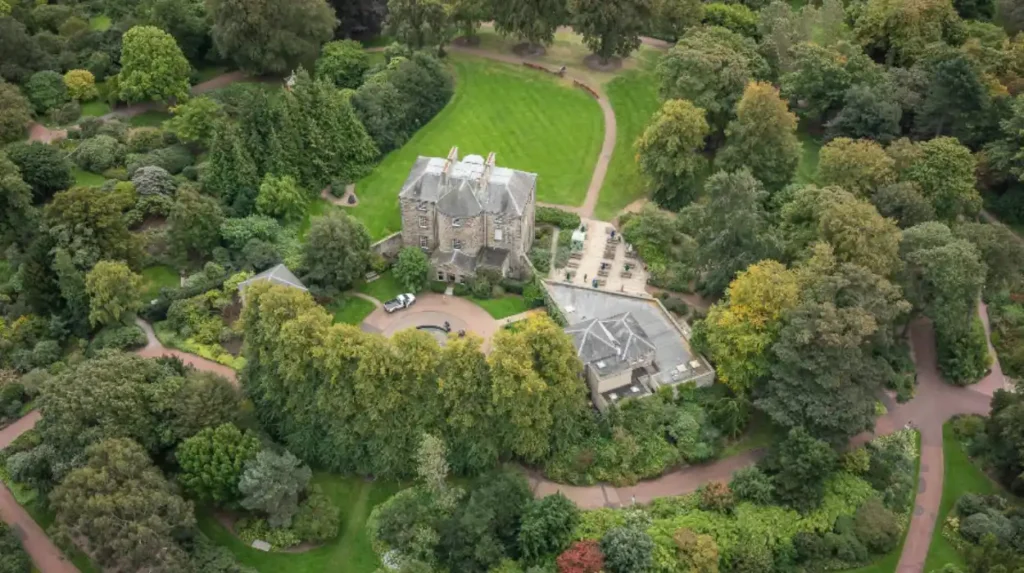
Malleny House and Garden, a 17th-century treasure owned by the National Trust for Scotland, dominates cultural highlights. Built principally between 1635 and the late 17th century by Sir James Murray of Kilbaberton, with a 1589 core and 1820 Georgian dome extension, the house remains private, but its gardens enchant publicly. Spanning three acres of walled paradise amid nine acres of woodland, it boasts four 100-year-old “Four Apostles” yew trees, Scotland’s heritage shrub rose collection, and once the National Bonsai Collection.
Other sites include the Scottish SPCA’s 1930-founded Animal Rescue and Rehoming Centre on Mansfield Road, originally a rest farm for horses, now aiding thousands annually. Red Moss, a rare raised sphagnum bog and Site of Special Scientific Interest managed by the Scottish Wildlife Trust, adds ecological significance.
Outdoor Adventures and Natural Beauty
Balerno’s gateway status to the Pentland Hills Regional Park invites endless exploration. Harlaw and Threipmuir Reservoirs offer serene walks, birdwatching, and cycling, while trails like the challenging 7.2-mile Pentland Hills route ascend 1,043 feet through grasslands, woods, and reservoirs.
The Water of Leith Walkway traces the former railway, providing flat paths for families amid riverside scenery. Proximity to Bavelaw Castle and the Edinburgh International Climbing Arena enhances adventure options, blending history with adrenaline. These pursuits underscore Balerno’s appeal as a nature lover’s retreat, with events like the annual Children’s Gala in May featuring parades and activities at Malleny Park.
Education and Family-Friendly Amenities
Families thrive in Balerno, anchored by Dean Park Primary School, relocated to a modern 1972 building, and Balerno Community High School, opened in 1983 on the former goods station site. Serving S1 to S6 pupils from Balerno, Kirknewton, Ratho, and beyond, it also hosts Heart of Midlothian FC’s academy.
Harmeny School, established 1958, specializes in support for children with social, emotional, and behavioral needs, utilizing the Category B listed Mansfield House designed by Dunn & Findlay with Robert Lorimer alterations. Community facilities like the Balerno Community Centre on Main Street host events, reinforcing family-centric living.
Modern Living and Property Market
Balerno’s residential surge since the 1950s has created a commuter-friendly suburb, with properties ranging from modern flats to family homes. Recent sales show averages around £285,000 for two-bedroom top-floor flats in developments like Byrne Crescent, up to £840,000 for larger houses.
The area’s desirability stems from green spaces, low crime, and quick city access, with house prices reflecting steady appreciation despite fluctuations like Bavelaw Road’s £180,750 yearly average. New estates blend seamlessly with conservation zones, offering amenities like the monthly farmers’ market and village screen cinema.
Cultural Events and Vibrant Community Life
Balerno pulses with culture through its music festival, launched in 2008, featuring concerts at churches, clubs, and inns, including taiko drums and jazz. The Village Screen, since 2013, draws 400 monthly for free films at Ogston Hall and St Joseph’s Centre.
Sports shine at Malleny Park, home to Currie RFC, premiership winners in 2007 and 2010, and Balerno Bowling Club from 1885. Churches like Gothic 1888 Balerno Parish Church and 1869 St Mungo’s add spiritual depth. Local media, including C&B News since 1976 and Konect magazine, keep the community connected.

Transportation and Connectivity
No rail since 1943, but Lothian Buses’ 32 to Cramond and 44 to Wallyford link Balerno via Currie and Slateford to Edinburgh center in about 31 minutes for £2. The A70 aids drivers, with taxis covering 8 miles in 19 minutes for £27-33. This setup suits commuters, blending rural peace with urban reach.
Notable Figures from Balerno
Balerno has nurtured talents like goalkeepers Neil Alexander and Craig Gordon, hockey players Graham Moodie and Chris Grassick, singer Nina Nesbitt, and Boards of Canada musicians Marcus and Michael Sandison. Others include diver Peter Heatly, economist Andrew Wilson, and journalist Michael Deacon.
Why Balerno Endures as Edinburgh’s Hidden Gem
Balerno masterfully balances its industrial past with contemporary comforts, from mill remnants to rose-filled gardens and hilltop trails. Its community-driven ethos, family focus, and nature proximity make it a timeless choice for those seeking Edinburgh’s best without the frenzy. Whether strolling Main Street or summiting Pentlands, Balerno invites enduring discovery.