Edinburgh presents an extraordinary architectural landscape defined by Enlightenment urban planning and Victorian engineering.
- What Defines Georgian Architecture in Edinburgh’s New Town?
- Which Key Georgian Highlights Should Architecture Enthusiasts Visit?
- How Did Victorian Architecture Transform the Edinburgh Cityscape?
- What Are the Top Victorian Architectural Landmarks in Edinburgh?
- How Do Georgian and Victorian Architectural Styles Compare?
- Structural and Decorative Comparisons
- Material Selection and Masonry Techniques
- What is the main difference between Georgian and Victorian architecture in Edinburgh?
- Who was the primary planner behind Edinburgh’s Georgian New Town?
- Why is sandstone so prominent in Edinburgh’s historic buildings?
- Where can visitors see intact Georgian interiors in Edinburgh?
- Why does the Balmoral Hotel clock tower run three minutes fast?
The Scottish capital contains two distinct historic areas recognized by UNESCO in 1995: the medieval Old Town and the Neoclassical New Town. The architectural transition from congested medieval tenements to expansive Georgian terraces reflects massive social, economic, and political shifts during the eighteenth century.
Understanding this urban environment requires analyzing structural evolution, masonry techniques, and stylistic principles. Sandstone construction dominates both eras, creating a unified visual texture across contrasting urban grids. This comprehensive study examines the primary masterpieces, master planners, and preservation frameworks that shape the built environment of Edinburgh.
What Defines Georgian Architecture in Edinburgh’s New Town?
Georgian architecture in Edinburgh is defined by symmetrical Neoclassical facades, standardized stone ashlar masonry, and strict height ratios. Designed according to Enlightenment principles of order and harmony, these structures feature rusticated ground floors, multi-pane sash windows, timber fanlights, and uniform slate rooflines.
Planning History and James Craig’s Grid
In 1766, the Town Council launched a competition to design a modern urban expansion north of the Nor Loch. A twenty-three-year-old architect named James Craig won the competition in 1767 with a plan featuring three parallel axes: Princes Street, George Street, and Queen Street.
This rigid grid was terminated at both ends by formal civic squares: St Andrew Square to the east and Charlotte Square to the west. The symmetrical layout intentionally contrasted with the organic, narrow wynds of the medieval Old Town. Construction of the First New Town began in 1767 and continued through the early nineteenth century.
Neoclassical Design Rules and Materials
Georgian builders adhered strictly to classical proportions based on ancient Roman and Greek architecture. Standardized elements included Craigleith sandstone facing, molded cornices, classical pediments, and geometric window alignment. The facade height directly matched the width of primary thoroughfares to ensure maximum natural light penetration into living quarters.
Interior structural designs prioritized spatial hierarchy, placing grand formal drawing rooms on the piano nobile floor above lower service spaces. Decorative plasterwork, marble chimneypieces, and cast-iron balcony rails enhanced the refined exterior symmetry across residential terraces.
Which Key Georgian Highlights Should Architecture Enthusiasts Visit?
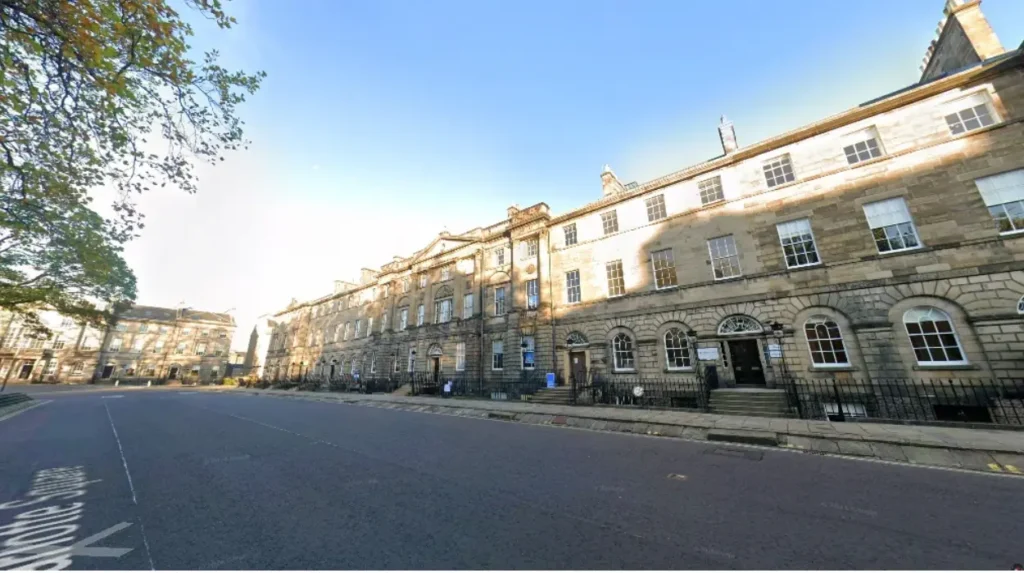
Essential Georgian sites include Charlotte Square, the Georgian House, St Andrew Square, Heriot Row, and the Royal College of Physicians.
These locations showcase premier Neoclassical domestic design, civic monuments, and intact architectural ensembles created by leading master builders.
Charlotte Square and Robert Adam’s Vision
Charlotte Square represents the pinnacle of Edinburgh’s First New Town planning. Designed by architect Robert Adam in 1791, the square features palace-style street elevations that unite individual townhouses behind a single grandiose classical facade.
The north side of the square houses Bute House, the official residence of the First Minister of Scotland, alongside the Georgian House museum at Number 7. The facade incorporates rusticated basements, Corinthian columns, and ornamental sphinxes.
Residential Terraces and Civic Buildings
Heriot Row and Great King Street exemplify subsequent phases of Georgian residential expansion designed by William Sibbald and Robert Reid. These streets display long stone terraces overlooking private communal gardens, preserving original cobblestones, iron railings, and arched fanlights.
Civic monuments such as the Melville Monument in St Andrew Square and the Register House on Princes Street highlight the scale of Neoclassical civic architecture. Register House, designed by Robert Adam in 1774, was purpose-built to house national public records using fireproof masonry vaulting.
How Did Victorian Architecture Transform the Edinburgh Cityscape?
Victorian architecture transformed Edinburgh through ornate Scots Baronial revivals, massive railway infrastructure, and grand commercial institutions.
Driven by nineteenth-century industrial expansion, architects abandoned strict Neoclassical restraint in favor of expressive gothic revival, Italianate flourishes, and dramatic vertical profiles.
Architectural Styles and Structural Innovation
Victorian development introduced rich architectural eclecticism across commercial and public spaces. The Scots Baronial revival style gained immense popularity, reintroducing medieval Scottish features such as crow-stepped gables, conical turrets, bartizans, and heavy stone machicolations.
Engineers utilized cast iron, wrought iron, and structural glass alongside native sandstone to build vast public structures. The introduction of steam railways required massive viaducts, cavernous glass-roofed stations, and grand railway hotels that dramatically altered urban topography.
Historical Context and Urban Growth
Between 1837 and 1901, Edinburgh expanded outward beyond its Georgian borders, establishing dense stone tenements in areas such as Marchmont, Bruntsfield, and Morningside. Rapid industrialization required specialized civic, educational, and commercial infrastructure to serve a growing urban population.
Urban planners integrated monumental bridges, including the Dean Bridge designed by Thomas Telford in 1832, to cross deep river valleys and open up new land for Victorian suburban development. Public health legislation mandated higher ceiling heights, wider stairwells, and modern sanitation systems within tenement blocks.
What Are the Top Victorian Architectural Landmarks in Edinburgh?
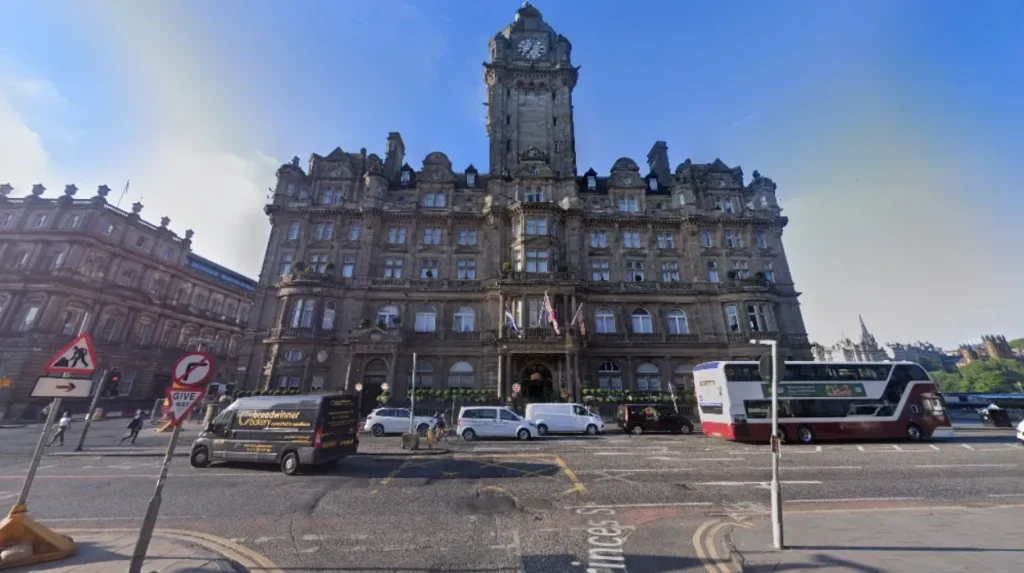
Top Victorian landmarks include the Balmoral Hotel, the Scott Monument, the Royal Museum building, and the Scottish National Portrait Gallery.
These structures showcase impressive engineering, intricate stone carving, and expressive stylistic choices from the late nineteenth century.
The Balmoral Hotel and Railway Engineering
Opened in 1902 as the North British Station Hotel, the Balmoral Hotel at 1 Princes Street represents a masterwork of Victorian Victorian-Baronial architecture designed by W. Hamilton Beattie. Situated directly above Waverley Station, the hotel features a prominent 190-foot clock tower visible across the city.
The stone exterior features ornamental cornices, heavy rustication, decorative balconies, and towering chimneys. The famous clock tower was historically set three minutes fast to ensure passengers caught their departing trains at the adjacent rail station.
Gothic Revivals and Civic Institutions
The Scott Monument on Princes Street, designed by George Meikle Kemp and completed in 1846, is a towering Victorian Gothic spire reaching 200 feet in height. Built from local sandstone, the monument features intricate pinnacles, flying buttresses, and sixty-eight carved statues representing characters from Sir Walter Scott’s novels.
The National Museum of Scotland’s Grand Gallery, designed by Francis Fowke and opened in 1866, features a structural cast-iron frame supporting a vaulted glass roof. Nearby, the Scottish National Portrait Gallery, designed by Sir Rowand Anderson in 1889, showcases red sandstone Neo-Gothic architecture inspired by the Doge’s Palace in Venice.
How Do Georgian and Victorian Architectural Styles Compare?
Georgian and Victorian styles differ fundamentally in structural symmetry, decorative philosophy, space utilization, and industrial material integration. Georgian design emphasizes Neoclassical horizontal uniformity, whereas Victorian design favors eclectic vertical movement, historical revivalism, and ornate masonry detailing.
Structural and Decorative Comparisons
Georgian buildings prioritize horizontal restraint, symmetrical window arrangements, and understated stone facades. Victorian buildings feature asymmetrical massing, decorative gables, polychromatic masonry, and elaborate ironwork integrated into structural frames.
Georgian interiors feature formal proportional layouts centered on high-ceilinged reception rooms. Victorian interiors emphasize compartmentalized living spaces, decorative stained glass, rich timber paneling, and integrated modern services such as plumbing and gas lighting.
Material Selection and Masonry Techniques
Georgian architects relied almost exclusively on blonde Craigleith sandstone, carved into smooth ashlar blocks for precise Classical joinery. Victorian stonemasons utilized varied sandstone sources, including red stone from Dumfriesshire, to create rich color contrasts and highly textured surface treatments.
Victorian construction incorporated mass-produced cast iron girders, decorative glass, and terra cotta elements alongside traditional masonry. This structural shift allowed Victorian builders to construct larger window openings, grander exhibition spaces, and taller roof structures than Georgian engineers could achieve.
What is the main difference between Georgian and Victorian architecture in Edinburgh?
Georgian architecture focuses on Neoclassical symmetry, uniform stone facades, and strict classical proportions established in the late eighteenth century. Victorian architecture features revivalist styles, asymmetrical designs, rich stonework, turrets, and industrial materials like cast iron.
Who was the primary planner behind Edinburgh’s Georgian New Town?
James Craig won the official urban design competition in 1767 with a planned grid layout consisting of three main parallel streets and two civic squares. Famous architects like Robert Adam later refined specific streets and squares within the development.
Why is sandstone so prominent in Edinburgh’s historic buildings?
Local Craigleith and Scottish sandstones were heavily quarried nearby, providing a durable, high-quality building material that gave the city a consistent gray and blonde aesthetic across both Georgian and Victorian eras.
Where can visitors see intact Georgian interiors in Edinburgh?
The Georgian House at 7 Charlotte Square, managed by the National Trust for Scotland, offers fully restored, period-accurate Georgian residential interiors, furnishings, and domestic quarters.
Why does the Balmoral Hotel clock tower run three minutes fast?
The clock tower on Princes Street was set three minutes fast starting in 1902 to help railway passengers catch their trains on time at the adjacent Waverley Station.