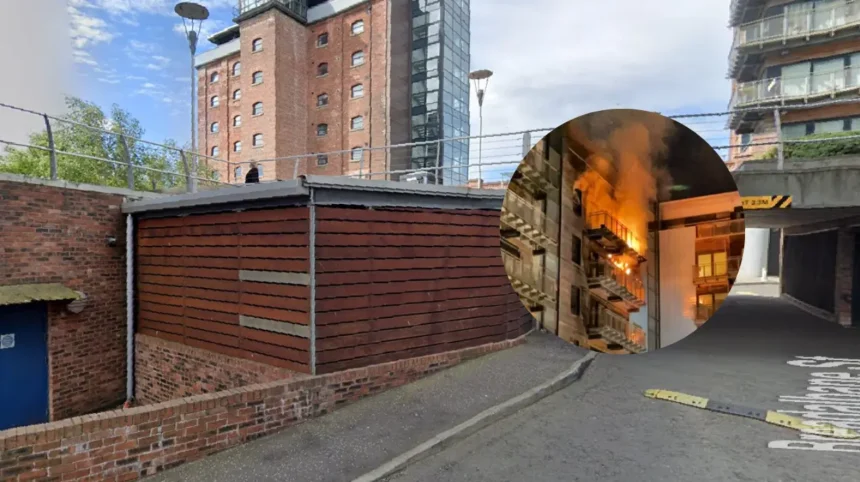
Key Points
- New SBA for Bond Building, Edinburgh, highlights serious internal fire safety failings that have been overlooked until now.
- Located at 35-39 Breadalbane Street, Bonnington, the building was evacuated in July 2026 following a warning to evacuate immediately from experts due to a “high fire risk”.
- These include lack of fire stopping between flats and stair/lift cores, unsealed service penetrations, cavity barriers not installed, combustible cladding and lifts not compliant with the requirements.
- In March 2024 there was a fire in the building resulting in injuries of two firefighters and 100 residents being unable to reoccupy the premises; the latest SBA concerns all the remaining flats.
- Persimmon Homes, which is the developer, has arranged for alternative accommodation for all affected tenants and says remediation work will take two to three years when commenced.
- The building got B2 rating on its EWS1 form, meaning that combustible materials are used and remedial work should be done.
- Residents were told that there were defects in the original construction drawings and these drawings were not correct.
Edinburgh Fire (Edinburgh Daily) August 08, 2026 – A damning new fire safety report on the Bond Building in Bonnington has laid bare extensive internal defects that could allow fire and smoke to spread rapidly through the tower block, prompting the full evacuation of remaining residents last month.
- Key Points
- Why were residents told to leave Bond Building immediately?
- What fire safety defects were found in Bond Building Edinburgh?
- How does this link to the 2024 Bond Building fire?
- What have residents been told about repairs and timelines?
- What legal framework applies to Bond Building Edinburgh?
- Background of the Bond Building Edinburgh development
- Prediction: How could this development affect Bond Building residents and similar high-rise owners?
The Single Building Assessment (SBA), carried out in May 2026 under the Housing (Cladding Remediation) Act 2024, revealed previously unidentified flaws in fire compartmentation, including a lack of fire stopping between flats and between flats and stair/lift cores, unsealed gaps around ducts and pipes passing through floors, and omitted cavity barriers where timber floors cross separating walls.
As reported by journalists at Infrastructure Now and The Herald, these defects mean fire and hot smoke can pass through voids in the walls, compromising escape routes and allowing flames to race through cavities that behave like flues.
Why were residents told to leave Bond Building immediately?
Persimmon Homes, the developer responsible for the conversion of the former whisky bond on Breadalbane Street, issued an urgent notice to residents in mid-July 2026 advising them to vacate their apartments immediately.
In a statement, a Persimmon spokesperson said: “Following a recent detailed investigation of the building, experts advised that residents should relocate from their apartments as a precautionary measure.”
The company added that alternative accommodation had been offered to all affected residents, with the majority having already taken up the offer, and that it was working with individuals on a case-by-case basis to provide appropriate support.
What fire safety defects were found in Bond Building Edinburgh?
The SBA process, which requires two stages of fire risk assessment including intrusive checks, allowed investigators to cut holes between apartments to examine the full cross-section of the walls.
Arturus, the firm conducting the assessment, noted:
- A lack of fire stopping between flats and between the flats and stair/lift cores.
- Lack of fire stopping where ducts and pipes pass through separating floors.
- Omission of cavity barriers where timber floors cross separating walls.
These issues compound problems identified in earlier surveys, including combustible cladding and insulation on the external walls, combustible decking on balconies and roof terraces, and seven internal lifts that do not meet fire-fighting lift standards.
Smoke extraction systems in the lobbies were also found not to work, and there were “issues” with the fire alarm system.
Following the assessment, the building was given a B2 rating on its EWS1 form, denoting that combustible materials are present in the external wall and that the fire risk is sufficiently high that remedial works are required.
How does this link to the 2024 Bond Building fire?
A fire at the Bond Building in March 2024 engulfed one of the flats, injured two firefighters, and led to the evacuation of around 100 residents, many of whom have been unable to return to their homes.
In the wake of that incident, City of Edinburgh Council’s regulatory committee noted that a building survey carried out in May 2022 had already identified “multiple life safety critical issues” with the block, including combustible cladding and insulation, combustible decking, internal fire-stopping issues, and non-compliant lifts.
Despite these earlier findings, the latest SBA uncovered additional internal defects that had not been previously identified, leading to the decision to evacuate the remaining flats.
What have residents been told about repairs and timelines?
At a recent meeting, residents were informed that the original drawings for the building contained defects and that there were several inconsistencies between the drawings and what was actually built.
Persimmon Homes said further investigations were continuing and that their findings would determine the scope of the remediation works required, as well as the programme and timescales for delivery.
So far, no firm timeline has been laid out for how long the work will take, with residents given an estimate of two or three years once the project begins.
What legal framework applies to Bond Building Edinburgh?
Under the Housing (Cladding Remediation) Act 2024, buildings with potentially unsafe cladding are subject to a Single Building Assessment, which came into force in January 2025.
The SBA requires two stages of fire risk assessment: a non-intrusive assessment in common areas, plant rooms and non-domestic areas, followed by an intrusive investigation to check the consistency of construction through the full cross-section of the walls.
The Bond Building’s assessment was carried out in May 2026, and its findings triggered the “precautionary decanting” of residents.
Background of the Bond Building Edinburgh development
The Bond Building is a conversion of a former whisky bond warehouse on Breadalbane Street in the Bonnington area of Edinburgh, developed into residential flats by Persimmon Homes.
The block first came under scrutiny after a fire in March 2024, which exposed serious fire safety concerns and led to the evacuation of around 100 residents.
Prior to that, a May 2022 building survey had already identified multiple critical fire safety issues, including combustible cladding and insulation, combustible decking, internal fire-stopping faults, and non-compliant lifts.
Despite these findings, the building remained occupied until the latest SBA in May 2026 revealed further internal defects, prompting Persimmon to urge all remaining residents to leave immediately in July 2026.
The building has since been issued a B2 rating on its EWS1 form, indicating that remedial works are required before it can be considered safe for occupation.
Prediction: How could this development affect Bond Building residents and similar high-rise owners?
The Bond Building case is likely to have significant implications for residents of the block and for owners of similar high-rise and converted industrial buildings across Scotland and the wider UK.
For Bond Building residents, the immediate effect is prolonged displacement, with many facing two to three years or more in temporary accommodation while remediation works are planned and carried out.
Financially, homeowners may face uncertainty over mortgage approvals, property valuations, and insurance, given the B2 EWS1 rating and the scale of the defects identified.
Psychologically, the repeated evacuations and the revelation that serious fire risks were known as far back as 2022 but not fully addressed could erode trust in developers, regulators, and building safety processes.
More broadly, the Bond Building Edinburgh report may prompt closer scrutiny of other buildings converted under similar schemes, particularly where original construction drawings do not match what was built.
Regulators and local authorities may face pressure to accelerate Single Building Assessments and to ensure that earlier fire safety findings are acted upon more swiftly, to avoid situations where residents live for years in buildings with known critical fire risks.
For the wider housing market, the case underscores the potential long-term costs and disruptions associated with cladding and fire safety remediation, and could influence lending criteria, insurance premiums, and buyer confidence in high-rise and converted properties.