Key Points
- Police officers and paramedics suffered injuries after being targeted with fireworks in several UK locations on Bonfire Night.
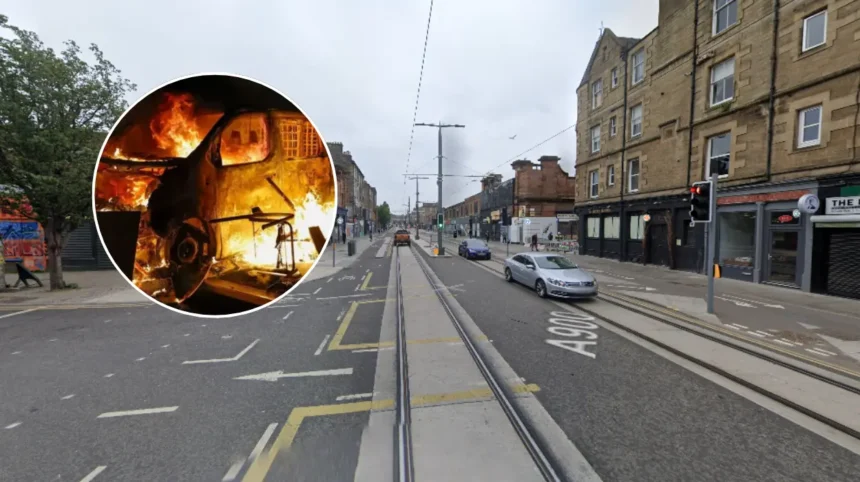
- Attackers set fire to a police car on Greenside Street in Edinburgh, leaving the vehicle severely damaged.
- Scottish Police Federation chair David Threadgold said society cannot treat annual violence against emergency crews as normal.
- Community Safety Minister Siobhian Brown called the attacks “totally unacceptable” and stated that emergency services were prepared for the night.
- Officers made several arrests, including a 16-year-old male charged over the Edinburgh vehicle arson and attacks on emergency staff.
Edinburgh (Edinburgh Daily) November 6, 2026 – Police representatives and government ministers have launched a firm response following widespread violent disruptions, arson, and direct attacks on emergency service responders during Bonfire Night celebrations across the region.
Police vehicles were damaged, and multiple front-line personnel suffered injuries as pyrotechnics were used as improvised weapons against first responders.
Police staff associations have issued warnings that public order breakdown surrounding annual fireworks traditions cannot be treated as an inevitable baseline for emergency service operations.
What occurred during the Bonfire Night emergency operations?
Emergency services faced targeted attacks while responding to routine calls and public safety incidents on the night of November 5. In Edinburgh, police officers and ambulance crews were called to Greenside Street to attend to a reported injured civilian when groups targeted the responding vehicles with lit fireworks.
The incident resulted in physical injuries to both a police officer and a paramedic, alongside the destruction of a police vehicle that was set on fire.
As reported by Dave Clark, Lucinda Cameron, Danyel VanReenen, and Ryan McDougall of the Press Association, emergency crews faced sustained hostility while attempting to deliver medical aid. Law enforcement confirmed that a 16-year-old male was arrested in connection with the disorder on Greenside Street as investigations into the violence continue.
Further disorder was reported in several urban areas where specialist public order units were deployed to disperse groups targeting residential streets and passing traffic with high-powered fireworks.
As reported by Dave Clark, Lucinda Cameron, Danyel VanReenen, and Ryan McDougall of the Press Association, police confirmed: “Police and an ambulance were responding to a report of an injured man in Greenside Street when one police officer and an ambulance staff member sustained minor injuries after both crews were attacked with fireworks and a police vehicle was set alight and seriously damaged.”
How have police representatives and ministers reacted to the disorder?
The Scottish Police Federation and government leaders have expressed deep concern over the level of hostility aimed at public servants during the annual event. Officials emphasized that while the majority of public displays ran without incident, the recurring anti-social behavior directed at emergency personnel requires structural evaluation.
Speaking on public broadcast media, representatives noted that emergency workers should not expect physical hostility as an inherent condition of their seasonal duties.
As reported by Dave Clark, Lucinda Cameron, Danyel VanReenen, and Ryan McDougall of the Press Association, Scottish Police Federation chair David Threadgold stated: “We can’t accept it as normal. So we have to look into and see what we can do. The only way I think we do that is by relooking at what’s going on in Scotland at the moment and looking at our society to see how can we fix this.”
Community Safety Minister Siobhian Brown addressed the emergency operations, defending the initial operational preparation while condemning the individuals involved in the violent clashes.
As reported by Dave Clark, Lucinda Cameron, Danyel VanReenen, and Ryan McDougall of the Press Association, Siobhian Brown stated on BBC Radio Scotland’s Breakfast programme: “Police Scotland were well prepared. Our emergency services were well prepared. The vast majority of displays went ahead without any problems, and that’s to be welcomed. But nonetheless, I would want to be absolutely unequivocal. Totally unacceptable that any disorder related to fireworks should be ongoing.”
As reported by Paul Trainer of Scottish News, Police Scotland confirmed that proactive intelligence measures had allowed officers to confiscate substantial quantities of illegal pyrotechnics prior to the evening’s events, mitigating potentially wider destruction.
Background of the particular development
Over recent years, public order policing around Bonfire Night across the United Kingdom has required increasingly intensive operational deployments. Annual reporting demonstrates a persistent trend of front-line police officers, Scottish Fire and Rescue Service personnel, and Scottish Ambulance Service staff coming under fire from consumer-grade pyrotechnics modified or aimed maliciously at responders.
Legislative interventions, such as the introduction of Fireworks Control Zones (FCZs) enabling local authorities to restrict pyrotechnic use in specific neighborhoods, were designed to curb localized anti-social behavior. In addition, national consultations regarding stricter controls on the sale, maximum noise levels, and public availability of fireworks have been advanced to restrict access to hazardous items.
Despite these statutory powers and intelligence-led preventative seizures, seasonal disorder continues to demand heavy allocations of public order resources, protective gear, and specialized public safety responses every November.
Prediction: How this development can affect front-line emergency responders and local communities
The public escalation of Bonfire Night violence is expected to accelerate political momentum toward tighter statutory controls on the private sale and possession of pyrotechnics across the UK.
For front-line emergency service workers, these repeated incidents are likely to prompt demands from staff associations for enhanced protective equipment, mandatory public order training for general response units, and stricter judicial sentencing guidelines for offenses involving attacks on blue-light personnel.
For local communities, persistent seasonal disorder could lead to wider implementation of local Fireworks Control Zones, greater restrictions on over-the-counter firework sales, and increased operational policing costs allocated to public order enforcement during autumn events.