Key Points
- City of Edinburgh Council Leader Jane Meagher welcomed the reopening of Princes Street on Saturday, 29 August 2026, two days ahead of schedule.
- The street was closed on 9 July 2026 after a major fire at the former B-listed Debenhams department store between Castle Street and Frederick Street.
- Public transport services, including Lothian Buses and Edinburgh Trams between Edinburgh Airport and Newhaven, resumed following overnight testing.
- Specialist engineers secured the site by manually removing tonnes of loose stonework and bricks, installing steel support beams, and lowering the eastern gable by two metres.
- The Scottish Government allocated up to £5 million in emergency funding for structural repairs, transport relief, and local business recovery.
- Opposition councillors criticized council communications with businesses in Leith and the north of the city, where footfall fell sharply during the seven-week closure.
- Council Leader Meagher announced the launch of the “More by the Shore” marketing campaign to help affected local traders.
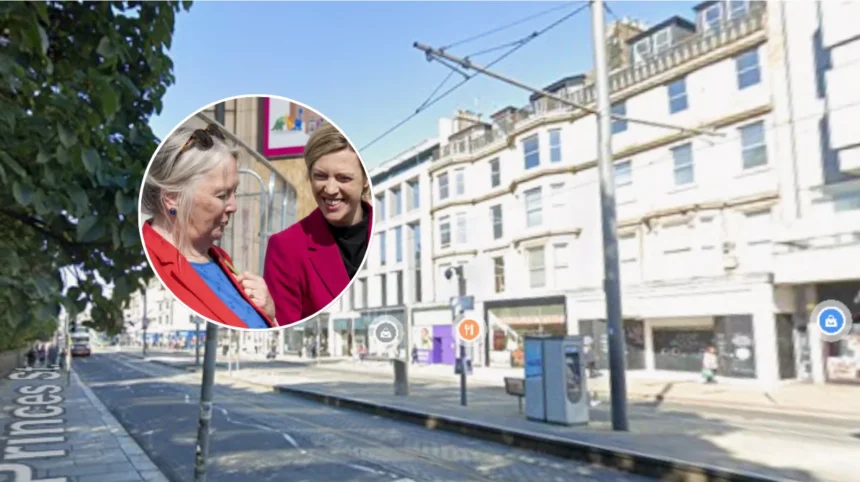
Edinburgh (Edinburgh Daily News) August 29, 2026 — City of Edinburgh Council Leader Jane Meagher has expressed her delight following the full reopening of Princes Street today, bringing to an end a seven-week transport shutdown across the capital’s main thoroughfare. The thoroughfare was abruptly closed to all vehicular, tram, and pedestrian traffic between Castle Street and Frederick Street on 9 July 2026, when a major blaze gutted the historic former Debenhams department store building. Following complex engineering efforts to stabilize the ruined B-listed façade, full operations for both Lothian Buses and Edinburgh Trams resumed early on Saturday morning.
- Key Points
- How Was the Structural Safety of the Building Achieved?
- What Did Political Leaders and Transport Authorities Say About the Reopening?
- What Support Is Being Provided to Local Businesses Impacted by Disruption?
- Background of the Particular Development
- Expected Impact on Commuters, Traders, and Public Services
As reported by the Press Association, Council Leader Jane Meagher stated: “I couldn’t be more pleased that the city is getting back to business as usual. We know that this has had a huge impact on the city and on people visiting the city. This happened just on the cusp of one of the biggest arts festivals in the world coming to Edinburgh, so it was inevitably going to have a major impact.”
How Was the Structural Safety of the Building Achieved?
The seven-week closure was dictated by the severe structural instability of the disused department store building. According to official statements released by The City of Edinburgh Council, specialist engineers performed extensive manual labor under highly complex conditions to secure the remaining shell of the structure.
The remediation works included:
- Installing supporting steel framework beams to fully stabilize the front elevation facing Princes Street. Edinburgh Council
- Securing the eastern gable end by reducing its overall height by approximately two metres and erecting heavy-duty scaffolding. Edinburgh Council
- Dismantling and manually removing several tonnes of dangerous masonry, unbonded brickwork, and loose stone blocks—some weighing as much as 850kg per piece—from the upper stories to prevent uncontrolled collapse. Edinburgh Council
- Clearing tonnes of fire debris from inside the interior envelope while retaining historic architectural elements where viable. Edinburgh Council
As detailed in the Council’s media release, Councillor Meagher explained the technical delay, noting: “A lot of people have asked me why it has taken so long to make the building safe and the answer is that it has all had to be done painstakingly by hand. Throughout the closure, the safety of the public has been our highest priority.”
While the main road carriageway, bicycle lanes, and southern footpaths have returned to service, the north pavement directly adjacent to the damaged former department store remains cordoned off. One lane of the eastbound carriageway has been repurposed as a temporary pedestrian walkway to ensure foot traffic can bypass the site safely.
What Did Political Leaders and Transport Authorities Say About the Reopening?
The reopening involved close coordination between municipal authorities, national government figures, and public transport operators.
The Independent
As reported by The City of Edinburgh Council News, Scottish Government Deputy First Minister Jenny Gilruth stated: “News of Princes Street fully reopening will provide relief to business and commuters who have had to adapt during the widespread disruption in the city. The Scottish Government has been determined from the start to ensure that we support the council in assisting those affected and this is why we provided funding of up to £5 million to keep the city moving and to enable long-term recovery.”
Speaking to The Herald, Chief Executive of Lothian and Edinburgh Trams Sarah Boyd said: “Our teams are now focused on reinstating bus and tram services along one of the city’s most important transport corridors and we encourage customers to check the latest service updates and allow extra time for travel. I would like to thank our customers for their patience, understanding and support throughout this period of continued disruption.”
However, the political response to the council’s handling of the crisis was not without friction. As reported by standard political correspondent coverage in The Herald, SNP Group Leader Lesley Macinnes challenged Councillor Meagher during council proceedings, asking whether the council leader would apologize to local traders for a perceived “lack of clarity” over the timeframe of the street closure.
Replying directly in the chamber, Councillor Meagher strongly rejected the criticism, remarking: “The first and urgent and immediate priority was to assess what remained of the building after the fire, and to ensure the safety of the public. I take my hat off to all involved in making sure that happened. I don’t recognise your characterisation of what happened. I was impressed by the way people came together. I regret the disparaging remarks you made about those efforts. I think it is unseemly.”
What Support Is Being Provided to Local Businesses Impacted by Disruption?
The total disruption caused by the emergency road closure extended far beyond Princes Street itself. Because the Edinburgh Trams line was truncated at the West End during the crisis, areas along the northern extension—including Leith, The Shore, and Newhaven—were left without direct light rail connections for nearly two months.
As reported by The Herald, independent business owners voiced strong frustration regarding commercial losses. Representatives of Leith-based business Argonaut Books stated on social media that local traders had endured “20 minute plus delays on buses, massively reduced footfall and a council effectively asleep at the wheel.” Similarly, independent hospitality vendors in Leith reported sales revenue drops of up to 60 per cent while the line remained severed.
To mitigate these losses, Council Leader Meagher announced the official launch of a dedicated recovery campaign titled More by the Shore. Funded partly through the Scottish Government’s £5 million emergency allocation, the initiative aims to actively drive footfall back to businesses in Leith and Newhaven.
Councillor Meagher noted: “We’re committed to supporting these businesses to get back on their feet and have outlined a range of measures, including our business support campaign ‘More by the Shore’, to support them not only in the here and now but well into the Christmas period and beyond.”
The £5 million Scottish Government funding package is set to be distributed by the local authority across key priority sectors:
- Building Emergency Costs: Offsetting the daily public costs associated with stabilizing the B-listed structural masonry and maintaining site security. The council intends to seek full recovery of these expenses from the building’s private owners under the Building (Scotland) Act 2003. Edinburgh Council+ 1
- Business Recovery & Marketing: Funding local events, footfall incentives, and targeted promotional drives for traders in Leith and the northern districts. Edinburgh Council
- Public Transport Stabilization: Assisting Edinburgh Trams and Lothian Buses with operational income losses and detour expenses incurred during the peak August festival season.
- Princes Street Aesthetics: Installing temporary street dressing and hoardings around vacant or damaged shopfronts to protect the capital’s visual appeal. Edinburgh Council
Background of the Particular Development
The emergency on Princes Street began on 9 July 2026, when a major fire broke out inside the former Debenhams building. The property, a historic B-listed commercial venue, had stood largely vacant prior to the blaze following the retailer’s liquidation. The scale of the fire severely compromised the integrity of the timber, stone, and steel framework of the roof and upper levels.
Due to the imminent risk of masonry collapsing onto the street below, Police Scotland and the Scottish Fire and Rescue Service established an immediate exclusion zone. This safety perimeter necessitated the total shutdown of all transport modes along the central section of Princes Street.
The timing of the disaster coincided directly with the start of the Edinburgh Festival Fringe and the Edinburgh International Festival, creating significant operational challenges during the capital’s busiest period of the year. Trams operating from Edinburgh Airport were forced to terminate prematurely at the West End, while dozens of Lothian Bus routes were diverted onto George Street and surrounding thoroughfares, leading to severe traffic congestion across the city centre.
Complex ownership structures associated with the former department store building complicated early efforts to coordinate structural repairs. Consequently, the City of Edinburgh Council utilized emergency powers to intervene directly, commissioning specialist contractors to stabilize the façade and ensure public safety before reopening the highway.
Expected Impact on Commuters, Traders, and Public Services
The early reopening of Princes Street directly affects several key groups across the city:
1. Commuters and Public Transport Passengers
The restoration of full tram and bus operations removes significant daily travel delays. Passengers traveling between the West End, the city centre, Leith, and Newhaven no longer face transfer interruptions or lengthier journey times caused by bus diversions on George Street. Transport operators will see a return to regular timetabling, easing overcrowding across the broader urban transit network.
2. Retail and Hospitality Businesses in Leith and North Edinburgh
For business owners in Leith and along the northern tram corridor, the resumption of direct tram transit removes a major barrier to customer footfall. The deployment of the council’s More by the Shore marketing fund is intended to restore trade volumes lost during the crucial August festival period. However, full financial recovery for independent traders may take several months as regular customer commuting habits re-establish.
3. City Center Retailers and Tourism Sector
The removal of heavy scaffolding barriers along Princes Street improves accessibility for shoppers and international visitors during the final days of the summer festivals. The creation of a dedicated, protected walkway along the northern pavement allows foot traffic to navigate the central shopping district safely without impeding main road transport flow.
4. Municipal Taxpayers and Property Owners
While the city council used public emergency funds to execute site stabilization, legal proceedings under the Building (Scotland) Act 2003 mean the private property owners of the former Debenhams site will