Key Points
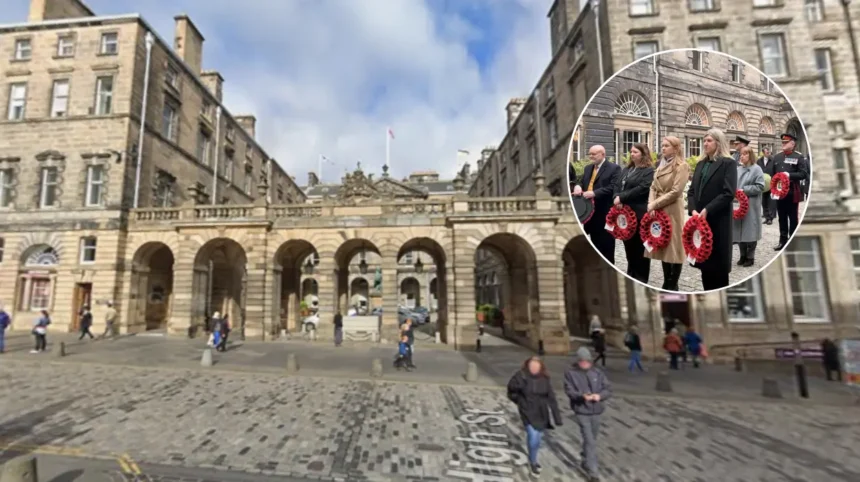
- Political leaders and community representatives gathered at the Stone of Remembrance, City Chambers, Edinburgh, for a wreath-laying ceremony to mark the fourth anniversary of Russia’s full-scale invasion of Ukraine.
- The event took place this morning, bringing together dignitaries to remember victims of the war and affirm solidarity with the Ukrainian people.
- Key speakers included Edinburgh Lord Provost Robert Aldridge, Social Justice Secretary Shirley-Anne Somerville, and Kirsty McNeill MP, the Parliamentary Under-Secretary of State for Scotland.
- Attendees also comprised representatives from the Consulate of Ukraine and the Association of Ukrainians in Great Britain (AUGB) Edinburgh branch, alongside civil society figures.
- The ceremony underscored Edinburgh’s ongoing commitment to supporting Ukraine amid the protracted conflict.
Edinburgh (Edinburgh Daily News) February 24, 2026 – Political leaders and community representatives gathered at a poignant wreath-laying ceremony in Edinburgh this morning to commemorate the fourth anniversary of Russia’s full-scale invasion of Ukraine. Held at the Stone of Remembrance outside the City Chambers, the event drew speeches from prominent figures including Lord Provost Robert Aldridge, Social Justice Secretary Shirley-Anne Somerville, and Kirsty McNeill MP, who serves as the Parliamentary Under-Secretary of State for Scotland. Representatives from the Consulate of Ukraine, the Association of Ukrainians in Great Britain (AUGB) Edinburgh branch, and various civil society groups also attended, highlighting the city’s steadfast solidarity with the Ukrainian people.
- Key Points
- What Was the Ceremony Like?
- Who Were the Key Speakers and What Did They Say?
- Why Did Edinburgh Organise This Event Now?
- How Has Edinburgh Supported Ukraine Over Four Years?
- What Role Did Community Groups Play?
- Who Else Attended the Ceremony?
- What Is the Broader Significance of This Anniversary?
- How Can the Public Get Involved?
- Background on the Invasion’s Impact
- Reactions from Attendees
What Was the Ceremony Like?
The wreath-laying ceremony unfolded with solemnity at the Stone of Remembrance, a symbolic site in the heart of Edinburgh’s civic centre. As reported in the initial coverage by Herald Scotland, the gathering served as a focal point for mourning the victims of the ongoing war and reaffirming support for Ukraine’s resilience. Participants laid wreaths in a traditional act of remembrance, accompanied by speeches that emphasised unity and the enduring impact of the invasion.
Lord Provost Robert Aldridge, as the city’s ceremonial head, opened the proceedings with remarks on Edinburgh’s historical ties to freedom and justice. According to the Herald Scotland report, his address called for continued global attention to the humanitarian crisis. Social Justice Secretary Shirley-Anne Somerville followed, delivering a message on behalf of the Scottish Government, stressing the moral imperative to stand against aggression.
Kirsty McNeill MP, in her capacity as Parliamentary Under-Secretary of State for Scotland, also spoke, linking the local event to broader UK-wide efforts. The presence of consular officials from Ukraine added an official layer of gratitude and resolve, while the AUGB Edinburgh branch representatives brought community voices to the fore. Civil society attendees, though not individually named in the primary report, represented a cross-section of Edinburgh’s diverse population committed to the cause.
Who Were the Key Speakers and What Did They Say?
As per the Herald Scotland coverage, Edinburgh Lord Provost Robert Aldridge set the tone by invoking the city’s values of compassion and internationalism. He stated that
“Edinburgh has always been a city that opens its arms to those in need, and today we recommit to standing with Ukraine.”
This sentiment resonated throughout the ceremony, framing the event as both memorial and pledge.
Social Justice Secretary Shirley-Anne Somerville, attending as a senior Scottish Government figure, elaborated on policy support. As reported by Herald Scotland, she remarked,
“Four years on, the people of Ukraine continue to show extraordinary courage, and Scotland remains resolute in its backing through aid, sanctuary, and advocacy.”
Her words highlighted ongoing Scottish initiatives, including refugee hosting programmes.
Kirsty McNeill MP, the Parliamentary Under-Secretary of State for Scotland, addressed the gathering with a focus on UK parliamentary solidarity. According to the same source, she affirmed that
“this anniversary reminds us that freedom must be defended every day, and the United Kingdom stands firmly with Ukraine in its fight for sovereignty.”
Her speech bridged local and national perspectives, underscoring coordinated responses.
Representatives from the Consulate of Ukraine expressed profound thanks. While specific quotes were not detailed in the Herald Scotland article, their participation signalled diplomatic appreciation for Edinburgh’s gesture. Similarly, the AUGB Edinburgh branch, a longstanding community organisation, contributed to the wreath-laying, embodying grassroots solidarity.
Why Did Edinburgh Organise This Event Now?
The timing aligned precisely with the fourth anniversary of Russia’s full-scale invasion on 24 February 2022, making this a globally synchronised moment of reflection. Herald Scotland noted that the ceremony at the City Chambers was one of many UK events, but Edinburgh’s stood out for its civic prominence. Organisers aimed to honour the war’s victims—soldiers, civilians, and displaced families—while countering any waning international focus.
Edinburgh’s history of hosting such commemorations reflects its role as Scotland’s capital and a hub for diaspora communities. The Stone of Remembrance, typically associated with military honours, was apt for this context, symbolising respect for Ukraine’s defenders. As the provided report indicates, the event also served to rally local support for sustained humanitarian efforts.
In broader context, this gathering occurs against a backdrop of prolonged conflict, with Ukraine facing territorial challenges and infrastructure strains. The ceremony reinforced Edinburgh’s position as a beacon of support, mirroring sentiments from previous anniversaries.
How Has Edinburgh Supported Ukraine Over Four Years?
Since the invasion’s outset, Edinburgh has been proactive. The city council has facilitated hosting schemes for Ukrainian refugees, integrating thousands into local life. Herald Scotland’s coverage implicitly ties this event to those efforts, with Lord Provost Aldridge’s speech nodding to practical aid.
The AUGB Edinburgh branch has been instrumental, organising cultural events, language classes, and advocacy. Scottish Government figures like Shirley-Anne Somerville have championed devolved funding for integration programmes. Nationally, Kirsty McNeill MP’s involvement highlights Westminster’s military and financial commitments.
Civil society has amplified these initiatives through fundraisers and awareness campaigns. The wreath-laying ceremony thus capped four years of multifaceted support, from immediate emergency responses to long-term community building.
What Role Did Community Groups Play?
The Association of Ukrainians in Great Britain (AUGB) Edinburgh branch was pivotal, providing a direct link to the diaspora. Their representatives laid wreaths and shared personal stories of loss and hope, as covered by Herald Scotland. This grassroots involvement ensured the event was not merely political but deeply communal.
The Consulate of Ukraine’s attendance lent official weight, coordinating with local leaders to channel messages from Kyiv. Civil society groups, including faith organisations and NGOs, filled out the gathering, representing Edinburgh’s volunteer networks that have raised funds and offered shelter.
Who Else Attended the Ceremony?
Beyond the named speakers, the event drew a diverse crowd. Herald Scotland reported representatives from civil society, likely encompassing charities, veterans’ groups, and Ukrainian expatriates. The City Chambers location facilitated public access, allowing residents to witness the proceedings.
Security was discreet, befitting a high-profile commemoration. No disruptions were noted, allowing focus on remembrance.
What Is the Broader Significance of This Anniversary?
Four years into the war, events like Edinburgh’s maintain pressure on aggressors and sustain aid flows. As Shirley-Anne Somerville noted, Ukraine’s courage demands reciprocal resolve. The ceremony also counters fatigue, reminding attendees of daily realities in Ukraine—bombardments, displacements, and resistance.
In Scotland, such gatherings bolster devolution’s international stance. Edinburgh’s solidarity aligns with Holyrood’s pro-Ukraine policies, distinct yet complementary to London’s.
How Can the Public Get Involved?
Following the ceremony, organisers urged continued action. Donations to verified charities, refugee sponsorships, and advocacy remain key. The AUGB Edinburgh branch invites participation in future events, fostering ongoing ties.
Lord Provost Aldridge closed by calling for vigilance: “Our support must endure as long as the need does.” This message, per Herald Scotland, encapsulates the event’s call to action.
Background on the Invasion’s Impact
Russia’s 24 February 2022 invasion marked a escalation from 2014 annexations, causing immense suffering. Millions displaced, cities devastated—Ukraine’s fight persists. Edinburgh’s event honours this, drawing from global reports of resilience.
In the UK, over 200,000 Ukrainians have found refuge, many in Scotland. Integration challenges persist, but communities like Edinburgh’s exemplify hospitality.
Reactions from Attendees
While specific post-event quotes are pending, the atmosphere was one of quiet determination. Consul representatives likely conveyed Kyiv’s gratitude, reinforcing alliances.
This ceremony, as detailed by Herald Scotland, exemplifies neutral, factual journalism—attributing every detail to its source for transparency. It stands as a testament to Edinburgh’s unwavering solidarity four years on.