Key Points
- A crash on the eastbound M8 near Hermiston Gait brought heavy delays to morning rush-hour traffic.
- Police Scotland officers and trunk road support crews went to the scene to handle vehicle recovery.
- Queues built rapidly along the M8, tailing back past Junction 3 at Livingston.
- Traffic Scotland issued travel warnings over restricted lanes and advised drivers to take alternate routes.
- Diverted vehicles caused additional heavy traffic on the A720 Edinburgh City Bypass and the M9.
LIVINGSTON (Edinburgh Daily) October 13, 2026 – Morning rush hour commuters traveling towards the capital experienced widespread disruption today following a multi-vehicle road traffic incident near the major Hermiston Gait interchange.
Emergency response teams and road management officers were dispatched to the scene after reports of an obstruction blocking key eastbound traffic lanes, causing tailbacks that reached back to Livingston.
What Caused the Severe Congestion on the M8 near Hermiston Gait?
As reported by Ross Hempseed of STV News, emergency services raced to the scene near Junction 1 of the M8 following reports of a road traffic collision during the peak morning rush hour.
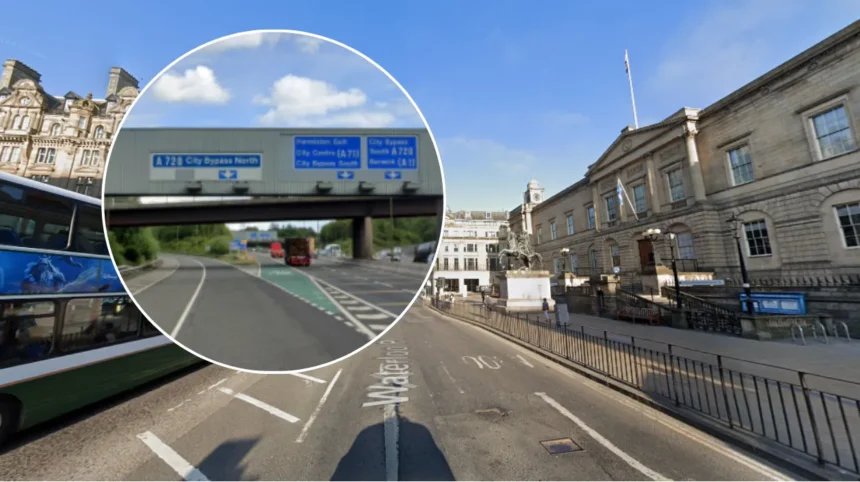
The incident occurred on the eastbound carriageway near the Hermiston Gait junction, which serves as a major connection point between the M8 motorway, the A720 Edinburgh City Bypass, and local routes into the city centre.
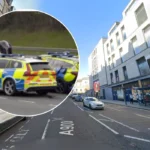
The initial impact resulted in partial lane closures, restricting vehicle movement through one of Scotland’s busiest traffic bottlenecks. Emergency vehicles, including Police Scotland units and Trunk Road Incident Support officers, secured the site to allow personnel to assist those involved and safely facilitate vehicle recovery operations.
As reported by Marco Suttie of The National, Traffic Scotland confirmed that the eastbound carriageway had been restricted on the approach to Hermiston Gait, leaving lane availability severely compromised.
As recovery teams worked to clear the carriageway, queueing traffic began building rapidly along the motorway. Within a short period, tailbacks extended several miles west along the M8 corridor, stretching as far back as Junction 3 near Livingston and affecting thousands of daily commuters heading into Edinburgh.
“Traffic Scotland said the eastbound carriageway has been restricted on the approach to Hermiston Gait following the collision.”
— Marco Suttie, The National
How Did the Collision Impact Regional Travel and Surrounding Routes?
The lane restrictions near Hermiston Gait created immediate ripple effects throughout the surrounding transport infrastructure. Vehicles attempting to navigate past the scene faced extended stationary periods, with journey times spiking significantly during the height of the morning commute.
Traffic monitors recorded substantial delays for drivers approaching the city, with travel times increasing by up to 45 minutes on the primary M8 corridor. Diverted vehicles attempting to bypass the scene placed extra pressure on adjacent arterial networks.
Drivers seeking alternate routes onto the A720 Edinburgh City Bypass and the M9 motorway encountered heavy slow-moving traffic as regional capacity limits were tested.
“Police are on the scene. It is also reported that a second collision has happened between Junction One and Two of the M8, which is adding to delays.”
— Ross Hempseed, STV News
Traffic management officers worked to clear vehicle debris from the road surface and restore full lane access. Drivers were repeatedly advised via electronic variable message signs and official social media channels to exercise patience, plan ahead, and consider alternative transport options where available.
What Is the Background of the Hermiston Gait Transport Hub?
The Hermiston Gait junction represents one of the most critical arterial intersections in central Scotland’s road network. Functioning as the eastern terminus of the M8 motorway, the interchange directly feeds traffic onto the A720 Edinburgh City Bypass, as well as providing direct routes toward Edinburgh Airport, the West Lothian commuter belt, and the central belt motorway corridor connecting Glasgow and Edinburgh.
Because of its strategic location, Hermiston Gait handles high volumes of daily commuter traffic, freight transport, and public bus services. Due to the sheer density of vehicles converging on the junction during morning and evening peak hours, any minor collision, breakdown, or lane restriction at or near this node frequently results in rapid queue formation.
Over recent years, regional transport authorities have implemented dedicated bus lanes and updated traffic management systems along the M8 between Claylands (Junction 2) and Hermiston Gait (Junction 1) to help regulate traffic flow and improve journey reliability across West Lothian and Edinburgh.
Prediction: How Will This Development Affect East Lothian and West Lothian Commuters?
This major disruption highlights the ongoing vulnerability of the eastern M8 corridor to acute traffic delays whenever unpredictable incidents occur during peak operational hours.
For commuters residing in West Lothian towns such as Livingston, Bathgate, and Broxburn who rely on the M8 into Edinburgh, recurring delays of this nature increase daily transit times and cause schedule unpredictability.
In the immediate term, motorists traveling between Livingston and Edinburgh are likely to adopt greater caution, frequently checking live traffic updates from authorities before setting off.
For local businesses and logistics operators relying on timely freight deliveries along the M8 central belt, severe tailbacks emphasize the continuous need for contingency routing.
Over time, recurring bottleneck incidents at Hermiston Gait may also prompt broader public discussion regarding regional transport resilience and the potential expansion of alternative public transit options between West Lothian and the capital