Key points
- Major disruption to ScotRail services between Edinburgh and Glasgow due to a fire near the railway line in May 2026.
- Network Rail and ScotRail warned of delays, cancellations and diversions affecting cross‑country and regional routes.
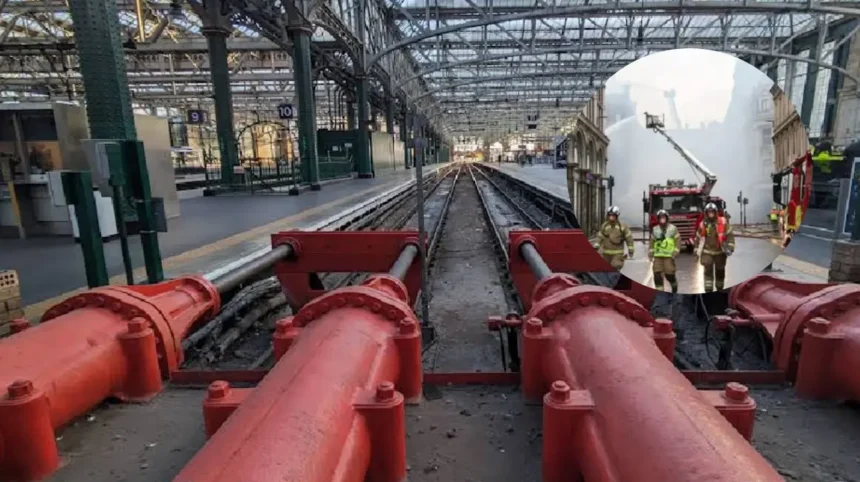
- The fire broke out near a building adjacent to Glasgow Central, one of Scotland’s busiest hubs, leading to temporary closures and platform restrictions.
- Fire crews from the Scottish Fire and Rescue Service remained on site for several hours addressing the blaze and ensuring tracks and structures were safe.
- Passenger‑rail operators, including ScotRail and Avanti West‑Coast, advised travellers to check live updates and avoid non‑essential journeys.
- No immediate reports of serious injuries among passengers or staff, according to official statements.
Local Edinburgh(Edinburgh Daily) May 25, 2026 – Travellers using ScotRail services between Edinburgh and Glasgow faced major disruption after a fire broke out near the railway line close to Glasgow Central in May 2026. The blaze, which began in a commercial premises adjacent to the station, spread to a nearby Victorian structure and forced both Network Rail and ScotRail to suspend and alter services for several hours. As reported by National Rail, the incident led to significant delays and cancellations on the main Edinburgh–Glasgow corridor, with knock‑on effects on cross‑country and regional routes.
- Key points
- Why Glasgow Central is so critical for this route
- How ScotRail, Network Rail, and other operators responded
- Impact on passengers and the travel experience
- What changes were made to the timetable and routes
- Background of the development
- Prediction: How this disruption could affect future travellers
Why Glasgow Central is so critical for this route
Glasgow Central is Scotland’s busiest railway station and a key junction for ScotRail, Avanti West‑Coast and other operators serving Edinburgh and the Central Belt. Reporting for The Guardian, journalist Jamie Matheson noted that the fire near Union Street – thought to have started in a vape shop – caused “severe damage” to a Grade B‑listed adjoining building, which in turn forced the temporary closure of high‑level platforms and rerouting of low‑level services. This connection meant that when Glasgow Central’s platforms were partially or fully out of use, ScotRail could not run its usual fleet of inter‑city and commuter trains along the core Edinburgh–Glasgow line.
National Rail’s incident page later confirmed that all platforms had since reopened and “a normal train service is now able to operate to / from / through this station,” but the initial shutdown and subsequent safety checks left a lasting impact on the day’s timetable.
How ScotRail, Network Rail, and other operators responded
In statements issued on the day, Network Rail described the fire as a major incident requiring “full safety assessments” before services could resume at full capacity. The organisation emphasised that although the station itself sustained “minimal structural damage,” adjacent structures and overhead infrastructure had to be inspected for heat‑related warping and debris. As quoted in a BBC report, a Network Rail spokesperson said passengers should expect “days of disruption” while crews worked to restore normal operations.
ScotRail, whose services form the backbone of the Edinburgh–Glasgow connection, announced that no trains would run to or from Glasgow Central on the day of the fire, with many journeys instead diverted through alternative routes or replaced by buses. Reporting for The Guardian, the journalist noted that ScotRail advised passengers to allow extra journey time and to “check live departures” before travelling.
Other operators were also affected. Avanti West‑Coast stated that trains to Preston, Carlisle and Motherwell would still run, but with modified services designed to let passengers connect to local ScotRail services in the Glasgow area. TransPennine Express warned of delays and cancellations between Edinburgh and Newcastle or Manchester Airport, illustrating just how far the ripple effect of the fire travelled beyond the immediate vicinity of Glasgow Central.
Impact on passengers and the travel experience
Commuters using the Edinburgh–Glasgow line – one of the busiest rail corridors in the UK – reported long queues, crowded replacement buses and confusion over platform changes. One traveller quoted in a BBC article described standing on the platform as announcements were issued in rapid succession, with routes changing every few minutes. The Guardian piece also relayed experiences of office workers arriving late for meetings and students missing scheduled exams, underlining the practical difficulties posed by the disruption.
Authorities from the Scottish Fire and Rescue Service confirmed that several crews remained on site overnight, extinguishing remaining hotspots and monitoring the stability of the damaged building. In a statement carried by multiple outlets, the service urged the public to “avoid the area if possible” to allow emergency crews and network engineers to work safely.
Operator‑level statistics later suggested that hundreds of thousands of journeys were affected over the course of the disruption. In one follow‑up article, The Guardian reported that around 953,000 passenger trips had been disrupted in the week following the fire, as reduced timetables and partial reopening of the station continued to alter normal operations.
What changes were made to the timetable and routes
Following the blaze, ScotRail and Network Rail jointly implemented a temporary timetable that significantly reduced the number of trains between Edinburgh and Glasgow. According to National Rail’s service‑disruption page, many services were either cancelled outright or rerouted via alternative lines, with some journeys terminating short of their usual destinations. This led to a concentration of passengers at alternative stations, including Glasgow Queen Street and Paisley Gilmour Street, where ScotRail deployed additional staff and signage to manage crowds.
For cross‑country services, Avanti West‑Coast and TransPennine Express introduced amended schedules, with some routes running only between key hubs and requiring passengers to transfer to ScotRail or local buses to complete their journeys. The Guardian’s coverage highlighted that these changes were communicated via National Rail Enquiries, operator websites and station announcements, though several passengers told reporters they had only discovered the full extent of the disruption on arrival at the station.
Background of the development
The disruption on the Edinburgh–Glasgow route forms part of a broader pattern of fire‑related incidents near major UK rail hubs in recent years. Glasgow Central, being a Grade B‑listed Victorian station, sits in a dense urban environment where nearby commercial buildings share airspace and infrastructure with the tracks. Fires in adjacent structures – whether in shops, offices or warehouses – can quickly compromise the safety of overhead wires, signalling equipment and platform access, forcing operators to suspend services even if the station fabric itself is largely intact.
This incident also underscores the fragile interdependence between urban rail infrastructure and local commercial development. The vape shop reported as the likely origin of the fire was located on Union Street, a busy commercial thoroughfare running alongside the station. As detailed in The Guardian’s coverage, the blaze spread through the Victorian building next door, which had been used for retail and office space, illustrating how a relatively small commercial property can trigger a system‑wide disruption to national‑scale rail networks.
Operational protocols for such events have been shaped by previous major incidents, including earlier fires and structural failures at large stations. Network Rail’s statement that Glasgow Central would remain closed “until further notice” followed well‑established procedures for assessing fire‑exposed structures before resuming services. The subsequent partial reopening of the main concourse and the restoration of a “normal” timetable, as noted on National Rail’s update page, reflect the balance operators must strike between passenger safety and economic impact when restoring services.
Prediction: How this disruption could affect future travellers
For regular commuters and occasional travellers on the Edinburgh–Glasgow corridor, this fire‑related disruption serves as a reminder of how vulnerable high‑frequency rail services can be to incidents in the surrounding urban environment. Passengers may increasingly expect operators to provide more detailed contingency plans, such as clearer communication about alternative routes, robust real‑time apps, and expanded bus‑replacement networks, especially during peak‑hour periods.
From an infrastructure‑planning perspective, the incident may also prompt regulators and Network Rail to review fire‑safety standards for buildings immediately adjacent to major stations, particularly those housing high‑risk trades or stock. Future developments in the vicinity of Glasgow Central and similar hubs could see stricter building‑code requirements and more compartmentalised fire‑barrier designs, in an effort to limit the chances of a local blaze escalating into a nationwide disruption.
For policy‑makers and transport planners, the disruption provides a case study in the economic cost of network instability. The reported figure of nearly a million passenger journeys affected in a single week highlights the potential impact on productivity, business travel and tourism, and could feed into arguments for greater investment in redundant infrastructure and digital‑resilience tools that allow services to adapt more quickly when incidents occur.