Key Points
- Barry Gilgun, 35, died after a violent disturbance outside Cables Wynd House, known locally as the ‘Banana Flats’, in Leith, Edinburgh.
- Police Scotland arrested and charged a 33-year-old man over the fatal incident.
- Emergency crews, armed officers, and forensic specialists went to the scene following reports of the disturbance.
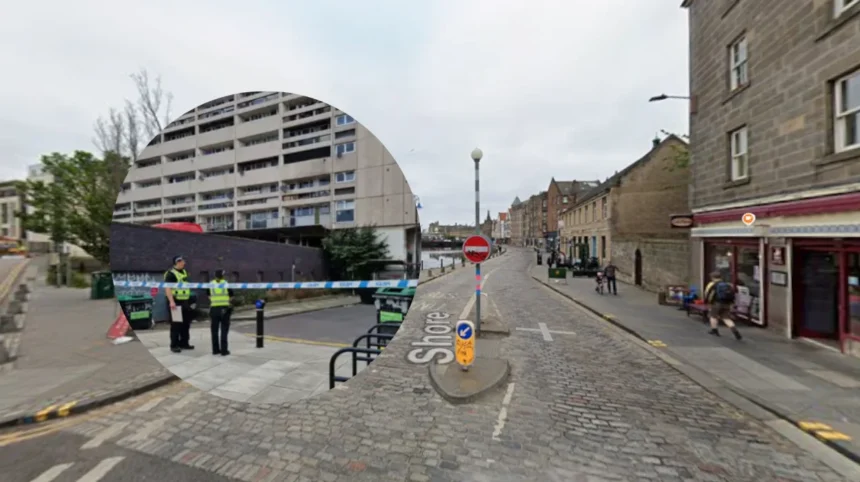
- Police taped off areas around Cables Wynd House and Henderson Street, forcing Lothian Buses to divert several routes.
- The suspect was remanded to appear at Edinburgh Sheriff Court.
Leith (Edinburgh Daily) September 22, 2026 – Police Scotland launched a murder investigation and cordoned off large swathes of Leith following a fatal disturbance outside Cables Wynd House—locally known as the “Banana Flats” due to its distinct curved architecture. Emergency services rushed to the location following reports of a violent altercation, which resulted in the death of a 35-year-old man, identified as Barry Gilgun. A 33-year-old man was subsequently arrested and charged by investigating officers in connection with the fatality.
- Key Points
- What happened outside Cables Wynd House in Leith?
- How did law enforcement and emergency services respond at the scene?
- How were local transport and residents affected by the police cordon?
- Background of Cables Wynd House and Local Crime Trends
- Prediction: How This Development May Affect the Local Community and Stakeholders
What happened outside Cables Wynd House in Leith?
As reported by Ruth Suter and William Gaddi of the Daily Record, emergency services were called to the scene outside Cables Wynd House at approximately 9:45 pm following reports of an ongoing disturbance. Upon arrival, police and paramedics discovered 35-year-old Barry Gilgun suffering from critical injuries sustained during an alleged stabbing. Mr Gilgun was immediately conveyed by ambulance to the Royal Infirmary of Edinburgh, where he succumbed to his injuries a short time later.
As detailed by Matthew Fulton of STV News, a Police Scotland spokesperson confirmed the timeline and the initial police response:
“Around 9.40pm on Sunday, July 5, 2026, police received a report of a disturbance outside Cables Wynd House, Edinburgh. Officers attended and a man was found with serious injuries. He was taken to the Royal Infirmary of Edinburgh, where he died a short time later. A 33-year-old man has been arrested and enquiries are ongoing.”
How did law enforcement and emergency services respond at the scene?
Witness accounts and photographs published across social media and local news outlets depicted a major police operation unfolding across Leith. As reported by Edinburgh Live, between 25 and 30 emergency vehicles—including marked police cars, ambulances, armed response units, and forensic specialists—attended the locus shortly after the incident was reported. Forensic investigators clad in protective suits erected scenes-of-crime tents and examined evidence across the immediate exterior of Cables Wynd House and nearby thoroughfares.
Police tape was used to establish a heavy cordon around the housing complex and Henderson Street. A Police Scotland spokesperson later provided an updated statement confirming the suspect had been charged:
“A 33-year-old man has been arrested and charged in connection with the death of 35-year-old Barry Gilgun in Edinburgh. Barry was found with serious injuries following a disturbance outside Cables Wynd House in the Leith area of the city. He was taken by ambulance to the Royal Infirmary of Edinburgh, where he died a short time later. The 33-year-old is due to appear at Edinburgh Sheriff Court. A report will be sent to the Procurator Fiscal.”
How were local transport and residents affected by the police cordon?
The extensive police presence and cordons created severe disruption throughout Leith. Henderson Street was closed off entirely to motor vehicles while investigators preserved the crime scene.
Lothian Buses confirmed that several key transit services were diverted as a direct consequence of the street closures. Bus routes 16, 17, 34, 35, 36, N16, and N35 were unable to serve their standard stops at The Shore and Commercial Street. Transport operators rerouted affected services via Great Junction Street and North Junction Street until scene examinations concluded. Local residents inside Cables Wynd House faced restricted access into and out of the complex as officers maintained static guards at entry points.
Background of Cables Wynd House and Local Crime Trends
Cables Wynd House is a prominent 10-storey council housing block constructed between 1962 and 1965. Designed by the architectural firm Alison & Hutchison & Partners, the building gained its famous colloquial moniker, the “Banana Flats,” owing to its curved concrete structure that mirrors the shape of the fruit. The structure holds Category A listed status in Scotland due to its architectural significance as an exemplar of post-war brutalist housing developments. It achieved international cultural fame after being featured heavily in Irvine Welsh’s 1993 novel Trainspotting and its subsequent film adaptations as the home of the character Simon “Sick Boy” Williamson.
Despite significant regeneration efforts and investment across Leith in recent decades, Cables Wynd House and its surrounding streets have occasionally seen incidents of violent crime and anti-social behavior, making policing in the high-density residential complex a recurring focus for Police Scotland’s North East Edinburgh Community Policing Team.
Prediction: How This Development May Affect the Local Community and Stakeholders
- For Leith Residents and Local Community: The occurrence of a fatal violent incident immediately outside a major residential block is likely to heighten public safety concerns among local residents. In the short term, residents will experience an increased presence of high-visibility police patrols aimed at offering community reassurance.
- For Housing and Municipal Authorities: City of Edinburgh Council and housing management groups may face intensified calls from residents’ associations to review safety measures within and around Cables Wynd House. This could lead to demands for enhanced closed-circuit television (CCTV) coverage, improved security lighting, and controlled access points around the estate.
- For Law Enforcement and Public Policy: The incident may prompt Police Scotland to re-evaluate targeted knife crime interventions and targeted anti-social behaviour initiatives across North Edinburgh. It could also influence broader council-led community safety strategies focusing on high-density social housing developments.