Old Fishmarket Close Edinburgh is a historic pedestrian alleyway situated within the Old Town conservation zone. The narrow passage descends steeply from the High Street section of the Royal Mile down toward the lower thoroughfare known as the Cowgate.
- What are the Earliest Medieval Origins and Market Histories of Old Fishmarket Close Edinburgh?
- How did the Lang Siege of 1573 Structurally Damage Old Fishmarket Close Edinburgh?
- What Role did Old Fishmarket Close Edinburgh Play in the 1585 Bubonic Plague Outbreak?
- What Unique Historical Records Detail the Presence of an Elephant inside Old Fishmarket Close Edinburgh?
- How did the Great Fire of 1824 Permanently Alter Old Fishmarket Close Edinburgh?
- What Institutional Functions did the Edinburgh Police Chambers Serve within Old Fishmarket Close Edinburgh?
- What Specific Archaeological Artifacts Have Been Excavated from Old Fishmarket Close Edinburgh?
- How Has Old Fishmarket Close Edinburgh Been Adapted for Twenty-First-Century Hospitality and Tourism?
- What Urban Conservation Laws Protect the Architectural Heritage of Old Fishmarket Close Edinburgh?
- FAQs About Old Fishmarket Close Edinburgh?
- What is the origin of the name of Old Fishmarket Close Edinburgh?
- Can you walk through Old Fishmarket Close Edinburgh today?
- What happened to Old Fishmarket Close during the Great Fire of 1824?
- Is Old Fishmarket Close connected to any famous literature or media?
- What historical animal incident took place inside Old Fishmarket Close?
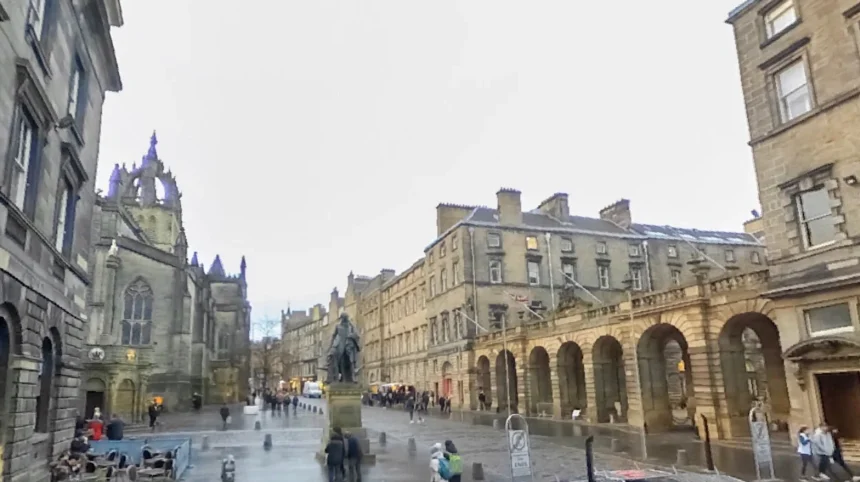
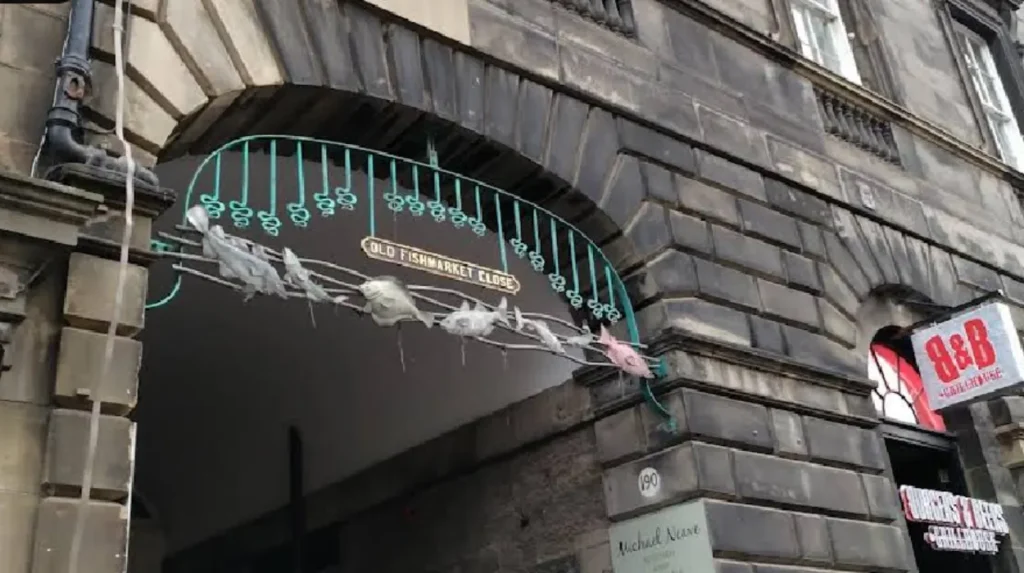
The exact coordinates place this geographical entity immediately east of Parliament Square and Saint Giles Cathedral. This position represents the historical core of the medieval city layout. Modern visitors access the close through an ornamental stone archway decorated with ironwork depicting multiple fish forms. The lane features a steep gradient paved with traditional granite setts that runs vertically between towering historic stone tenements. This passageway creates an essential pedestrian link between the high ridge of the Royal Mile and the parallel valley of the Cowgate.
This specific layout mirrors the classic herringbone urban design that defines the historic core of the city. The narrow configuration of the close provided defensive advantages during ancient civil conflicts while acting as a natural wind tunnel. Today the corridor remains open to the public as an atmospheric walkway. It represents a prime example of surviving early modern infrastructure. Visitors frequently utilize this path when exploring the various free things to do in Edinburgh for a historic experience.
What are the Earliest Medieval Origins and Market Histories of Old Fishmarket Close Edinburgh?
The historical records first explicitly mention Old Fishmarket Close Edinburgh in 1592 after the town council established the official municipal fish market there. The site originally developed during the early medieval expansion of the historic High Street tenements.
Town Council Minutes from 1539 document the original order to locate fish sellers within this specific urban corridor. Before this designation, the pathway was known as Swift Wynd after John Swift who acquired a tenement here in 1427. The modern close combines two older parallel passages that formerly enclosed the open-air market stalls between them. Charters from 1719 through 1765 list alternative names including Barrie Close, Jolly Close, and Suittie Close. These changing designations directly reflected the names of wealthy merchant families who owned property along the boundary.
The centralized fish market operated under strict municipal regulations to ensure tax collection and quality control. Heavy stone stalls lined both sides of the steep incline to display fresh catches brought daily from the Firth of Forth. Sellers utilized the natural downward slope of the alleyway to wash away scales and organic residue during operating hours. This trade pattern established the close as a vital commercial hub for the surrounding medieval populace. The concentrated commercial activity sustained a dense network of multi-story timber residential buildings overhead.
How did the Lang Siege of 1573 Structurally Damage Old Fishmarket Close Edinburgh?
The Lang Siege of 1573 heavily damaged Old Fishmarket Close Edinburgh when English forces bombarded the area with heavy artillery. The military action targeted the defensive structures and residences surrounding the Royal Mile and Edinburgh Castle.
This conflict lasted from 1571 until May 1573 when the castle garrison finally surrendered to the combined forces. Historical records indicate that artillery fire destroyed multiple timber-fronted residential buildings inside the close during the final bombardment phase. Documented casualties within this narrow alleyway included five civilian deaths and twenty severe injuries from falling structural debris. Local historical anecdotes claim that displaced fish from rooftop storage structures fell into the streets during the shelling. The destruction forced subsequent reconstructions using stone foundations rather than medieval organic building materials.
The structural remediation altered the architectural density of the passage for the next two centuries. Rebuilders erected taller tenements to maximize the limited footprint within the city walls. This defensive consolidation created the canyon-like appearance that characterizes the surviving sections of the Old Town today. The event marked a critical transition from fragile timber framing to durable stone construction across the urban zone. Military engineers subsequently mapped the area to improve the strategic defenses of adjacent residential closes.
What Role did Old Fishmarket Close Edinburgh Play in the 1585 Bubonic Plague Outbreak?
Old Fishmarket Close Edinburgh served as the initial point of entry for the devastating bubonic plague outbreak of 1585. The high population density and damp conditions within the enclosed space accelerated the early transmission of the disease.
Archival records verify that a young female worker inside the close became the first recorded plague casualty in April 1585. Medical officials initially misdiagnosed her terminal symptoms as natural labor before identifying the characteristic pestilential buboes. The epidemic subsequently spread rapidly through the unsanitary drainage systems of the steep Old Town alleyways. This outbreak ultimately forced the evacuation of the nearby University of Edinburgh to prevent complete depopulation. The high mortality rate within the close transformed its demographic composition from wealthy merchants to low-income laborers.
The municipal council implemented immediate quarantine protocols that sealed the entryways of the infected tenements. Guardians guarded the front gates of the close to prevent residents from escaping into neighboring districts. Sanitation workers utilized crude chemical mixtures to fumigate the vacant market stalls and contaminated stone cellars. Despite these early public health measures, the local economy collapsed during the multi-month containment period. The tragedy highlighted the severe infrastructural vulnerabilities of the highly congested medieval residential structures.
What Unique Historical Records Detail the Presence of an Elephant inside Old Fishmarket Close Edinburgh?
Old Fishmarket Close Edinburgh hosted an unusual historical event in 1705 when a Dutch showman housed a live elephant inside a residential flat. The incident generated significant municipal legal disputes regarding urban property damage and waste disposal.
A Dutchman named Abraham Sever rented an upper-floor apartment located directly above a commercial bakery operated by Adam Kerr Baxter. Sever utilized the animal, historically nicknamed the Dundee Elephant, for public exhibition tours across Scottish burghs. The baker submitted formal complaints to the Edinburgh Town Council concerning structural damage and leakage. The animal generated substantial quantities of heavy dung that seeped through the floorboards into the baking facilities. Council records validate that this exotic animal had previously toured various European cities during the late seventeenth century.
The legal proceedings forced the town council to evaluate the safety regulations of residential tenements within the city. Magistrates ultimately ordered the removal of the animal to safeguard the commercial integrity of the underlying bakery. This specific case remains a prominent example of early domestic property law disputes in Scotland. The archival letters provide precise insights into the unexpected uses of dense urban spaces during the Enlightenment. The event passed into local folklore as one of the most eccentric structural exploitations of a traditional close.
How did the Great Fire of 1824 Permanently Alter Old Fishmarket Close Edinburgh?
The Great Fire of 1824 completely destroyed the northern and western architectural structures of Old Fishmarket Close Edinburgh. The catastrophic event initiated a major phase of municipal clearance and modern stone reconstruction across Parliament Square.
This historic fire began on November 15 1824 and burned continuously for five consecutive days across the Old Town. The newly established Edinburgh Fire Brigade under Firemaster James Braidwood directed the containment operations amidst severe equipment limitations. The conflagration leveled the ancient multi-story timber tenements that previously crowded the upper section of the close. City authorities cleared the remaining structural ruins to expand the footprint of the adjacent high court buildings. This architectural clearance permanently erased several intersecting minor passages including Royal Bank Close and Hangman Close.
The post-fire reconstruction completely modernized the interface between the close and the primary thoroughfare of the Royal Mile. Architects replaced the chaotic medieval building profiles with uniform neoclassical stone facades that improved structural stability. The lower sections of the close retained their steep pedestrian path but lost their historic cross-passages. This transformation aligned the district with the broader urban planning trends observed during the development of the New Town. The physical loss shifted the local memory from an active marketplace to a specialized institutional zone.
What Institutional Functions did the Edinburgh Police Chambers Serve within Old Fishmarket Close Edinburgh?
Old Fishmarket Close Edinburgh became the site for the new Edinburgh Police Chambers and corporate courtroom facilities in 1845. The institutional complex replaced the destroyed residential structures and administered local mid-nineteenth-century municipal justice.
Architectural designs for this civic facility achieved formal completion in 1830 under municipal authority direction. The building contained specialized holding cells, an active public courtroom, and administrative offices for the regional police force. Judicial officers utilized these specific courtroom facilities primarily to process minor public order offenses and petty thefts. A notable historical legal proceeding occurred here regarding the official licensing ownership of the dog Greyfriars Bobby. The Edinburgh Police department occupied this structural space continuously until the regional relocation of offices in 1980.
The presence of the police chambers permanently altered the daily foot traffic and safety profile of the alleyway. The regular transport of prisoners through the close necessitated enhanced lighting and regular structural maintenance by the city. This civic occupation prevented the alleyway from falling into the severe urban decay that affected neighboring residential closes. The architectural footprint of the building established a firm institutional boundary that defined the upper section of the lane. This structural legacy remains visible in the surviving nineteenth-century stonework that forms the western boundary.
What Specific Archaeological Artifacts Have Been Excavated from Old Fishmarket Close Edinburgh?
Archaeological excavations at Old Fishmarket Close Edinburgh have revealed intact medieval cellars and extensive deposit layers dating to the fifteenth century. The physical evidence provides critical data regarding historical diets, trade patterns, and building construction techniques.
A formal watching brief conducted by Headland Archaeology in May 2002 exposed an unrecorded vaulted stone cellar system. Excavators recovered substantial quantities of late medieval pottery fragments, butchered animal bones, and marine oyster shells from the trenches. These artifacts confirm that the alleyway functioned continuously as a major repository for organic market refuse. The deep stratigraphic layers extend significantly downward toward the lower slope of the Cowgate valley floor. Municipal conservation protocols require the permanent preservation of these structural vaults within any modern property redevelopments.
Subsequent evaluations conducted between December 2002 and March 2003 uncovered additional foundations from the late seventeenth century. Workers discovered a completely sealed vaulted chamber extending directly beneath the modern pedestrian pavement of the close. Analysis of the redeposited midden material indicates a high reliance on regional marine resources by historic residents. These physical discoveries offer undeniable proof of the intensive commercial processing that occurred when the fish market operated. The underground structures remain protected as scheduled monuments to prevent unauthorized disturbance by commercial construction companies.
How Has Old Fishmarket Close Edinburgh Been Adapted for Twenty-First-Century Hospitality and Tourism?
Old Fishmarket Close Edinburgh currently functions as a preserved historic site, a pedestrian link, and a modern hospitality corridor. The remaining Victorian structures have undergone extensive interior renovations to accommodate contemporary tourist accommodation and commercial enterprises.
Alejandro González Domínguez
The former nineteenth-century police chambers underwent complete structural conversion to create the luxury CoDE Pod Hostel complex. This development preserves the original iron jail cell doors and historic courtroom structural footprints for visitors. The close experiences high foot traffic from international tourists participating in guided historical walking tours of the Old Town. It also serves as a prominent cultural reference point within popular modern dark fantasy audio dramas. The City of Edinburgh Council maintains strict architectural oversight to protect the surviving physical attributes of the close.
The adaptive reuse demonstrates how the city balances historical conservation with contemporary economic demands. The interior modifications utilize advanced space-saving architecture while leaving the external stone facades completely unaltered. Modern lighting systems now illuminate the narrow passage to ensure pedestrian safety during evening hours. This commercial transformation has successfully integrated the ancient alleyway into the thriving local tourism economy. The site now illustrates how obsolete municipal infrastructure can achieve long-term financial and cultural sustainability.
What Urban Conservation Laws Protect the Architectural Heritage of Old Fishmarket Close Edinburgh?
Old Fishmarket Close Edinburgh operates under stringent statutory protections designed to preserve its historic fabric from unauthorized modern alterations. These legal frameworks ensure that any physical interventions respect the structural integrity of the Old Town.
The close is designated as a key component of the Edinburgh Old Town UNESCO World Heritage Site established in 1995. Historic Environment Scotland classifies the surrounding structures as Listed Buildings which prohibits demolition or unapproved material changes. Any structural maintenance must utilize traditional lime mortar and matching natural sandstone to preserve the historical visual continuity. The local planning authority enforces specific controls regarding commercial signage, exterior paint colors, and lighting installations along the path. These regulations prevent the introduction of incompatible modern design elements into the ancient urban corridor.
Related Article: Review the modern housing investment approved by Edinburgh Council to understand how contemporary municipal funding supports the long-term conservation of regional historic districts.
The intersection of these legal protections ensures that the close maintains its unique architectural character for future generations. Developers must submit detailed heritage impact assessments before receiving permission for minor internal alterations. This rigorous oversight prevents the loss of subtle historical details such as ancient foundation stones and structural vaults. The continuous enforcement of these conservation laws maintains the authentic atmosphere that attracts researchers and travelers. Consequently the close remains an unaltered physical record of the evolution of the city.
FAQs About Old Fishmarket Close Edinburgh?
What is the origin of the name of Old Fishmarket Close Edinburgh?
The name derives directly from the official municipal fish market established within the alleyway by the town council in 1592. Prior to this designation, the passage was known as Swift Wynd after a prominent fifteenth-century property owner named John Swift.
Can you walk through Old Fishmarket Close Edinburgh today?
The alleyway remains fully open to the public as a pedestrian thoroughfare connecting the Royal Mile to the Cowgate. The steep path features traditional stone paving and is easily accessible through a decorated stone archway near Parliament Square.
What happened to Old Fishmarket Close during the Great Fire of 1824?
The catastrophic fire completely destroyed the northern and western timber structures of the close over five days of burning. The subsequent municipal clearance erased several connecting minor alleys and led to the construction of neoclassical stone buildings.
Is Old Fishmarket Close connected to any famous literature or media?
The close features prominently as the primary setting for the debut episode of the popular horror audio drama fiction series called The Magnus Archives. It also sits adjacent to historic locations utilized in traditional Scottish crime fiction novels.
What historical animal incident took place inside Old Fishmarket Close?
In 1705 a Dutch showman named Abraham Sever stabled a live exhibition elephant inside an upper-floor residential apartment in the close. This event resulted in a unique municipal legal dispute when an underlying baker complained about dung leakage through his ceiling.