Key Points
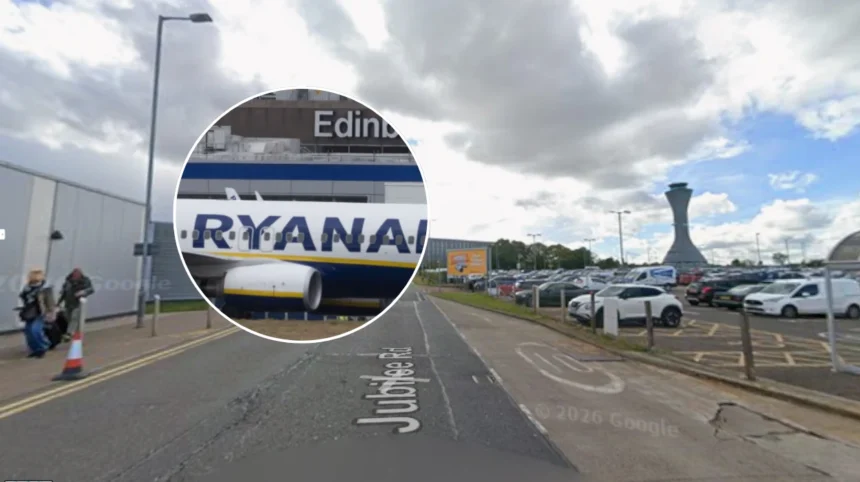
- Flight Departure: Ryanair flight RK514, a Boeing 737-8AS, left Edinburgh Airport for Marrakesh, Morocco, on Sunday morning.
- Mid-Air Medical Crisis: About an hour into the four-hour flight, a passenger became ill as the aircraft crossed the English Channel off the south coast of England.
- Flight Diversion: The pilot made a U-turn over Cornwall and headed north toward the West Midlands.
- Birmingham Landing: The aircraft held briefly over Rubery, Redditch, and Bromsgrove before landing at Birmingham Airport at around 8:15 am.
- Ground Response: Paramedics met the plane on the tarmac and removed the passenger for hospital treatment. Authorities have not released details on the person’s condition.
EDINBURGH (Edinburgh Daily) September 14, 2026 — A international flight departing from Scotland was forced into an immediate mid-air diversion after an unexpected medical emergency unfolded aboard the aircraft shortly after takeoff. Flight RK514, operated by Ryanair, departed Edinburgh Airport at approximately 7:22 am on Sunday, 13 September, carrying passengers bound for the North African destination of Marrakesh, Morocco. However, roughly 60 minutes into the planned four-hour passage, the flight crew was forced to alter their course following a sudden passenger illness while flying over the English Channel.
- Key Points
- Why did the Ryanair flight execute a U-turn over the English Channel?
- What official statements were issued by Ryanair regarding the incident?
- Background of the particular development after the news
- What is the prediction for how this development will affect airline passengers and aviation protocols?
Why did the Ryanair flight execute a U-turn over the English Channel?
As reported by Kirstie McCrum and Rebecca Robinson of the Irish Mirror, flight tracking information captured by FlightRadar24 demonstrated that the Boeing 737-8AS had cleared the southern coast of England and was actively crossing the English Channel when the onboard emergency arose. The pilot executed a sharp U-turn back toward the British mainland to seek the nearest suitable divert location equipped for medical triage.
As detailed by journalism staff at Edinburgh Live, tracking data traced the flight path back across Cornish airspace—passing directly above Fowey, Davidstow, and Marhamchurch. The aircraft then proceeded north towards the West Midlands. Upon reaching the destination area, the Boeing 737 entered a temporary holding pattern, looping just outside the Birmingham city perimeter and passing over local communities including Rubery, Redditch, and Bromsgrove, prior to commencing its final approach.
The aircraft landed safely on the tarmac at Birmingham Airport at approximately 8:15 am, roughly 53 minutes after departing Edinburgh.
What official statements were issued by Ryanair regarding the incident?
As reported by multimedia journalist Alasdair Ferguson of The National, an official spokesperson for Ryanair confirmed the details of the divert procedure and ground response.
In an official public statement provided to news outlets, the Ryanair spokesperson stated:
“This flight from Edinburgh to Marrakesh (13 Sep) diverted to Birmingham after a passenger onboard became ill. The aircraft was met by paramedics upon landing at Birmingham Airport, and the passenger was offloaded for further treatment.”
Emergency medical services were positioned directly at the Birmingham gate prior to touchdown, ensuring immediate attention for the individual upon arrival. Neither the airline nor medical officials have released details regarding the identity or current health status of the passenger.
It remains unclear from radar telemetry whether the pilot formally transmitted a “Squawk 7700” transponder code during the incident. As reported by transport reporters at The Mirror, a 7700 transponder entry serves as an international aviation signal indicating an aircraft is in distress, immediately granting it priority air traffic control handling over conventional commercial traffic.
Background of the particular development after the news
Medical emergencies occurring at high cruising altitudes present unique operational and physiological challenges for commercial aviation providers. Modern international protocols mandate that cabin crew undergo extensive training in aviation first aid, basic life support (BLS), CPR, and the use of onboard automated external defibrillators (AEDs) and emergency medical kits (EMKs).
When a passenger experiences severe illness at 30,000 feet, flight attendants stabilize the patient while the flight deck contacts specialized ground-based medical advisory services, such as MedLink or similar radio-telephony consultation centers. Flight physicians evaluate symptoms remotely to determine whether the patient requires immediate tertiary hospital care or if the situation can be managed until destination arrival.
If ground advisors and the aircraft commander deem an immediate landing necessary, pilots must rapidly assess variables including aircraft weight, fuel jettison requirements, weather conditions, runway lengths, and proximity to specialized hospital trauma units. In this instance, while crossing the English Channel, turning back to an airfield like Birmingham Airport provided a balance of adequate runway infrastructure, available emergency ground medical support, and reduced landing congestion compared to larger London hubs.
What is the prediction for how this development will affect airline passengers and aviation protocols?
For Travelling Passengers
In the immediate future, incidents of this nature highlight the reliance on swift, decisive action by flight crews during mid-air health crises. Passengers flying on long-haul and regional international routes may experience slight delays or schedule adjustments when unexpected diversions take place. However, the outcome reinforces public confidence in commercial flight safety frameworks, demonstrating that passenger health and life safety consistently take priority over operational schedules and fuel expenditures. Passengers with pre-existing health conditions will likely face continued encouragement from health authorities and airlines to disclose relevant medical issues prior to departure and carry necessary medications in hand luggage.
For Airline Operations and Crew Training
Airlines will continue to evaluate and refine their emergency diversion procedures and communication channels with ground-based medical consultants. As commercial air traffic grows globally, automated tracking tools and emergency coordination mechanisms will become even more integrated, allowing air traffic control networks to clear airspace corridors faster when pilots request sudden directional turnarounds. Moreover, airlines may review onboard diagnostic capabilities to assist flight crews in making rapid ground-transfer determinations while maintaining optimal flight efficiency.