Key Points
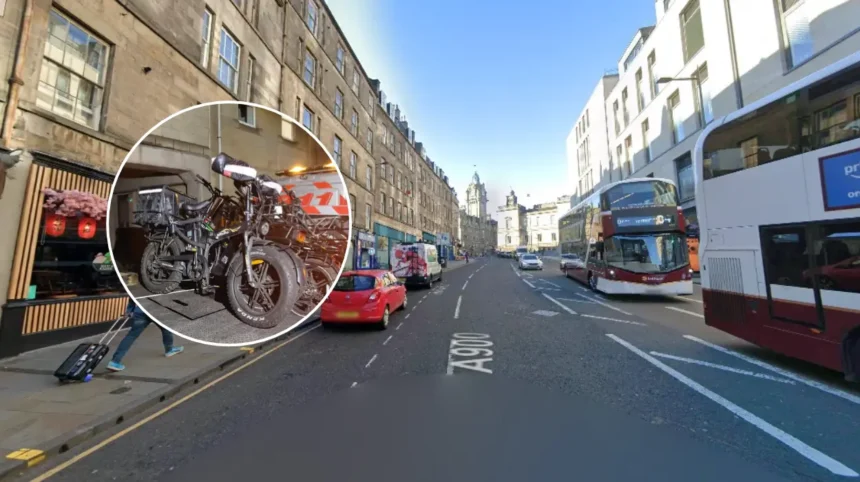
- Police Scotland seized seven illegal e-bikes and charged riders with 20 offences during a city centre crackdown in Edinburgh.
- The operation involved officers from the Edinburgh City Centre Policing Unit working alongside Home Office Immigration Enforcement officers.
- Home Office officials are handling two separate immigration issues identified during the joint patrols.
- Under UK law, e-bikes with motors exceeding 250 watts or speed assistance above 15.5 mph are classed as motor vehicles and require tax, insurance, a driving licence, and an approved helmet.
- Police confiscated the non-compliant vehicles under section 165 of the Road Traffic Act 1988, with unclaimed or illegal bikes facing destruction.
Edinburgh (Edinburgh Daily) October 30, 2026 – Police Scotland officers operating in Edinburgh city centre have seized multiple non-compliant electric bikes and charged several riders as part of a sustained enforcement initiative targeting illegal vehicle modifications, dangerous riding, and antisocial behaviour across the capital.
What prompted the latest police action against illegal e-bikes in Edinburgh?
The targeted operation was launched in response to growing community safety complaints regarding high-speed, modified electric personal vehicles operating on pedestrian footpaths and public roadways.
As reported by Ross Hempseed of STV News, law enforcement officers conducted targeted patrols across high-footfall areas in the city centre to inspect vehicles and check compliance with road traffic legislation.
During the operation, officers stopped numerous e-bike riders to verify motor outputs, maximum throttle capabilities, and speed limiters. Vehicles found to be operating beyond statutory electrical assistance thresholds were immediately impounded under road traffic enforcement powers.
As reported by Edinburgh Live, Police Scotland confirmed that joint enforcement action carried out by the Edinburgh City Centre Policing Unit alongside Home Office Immigration Officers resulted in seven illegal e-bikes being seized, with riders charged with a total of 20 offences.
Police Scotland added: “Two immigration matters were also identified and are being dealt with separately by the Home Office.”
What legal limits define an e-bike on UK roads?
Under UK legislation, Electrically Assisted Pedal Cycles (EAPCs) must satisfy strict criteria to be legally ridden on public roads and cycle paths without registration or insurance. The motor must not exceed a maximum continuous rated power output of 250 watts, and electrical assistance must cut off automatically when the vehicle reaches a speed of 15.5 mph.
Vehicles that feature twist-and-go throttles operating above walking speed without pedalling, or those fitted with aftermarket conversion kits that bypass speed limiters, fail to meet EAPC regulations. Consequently, these modified vehicles are classified as moped or motorcycle equivalents.
“We are very clear that illegally modified e-bikes are dangerous and not suitable for the public road. They pose a risk to their own riders, the emergency services and other road users, particularly pedestrians,” stated Superintendent Andy Barclay, deputy head of Road Policing at Police Scotland.
Riding an unregistered, modified e-bike on public roads without a valid driving licence, third-party insurance, and an approved protective helmet constitutes a breach of the Road Traffic Act. Penalties include points on the rider’s driving licence, statutory fines up to £5,000, and immediate vehicle forfeiture.
“Please be mindful of where you can and can’t use vehicles of this type and take responsibility for your own actions and the safety of other road users,” added Superintendent Andy Barclay during a police briefing on road safety enforcement.
Background of the Edinburgh E-Bike Enforcement Strategy
The recent seizures in Edinburgh follow a broader nationwide initiative coordinated by Police Scotland to reduce road risks associated with illegally modified light electric vehicles.
Over recent years, the rapid proliferation of high-powered conversion kits available online has led to an increase in un-regulated vehicles capable of reaching speeds well in excess of 30 mph on public pavements and pedestrian plazas.
Local authorities and emergency services have raised repeated safety concerns regarding silent, heavy frame e-bikes maneuvering through pedestrian zones.
Furthermore, public feedback gathered through community policing panels in Edinburgh highlighted public anxiety surrounding reckless riding, delivery courier safety standards, and theft-related street crime involving un-tracked, high-speed micro-mobility devices.
In response, Police Scotland established dedicated enforcement windows alongside multi-agency partners—including municipal wardens and Home Office teams—to address illegal vehicle use, combat street crime, and clear non-compliant transport hardware from public corridors.
What does this development mean for Edinburgh residents and commuters?
This ongoing police enforcement strategy directly impacts local residents, pedestrians, commuters, and commercial delivery riders operating across Edinburgh.
For pedestrians, particularly elderly residents and families with young children, increased police intervention offers greater protection on city footpaths and shared cycle paths by reducing high-speed, near-miss incidents caused by unregistered modified bikes.
Improved safety on pedestrian streets like Princes Street, Rose Street, and the Royal Mile is expected as illegal vehicle numbers decrease.
For commercial gig-economy couriers and delivery workers, the crackdown emphasizes the necessity of operating fully compliant, legal EAPCs.
Couriers using non-compliant hardware risk losing their transport, receiving licence penalty points, facing severe financial penalties, or losing their earnings. Delivery agencies and operators may subsequently face increased pressure to verify that their fleet riders adhere strictly to UK road safety standards.