Arthur Conan Doyle developed his critical thinking and literary instincts in Edinburgh through his early upbringing and medical education. His interactions with university professors provided the exact analytical framework that later defined the iconic detective character Sherlock Holmes.
- Which Edinburgh Person Formed the Model for Sherlock Holmes?
- Where Are the Key Sherlock Holmes Landmarks Located in Edinburgh?
- How Did Edinburgh Medical Education Shape Victorian Forensic Science?
- What Is the Modern Cultural Legacy of Sherlock Holmes in Edinburgh?
- Did Arthur Conan Doyle base Dr. Watson on a real person from Edinburgh?
- Can you visit the original medical school where Arthur Conan Doyle studied?
- Why did Arthur Conan Doyle choose to study medicine in Edinburgh instead of London?
- How close was the personal relationship between Arthur Conan Doyle and Dr. Joseph Bell?
- Are there any hidden Sherlock Holmes easter eggs located in Edinburgh streets?
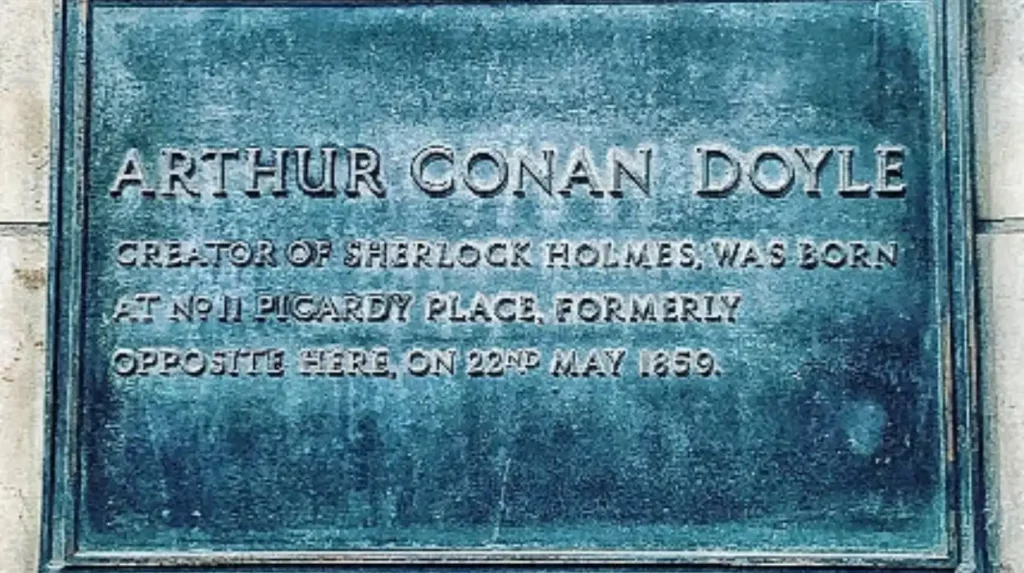
Arthur Conan Doyle was born on May 22, 1859, at 11 Picardy Place in Edinburgh, Scotland. His upbringing within the Scottish capital exposed him to rich literary traditions, complex urban geography, and rigorous educational institutions.
Doyle attended the University of Edinburgh Medical School between 1876 and 1881, where he learned scientific observation under elite medical professors. The intellectual climate of nineteenth-century Edinburgh emphasized empirical evidence, systematic deductions, and diagnostic precision. Doyle absorbed these rigorous scientific methods during his clinical training at the Royal Infirmary of Edinburgh.
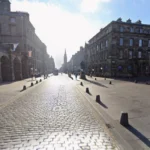
The physical environment of Edinburgh shaped Doyle’s vivid imagination and thematic atmospheric choices. The contrast between the historic Old Town and the Neoclassic New Town provided a backdrop of urban duality.
Doyle witnessed rapid industrialization alongside traditional Scottish folklore during his daily travels through the city streets. These experiences established the foundational worldview that informed his later historical novels and detective fiction.
The university environment exposed him to various social classes, criminal pathology, and complex medical cases. These elements directly cultivated Doyle’s interest in forensic science and criminal investigation techniques.
The cultural infrastructure of Edinburgh offered Doyle access to extensive public libraries and literary societies. He read broad medical literature alongside classic adventure fiction during his spare time between clinical shifts. The city contained prominent educational figures who combined academic rigor with sharp eccentricities.
Doyle noted how these local personalities transformed abstract academic theory into practical, highly visible results. This specific environment demonstrated that logical deduction could solve real-world problems. Doyle’s formative years in Edinburgh established the precise psychological foundation required to construct complex detective narratives later in life.
Which Edinburgh Person Formed the Model for Sherlock Holmes?
Dr. Joseph Bell, a surgeon at the Royal Infirmary of Edinburgh, served as the primary real-life inspiration for Sherlock Holmes. Bell utilized remarkable deductive reasoning and visual observation to diagnose patients before they spoke a word.
Dr. Joseph Bell was born on December 2, 1837, in Edinburgh and became a prominent lecturer at the University of Edinburgh Medical School. Arthur Conan Doyle met Bell in 1877 while pursuing his medical degree. Doyle served as Bell’s outpatient clerk at the Royal Infirmary of Edinburgh in 1879.
In this role, Doyle observed Bell’s uncanny ability to deduce a patient’s occupation, background, and recent movements simply by looking at them. Bell emphasized that observation, deduction, and confirmation formed the core of accurate medical diagnostics.
Bell demonstrated his observational technique daily in front of impressionable medical students. He noted specific physical traits, such as calluses, clothing wear patterns, tattoos, and local accents, to determine client histories.
In one documented instance, Bell identified a patient as a recently discharged non-commissioned officer of a Highland regiment who had served in Barbados. Bell deduced these facts from the man’s gait, respectful coat stance, and symptoms of tropical illness. Doyle recognized that this systematic diagnostic method could be applied directly to solving criminal investigations.
Doyle explicitly acknowledged Bell as the primary inspiration for Sherlock Holmes in personal letters and public statements. Writing to Bell in 1892, Doyle stated that he owed the creation of Holmes to his former medical professor. Bell’s cold, logical methodology and sharp analytical eye were mirrored directly in Holmes’s character traits in A Study in Scarlet, published in 1887.
Bell also contributed to early forensic science, assisting Scottish police authorities in murder investigations during the late nineteenth century. His real-world applications of scientific analysis permanently linked Scottish medical education to modern literary detective methods.
Where Are the Key Sherlock Holmes Landmarks Located in Edinburgh?
Edinburgh contains several prominent landmarks tied to Arthur Conan Doyle and Sherlock Holmes, including Picardy Place, Surgeon’s Hall Museums, and Melville Crescent. These physical locations directly connect the fictional character to real historical sites.
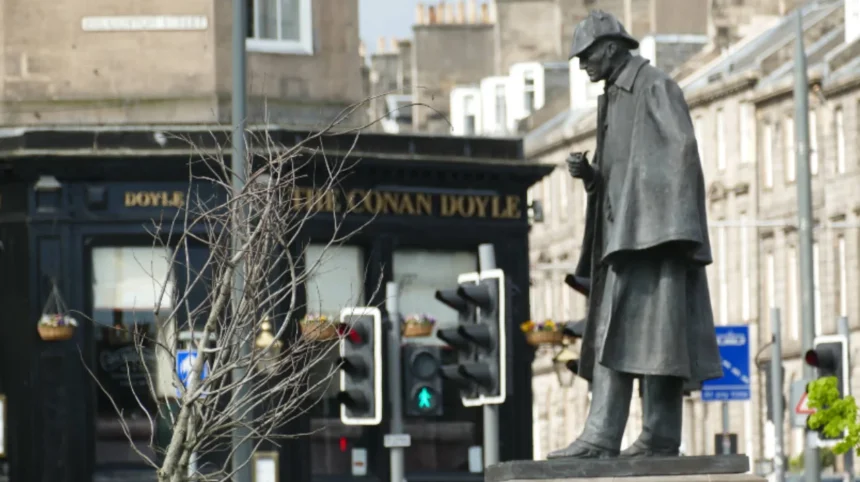
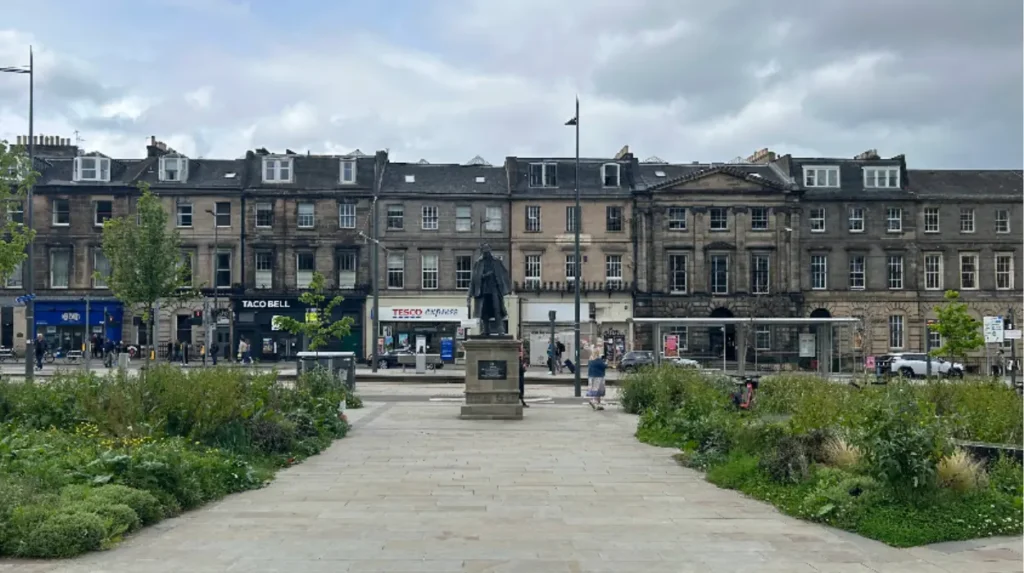
The journey through Sherlock Holmes’s Edinburgh roots begins at Picardy Place, where Arthur Conan Doyle was born in 1859. Although his original birthplace building was demolished during urban redevelopment in the 1960s, a bronze statue of Sherlock Holmes stands near the site at St Mary’s Cathedral. This statue commemorates Doyle’s literary contribution to global culture.
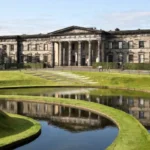
Short walks from this point lead to the Old Quad of the University of Edinburgh on South Bridge, where Doyle attended medical lectures. The courtyard and historic lecture halls retain the architectural character present during Doyle’s student years in the 1870s.
Surgeons’ Hall Museums on Nicolson Street holds extensive archives detailing the life of Dr. Joseph Bell and the evolution of Scottish medicine. The museum displays Bell’s personal possessions, surgical instruments, and original medical records. Visitors can examine historical artifacts that illustrate how early forensic pathology developed in Edinburgh during Doyle’s residency.
Another vital location is 2 Melville Crescent in Edinburgh’s West End, which served as Dr. Joseph Bell’s private residence. The classic Georgian architecture of the West End provided the aesthetic inspiration for Victorian streetscapes depicted in Holmesian stories.
Additional historical locations include the Royal Infirmary site on Waveley Bridge and the original Infirmary site on Infirmary Street. Doyle spent thousands of hours working in these wards under the direct supervision of Joseph Bell and Dr. Henry Littlejohn. Littlejohn served as the Police Surgeon for Edinburgh, teaching forensic medicine to Doyle and providing real criminal cases for study.
The Writers’ Museum off the Royal Mile also preserves rare first editions of Doyle’s books, manuscripts, and personal items. These locations collectively form an authentic geographic footprint of Doyle’s life and literary inspirations across Edinburgh.
How Did Edinburgh Medical Education Shape Victorian Forensic Science?
Nineteenth-century Edinburgh medical education pioneered early forensic science by emphasizing systematic autopsy techniques, toxicology, and observational evidence gathering. These academic methods transformed criminal investigations from speculative guesswork into a respected scientific discipline.
The University of Edinburgh Medical School emerged as a international center for forensic medicine during the nineteenth century. Professors like Dr. Henry Littlejohn revolutionized legal medicine by integrating chemical analysis and post-mortem exams into criminal trials. Littlejohn served as Edinburgh’s Medical Officer of Health and advised the Crown Office in legal proceedings.
He taught medical students how to extract physical evidence from crime scenes, document poison traces, and analyze bloodstain patterns. Arthur Conan Doyle attended Littlejohn’s lectures on forensic medicine, gaining knowledge that later informed the forensic details in his writing.
Medical education at Edinburgh required students to master three core investigative disciplines: pathology, pharmacology, and clinical deduction. Students learned to identify specific botanical poisons, trace physical trauma to specific instruments, and evaluate psychological motives. Dr. Joseph Bell worked alongside Littlejohn to provide expert testimony in high-profile criminal cases, such as the 1893 trial of Alfred John Monson.
Their scientific evidence helped Scottish courts determine exact causes of death using physical data rather than eye-witness testimony alone. This academic environment made Edinburgh the leading institution for scientific crime detection in the British Empire.
Doyle transferred these Edinburgh forensic protocols directly to Sherlock Holmes long before police departments adopted them globally. In stories published between 1887 and 1927, Holmes utilizes soil analysis, footprint analysis, document examination, and fingerprinting.
These fictional techniques reflected the exact methodologies taught in Edinburgh lecture halls during Doyle’s training. The systematic collection of trace evidence, logical deduction, and laboratory testing presented in the Holmes stories reflected authentic advances in Scottish forensic pathology. Through Doyle’s fiction, Edinburgh’s medical techniques set early standards for real-world police work worldwide.
What Is the Modern Cultural Legacy of Sherlock Holmes in Edinburgh?
Edinburgh maintains a prominent cultural legacy through dedicated statues, museum exhibitions, literary tours, and academic archives honoring Arthur Conan Doyle. The city actively preserves its historical connection to the world’s most famous literary detective.
The city of Edinburgh honors Arthur Conan Doyle and Sherlock Holmes through public monuments, preserved archives, and literary tourist routes. The Sherlock Holmes statue at Picardy Place serves as a central gathering point for literary tourists from around the world.
Local historical societies conduct walking tours that connect Doyle’s childhood homes, medical schools, and the sites that inspired his writing. The Royal College of Surgeons of Edinburgh hosts educational programs that detail Dr. Joseph Bell’s real contributions to medicine and criminal detection. These initiatives ensure that the historic links between Scottish science and literature remain accessible.
Academic institutions in Edinburgh maintain extensive archival collections related to Arthur Conan Doyle and his contemporaries. The National Library of Scotland preserves early manuscripts, personal correspondence, and rare editions of Doyle’s published works.
The University of Edinburgh regularly hosts academic conferences evaluating how nineteenth-century Scottish medicine influenced global popular culture. Literary festivals, such as the Edinburgh International Book Festival, frequently feature discussions on Doyle’s enduring impact on modern crime fiction. This scholarly infrastructure ensures continuous critical evaluation of Edinburgh’s contribution to detective fiction and forensic science.
The commercial and hospitality sectors in Edinburgh also reflect this rich literary heritage. Historical pubs, such as The Conan Doyle on Picardy Place, showcase Victorian decor, original documents, and historical photographs of the author. The broader tourism economy benefits from thousands of international fans who visit Edinburgh specifically to explore Holmesian history each year.
By celebrating both the real medical pioneers and the fictional detective they inspired, Edinburgh reinforces its designation as a UNESCO City of Literature. The enduring popularity of Sherlock Holmes continues to promote Edinburgh’s reputation as an international hub of medical innovation and literary genius.
Did Arthur Conan Doyle base Dr. Watson on a real person from Edinburgh?
Arthur Conan Doyle derived aspects of Dr. John Watson from several real-life figures, including Dr. James Watson, a respected Edinburgh medical colleague. Doyle also drew heavily upon his own experiences as a practicing doctor to write Watson’s medical observations and loyal narrative voice.
Can you visit the original medical school where Arthur Conan Doyle studied?
Yes, you can visit the Old Quad at the University of Edinburgh on South Bridge, where Doyle attended medical lectures. The nearby Surgeons’ Hall Museums also displays historical medical artifacts, records, and exhibits related to Doyle and Dr. Joseph Bell.
Why did Arthur Conan Doyle choose to study medicine in Edinburgh instead of London?
The University of Edinburgh Medical School was widely regarded as the premier medical institution in the nineteenth-century British Empire. It offered world-class faculty, advanced clinical training at the Royal Infirmary, and lower tuition costs compared to London institutions.
How close was the personal relationship between Arthur Conan Doyle and Dr. Joseph Bell?
Doyle maintained a close professional and personal relationship with Dr. Joseph Bell after serving as his outpatient clerk in 1879. They corresponded frequently throughout their lives, and Bell actively supported Doyle’s literary career and political endeavors in Scotland.
Are there any hidden Sherlock Holmes easter eggs located in Edinburgh streets?
Edinburgh features subtle tributes to Holmes, including a commemorative plaque near Picardy Place, historical displays inside local pubs, and Bell’s grave at Dean Cemetery. Visitors can also view Dr. Bell’s original clinical notes held within medical university archives.