Key Points
- The Church of Scotland formally apologized for its historical links to chattel slavery, a statement adopted at the General Assembly in Edinburgh.
- The apology expresses deep sorrow for harm caused by both actions and failures to act, and pledges changes to reflect genuine repentance.
- The apology follows a report and debate earlier in the General Assembly, which documented instances where ministers, elders or institutions benefited from slave-linked wealth, memorials or inherited plantations.
- The General Assembly instructed the Kirk to prepare the apology following earlier decisions to research and acknowledge the church’s links to the transatlantic slave trade.
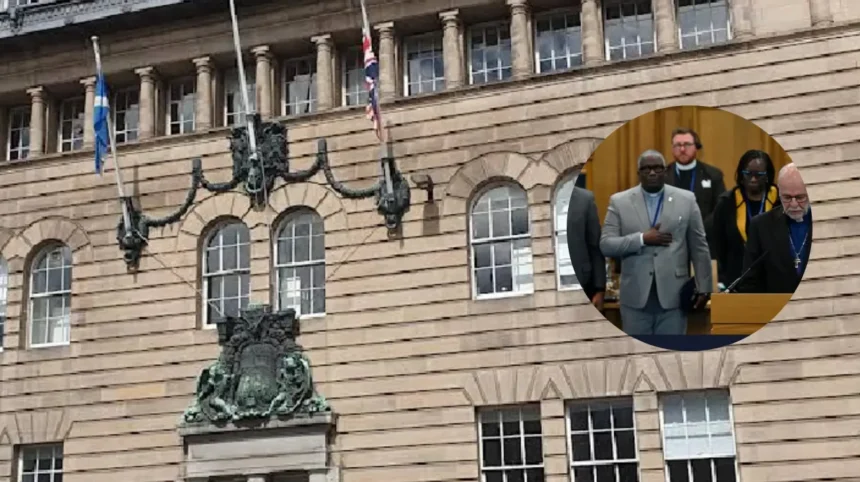
- The apology and related motions were discussed and adopted during the Church of Scotland’s General Assembly, which ran in mid-May 2026 at the Assembly Hall on the Mound in Edinburgh.
Edinburgh(Edinburgh Daily) May 17, 2026 – The Church of Scotland has adopted a formal apology at its General Assembly in Edinburgh for historical relationships with chattel slavery, expressing sorrow for the suffering caused and committing to steps intended to show genuine repentance.
What evidence and research prompted the apology?
Research presented to the General Assembly outlined historical connections between the Church of Scotland and the transatlantic slave economy, including examples where wealth tied to plantations and slavery was inherited by ministers or used to fund buildings and memorials within church communities. Those findings formed part of a report circulated ahead of the Assembly, prompting commissioners to conclude that an acknowledgement and apology were both necessary and appropriate. The decision to apologize follows previous movements within the Kirk to investigate and be transparent about historical records and benefactions that linked church members or institutions to slavery.
What were the main motions and procedural steps at the General Assembly?
The General Assembly debated motions instructing the Kirk to prepare a statement of acknowledgement and apology and to work with the wider church in drafting it. Commissioners debated the contents and the scope of the apology, considering both direct actions and failures to act, and then adopted the apology at the Assembly. Further procedural steps included directing the Kirk to bring a refined statement and an accompanying plan for follow-up measures back to a future Assembly for ratification and implementation.
What reactions and responses have been documented?
Official church communications framed the apology as an ethical and spiritual reckoning. Media coverage noted that the apology was ratified during the Assembly in Edinburgh and reported the apology’s language of sorrow and a pledge to change course and seek tangible outcomes that reflect repentance. Commentators and faith leaders within and beyond Scotland are likely to view the apology in the context of wider national and institutional reckonings with historical slavery and empire, given the documented instances of financial and memorial links to slavery noted in the preparatory research.
What follow-up actions did the Assembly recommend?
The General Assembly directed the Kirk to prepare the formal wording of the apology in consultation with affected communities and to return it for consideration at a later meeting, indicating the Assembly expects measurable outcomes linked to the apology. The Assembly’s instruction included working with the wider church to ensure the apology is informed by historical research and engagement with those most affected by the legacy of slavery.
Background
The Church of Scotland’s General Assembly is the Kirk’s supreme decision-making body, meeting annually in Edinburgh to consider doctrinal, moral and administrative matters affecting the national church. Over recent years, many religious and civic institutions across the UK and beyond have commissioned historical research into links with the transatlantic slave trade and have wrestled with how to respond to findings that memorials, benefactions or institutional wealth had origins connected to slavery. Within the Church of Scotland, earlier reporting and campaigning prompted commissioners to instruct investigations and, ultimately, to request a formal statement of acknowledgment and apology once the evidence was assembled and presented to the Assembly.
Prediction — how will this affect congregations, communities and institutional practice?
The formal apology and the Assembly’s instruction to prepare concrete follow-up measures are likely to prompt local congregations and the national church to review memorials, benefactions and institutional records where links to slavery may exist, and to consider reparative or commemorative actions in response to identified harms. For communities historically connected to the transatlantic slave trade and for people of African and Caribbean descent in Scotland and beyond, the apology may be seen as an important symbolic step that should be matched by tangible outcomes such as educational programmes, memorialization, or support for affected communities to be judged on delivery rather than words alone. Institutional practice within the Kirk may shift towards more rigorous historical auditing of records, transparent reporting of findings, and collaborative processes that include those with lived experience of the legacy of slavery in shaping responses and restitution.