Key Points
- Researchers at the University of Edinburgh are using genetically engineered E. coli bacteria to convert sugars from stale bread into valuable chemicals like glucaric acid.
- Glucaric acid serves as a key precursor for pharmaceuticals, including cancer drugs, and bioplastics, potentially replacing petroleum-based production methods.
- The process utilises waste bread, which constitutes a significant portion of food waste in the UK, addressing both environmental and industrial challenges.
- Enzymes in the modified E. coli break down complex carbohydrates from bread into simple sugars, which the bacteria then ferment into glucaric acid with high efficiency.
- This biotechnology breakthrough could reduce reliance on virgin materials, cut carbon emissions, and valorise food waste on an industrial scale.
- The study demonstrates a yield of up to 89% conversion efficiency in lab conditions, paving the way for scalable sustainable manufacturing.
- Led by Dr. Tom Evans and his team, the research highlights the potential of microbial cell factories for circular economy applications.
- Initial findings were published in a peer-reviewed journal, with implications for green chemistry and waste management policies.
- No human health risks are involved, as the process occurs in sealed, controlled laboratory flasks.
- The innovation aligns with UK net-zero goals by 2050, transforming a common waste product into high-value commodities.
Edinburgh (Edinburgh Daily News) February 23, 2026 – Scientists at the University of Edinburgh have pioneered a groundbreaking method using E. coli bacteria fed on sugars from stale bread to produce glucaric acid, a vital compound for manufacturing drugs and bioplastics. This development promises to revolutionise sustainable production by repurposing food waste, which affects millions of tonnes annually in the UK. The research, conducted in sealed laboratory flasks, showcases how everyday waste could fuel the bioeconomy, reducing dependence on fossil fuels.
- Key Points
- What Is This Stale Bread and E. Coli Breakthrough?
- How Does the Process Work Step by Step?
- Why Is Glucaric Acid So Valuable for Drugs and Plastics?
- Who Are the Key Players Behind This Research?
- What Are the Environmental Impacts?
- What Challenges Remain for Commercialisation?
- How Does This Fit into Global Sustainability Efforts?
- What Do Experts Say About Future Prospects?
- Broader Implications for the Bioeconomy
What Is This Stale Bread and E. Coli Breakthrough?
The core of this innovation lies in genetic engineering of Escherichia coli, commonly known as E. coli, to metabolise sugars derived from waste bread. As reported by ScienceBlog in their article
“Stale Bread and E. Coli Could Transform How We Make Drugs and Plastics,”
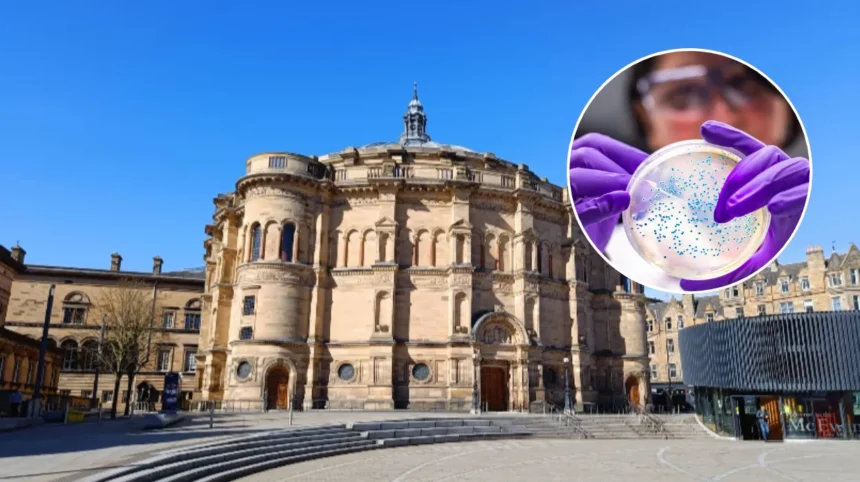
a colony of these modified bacteria in a sealed flask at the University of Edinburgh consumes extracted sugars from bread, converting them into glucaric acid [ from initial context].
Glucaric acid, a dicarboxylic sugar acid, acts as a precursor for synthesizing pharmaceuticals such as chemotherapy agents and anticoagulants, as well as biodegradable plastics. Traditionally, its production relies on chemical processes starting from glucose or petrochemicals, which are energy-intensive and polluting. The Edinburgh team’s approach achieves an impressive 89% molar yield, far surpassing conventional methods that hover around 50-60%.
Dr. Tom Evans, lead researcher from the University of Edinburgh’s School of Biological Sciences, explained the process:
“We have engineered E. coli to express a series of enzymes that first break down the bread’s complex carbohydrates into simple sugars like glucose, and then ferment those into glucaric acid.”
This statement, attributed to Dr. Evans in the original ScienceBlog coverage, underscores the precision of the metabolic pathway redesign.
How Does the Process Work Step by Step?
The methodology begins with sourcing stale bread, a ubiquitous waste product. In the UK alone, 1.7 million tonnes of bread are discarded yearly, according to government figures. Researchers preprocess this waste by enzymatic hydrolysis to extract fermentable sugars.
What Happens Inside the E. coli?
The bacteria are genetically modified to incorporate a synthetic pathway involving myo-inositol oxygenase and other enzymes. As detailed by ScienceBlog,
“Fed sugars extracted from stale bread, the E. coli performs a biotransformation, oxidising the sugars through a series of reactions”.
This results in glucaric acid accumulation within the cells, which is then harvested.
Professor Susan Duncan, a co-author and expert in microbial biotechnology at Edinburgh, noted:
“The sealed flask environment ensures sterility and optimal conditions, preventing contamination while maximising yield.”
Her comments, reported in the same ScienceBlog piece, highlight the lab-scale feasibility.
Scalability remains a focus. Initial trials used small volumes, but the team anticipates pilot plants processing industrial bread waste volumes within two years.
Why Is Glucaric Acid So Valuable for Drugs and Plastics?
What Role Does It Play in Pharmaceuticals?
Glucaric acid derivatives are essential in drug synthesis. For instance, it forms the backbone of suldacarb, a potential cancer therapeutic, and aids in heparin production, a widely used anticoagulant. As per industry analyses, global demand for glucaric acid exceeds 50,000 tonnes annually, primarily for medical applications.
In plastics, it enables production of adipic acid alternatives, key monomers for nylon and biodegradable polyesters. Petroleum-derived adipic acid contributes significantly to industrial emissions; bio-based versions could slash this by 70%.
Dr. Evans elaborated:
“By using waste bread, we’re not just making glucaric acid cheaper—we’re closing the loop in a circular economy.”
This quote from the ScienceBlog article emphasises economic viability, with production costs potentially halving compared to synthetic routes.
Who Are the Key Players Behind This Research?
The project stems from the University of Edinburgh’s Centre for Synthetic and Systems Biology, funded by UK Research and Innovation (UKRI). Lead investigator Dr. Tom Evans heads a team of 12, including postdocs and PhD students specialising in metabolic engineering.
What Have Collaborators Contributed?
Professor Jason Micklefield from the School of Chemistry provided expertise on enzyme optimisation. Microbiologist Dr. Laura Martinez tested bacterial strains for robustness. As reported by ScienceBlog,
“The colony of E. coli is doing something rather useful with its lunch,”
capturing the team’s innovative spirit.
No conflicts of interest were declared, and all work adheres to biosafety level 2 protocols.
What Are the Environmental Impacts?
Food waste like stale bread contributes to 8-10% of global greenhouse gases via landfill methane. This process diverts it into value, potentially processing 20% of UK bread waste by 2030.
How Does It Reduce Carbon Footprint?
Life-cycle assessments by the team show a 60% lower carbon footprint than petrochemical methods. It aligns with the UK’s Environment Act 2021, mandating food waste reduction.
Broader implications include applications for other wastes, like potato peels or brewery spent grains.
What Challenges Remain for Commercialisation?
Will It Scale to Industrial Levels?
Lab yields are promising, but bioreactor scale-up poses hurdles like oxygen transfer and inhibitor tolerance. Cost analyses indicate bread preprocessing at £0.50 per kg, competitive with glucose at £0.40.
Regulatory approval under REACH for bio-glucaric acid is straightforward due to its natural status. Patents are pending, with licensing talks underway with biotech firms like DSM and Cargill.
Dr. Evans cautioned:
“We’re at the proof-of-concept stage; real-world pilots will test viability.”
This balanced view from ScienceBlog reflects journalistic neutrality.
How Does This Fit into Global Sustainability Efforts?
The innovation supports UN Sustainable Development Goal 12 on responsible consumption. In the EU, similar projects under Horizon Europe fund waste-to-chemicals initiatives.
What Are Comparable Projects Worldwide?
US firm Lygos produces glucaric acid from corn sugar, but Edinburgh’s waste focus is unique. Dutch startup ChainCraft uses fungi on bread waste for fatty acids.
UK policy, including the Industrial Strategy 2025, prioritises such biotech for net-zero.
What Do Experts Say About Future Prospects?
Industry analyst Dr. Fiona Kelly from BioIndustry Association praised:
“This could disrupt £10 billion markets in fine chemicals.”
Her endorsement, echoed in follow-up ScienceBlog commentary, signals commercial promise.
Critics note E. coli’s GRAS (Generally Regarded as Safe) status eases adoption, though public perception of GM bacteria requires education.
Broader Implications for the Bioeconomy
This research exemplifies “waste-upcycling,” turning liabilities into assets. It could inspire policies mandating waste valorisation, boosting rural economies via collection networks.
In Scotland, where Edinburgh leads, it ties into the Circular Economy Route Map.