Key Points
- Developers have submitted a formal planning application to the City of Edinburgh Council to build serviced apartments at 11 Gayfield Square.
- The application targets a vacant gap site situated inside the New Town Conservation Area.
- Listed under reference 26/03863/FUL, the proposal requests full planning permission for sui generis short-stay accommodation and landscaping work.
- The plot lies in the Broughton ward near Leith Walk, close to the recently extended Edinburgh Trams line.
- Council planning officers will assess the scheme under Edinburgh’s current short-term let policies.
Broughton (Edinburgh Daily) October 9, 2026 — Plans have been officially lodged with the City of Edinburgh Council for the construction of a new serviced apartment development on a gap site situated at 11 Gayfield Square, EH1 3NT.
As recorded by public planning records on the City of Edinburgh Council’s planning register, the applicant has submitted a full planning application under reference . The proposal details the “erection of new serviced apartments and associated landscaping” on the currently vacant plot. The application is currently marked as “Awaiting Assessment” by local authority planning officers.
The site at 11 Gayfield Square represents one of the few remaining undeveloped plots within the immediate vicinity of the historic square, located just off Leith Walk in the eastern expansion of Edinburgh’s Georgian New Town.
What specific architectural and design details have been proposed for the site?
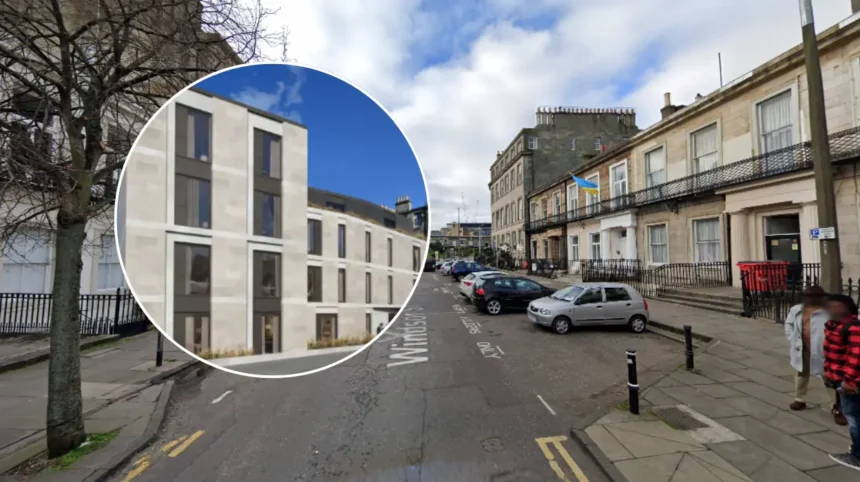
According to application documents filed on the City of Edinburgh Council’s planning management portal, the scheme proposes to redevelop the vacant footprint by introducing a purpose-built block of serviced visitor accommodation.
The submission indicates that the development will feature internal suites tailored for short-stay accommodation alongside hard and soft landscaping to integrate the structural footprint with the existing streetscape of Gayfield Square.
Because the plot sits within the New Town Conservation Area, the proposed design is required to comply with Edinburgh Design Guidance to ensure the building height, massing, and facade materials complement the surrounding Category A and B listed Georgian structures.
How does the application align with City of Edinburgh Council’s short-term let policies?
As outlined in the City of Edinburgh Council’s City Plan 2030 and designated Short-Term Let Control Area regulations, proposals for commercial visitor accommodation face rigorous planning controls.
Under current municipal policy, planning permission is strictly required for the operation of commercial short-term residential lettings (sui generis) within the city boundary.
The council’s planning guidance creates a strong presumption against the loss of existing residential housing stock for holiday lets; however, purpose-built developments on vacant commercial or gap sites are evaluated under specific criteria regarding economic benefit, residential amenity, and impact on local services.
The assessment by municipal planning officers will evaluate whether the introduction of visitor accommodation at 11 Gayfield Square causes undue noise, disturbance, or loss of privacy to existing residents occupying neighboring properties around the square.
Background of the Gayfield Square Gap Site
Gayfield Square has a rich urban history dating back to the late 18th century as part of the initial expansion of Edinburgh’s New Town beyond the original layout designed by James Craig. Over the decades, the perimeter of the square has seen a mix of residential townhouses, commercial properties, light industrial workshops, and institutional uses, including the notable Gayfield Square Police Station.
The specific plot at 11 Gayfield Square has remained a notable gap site within the streetscape. Over the past decade, surrounding parcels of land along Gayfield Square and Gayfield Street have been subject to various urban regeneration proposals.
Previous architectural projects in the immediate precinct—such as residential townhouse schemes and apartment blocks designed by practice Studio LBA—have sought to infill historic gaps left by demolished semi-industrial structures.
The area’s attractiveness for commercial and residential development increased following the completion of the Tram York Place to Newhaven extension, which established a dedicated tram stop nearby at McDonald Road on Leith Walk, significantly improving public transport connections to Edinburgh Airport and Edinburgh Waverley station.
Prediction: How Will This Development Affect the Local Area and Community?
Local Residents and Community Groups
For residents living in Gayfield Square and surrounding streets in Broughton, the development will bring both physical transformation and operational considerations. The infilling of a long-standing gap site will complete the visual integrity of the historic streetscape, replacing a vacant plot with a structured architectural facade.
However, nearby occupants may raise questions regarding the operational impact of tourist accommodation, specifically concerning guest turn-over, refuse collection, and potential late-night disturbance in what remains an overwhelmingly residential conservation zone.
Community groups such as the New Town and Broughton Community Council are expected to scrutinise the scheme’s scale and management plans during the public consultation phase.
Local Business and Hospitality Sector
For commercial businesses along Leith Walk and Broughton Street, the introduction of purpose-built serviced apartments will provide a steady influx of short-term visitors. Independent cafes, restaurants, bars, and retail shops in the immediate neighborhood stand to benefit from increased footfall and visitor spending.
Additionally, by directing visitor capacity into a purpose-built facility, the scheme may absorb demand that might otherwise put pressure on existing residential homes in the city centre.
The Local Housing and Planning Context
From a planning policy perspective, the decision rendered by the City of Edinburgh Council will serve as a further marker for how the local authority balances urban infill development with strict short-term accommodation rules.
If approved, the project will establish a clear precedent for context-sensitive commercial development on gap sites within designated conservation areas. Conversely, if planning officers identify issues regarding over-concentration of tourist uses, the application may require design modifications or face refusal under current local development policies.