Key Points
- Police Scotland made no arrests during a Saturday protest outside the US Consulate in Edinburgh.
- Demonstrators carried signs stating “I oppose genocide, I support Palestine Action,” despite the organization’s status as a proscribed group under anti-terror laws.
- Police officers gathered video footage and evidence at the scene and are reviewing it for potential retrospective enforcement.
- The rally took place alongside similar demonstrations in London, where police detained dozens of people ahead of a Supreme Court hearing on the group’s ban.
Edinburgh (Edinburgh Daily) October 31, 2026 – Activists staged a demonstration in support of Palestine Action outside the United States Consulate in the Scottish capital, with law enforcement reporting zero on-site detentions.
Why Were No Arrests Made During the Edinburgh Palestine Action Demonstration?
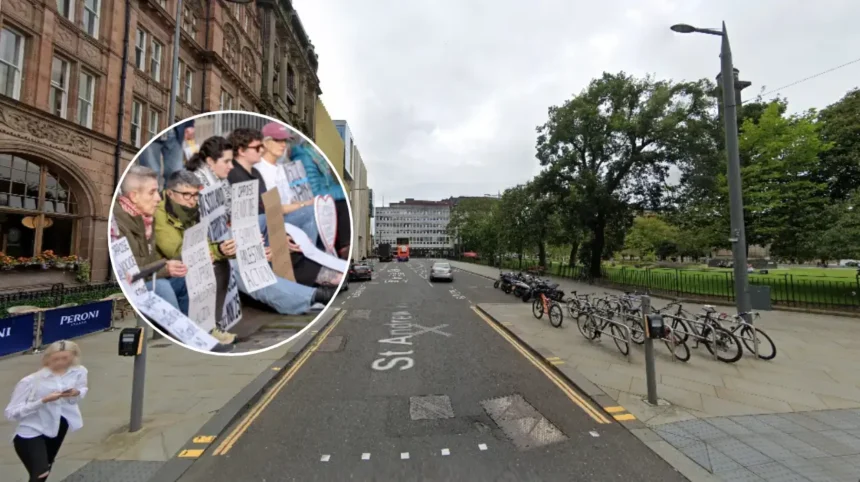
Dozens of campaigners gathered on Saturday outside the US Consulate General on Regent Terrace in Edinburgh to express solidarity with the direct-action organization Palestine Action. Demonstrators held printed signs displaying the slogan, “I oppose genocide, I support Palestine Action,” challenging the official proscription of the network under British anti-terrorism statutes.
Police officers maintained a presence throughout the rally to monitor attendees and keep order. Unlike parallel events across the UK, Police Scotland officers did not move to detain individuals on the scene.
A spokesperson for Police Scotland stated:
“No arrests were made at the time, however enquiries are ongoing to identify people seen wearing T-shirts and holding banners showing support for a proscribed organisation. Evidence is being reviewed and further action will be taken as appropriate.”
The event was organised days prior to high-stakes legal proceedings regarding the legal standing of the organization.
As reported by Lucy Jackson of The National, activists gathered outside the building without operational interference from law enforcement during the course of the demonstration.
How Did the Edinburgh Protest Differ From Events in London?
While the Scottish demonstration concluded without detentions, simultaneous protests held outside the United States Embassy in London resulted in widespread police action. Metropolitan Police officers detained nearly 50 individuals after declaring that attendees were assembled to commit offenses under counter-terrorism provisions.
Participants at the London gathering voiced frustration over the criminalisation of peace and anti-war advocacy.
As reported by Sammy Gecsoyler of The Guardian, demonstrator Sue Morhall, 79, stated:
“It’s a terrible shame that people who are trying to stop a genocide are being arrested.”
In contrast, Scottish authorities opted for retrospective evidence review rather than immediate public order detentions.
Background of the Particular Development
The legal landscape surrounding Palestine Action shifted when the UK Government formally proscribed the direct-action campaign group as a terrorist organisation under the Terrorism Act.
The ban made expressing public support for, or maintaining membership in, Palestine Action a criminal act carrying maximum penalties of up to 14 years in prison.
The decision triggered widespread legal challenges led by Palestine Action co-founder Huda Ammori, who argued that the proscription represented a disproportionate infringement on basic human rights and civil liberties.
Although three High Court judges initially ruled the proscription unlawful in early 2026, the Court of Appeal subsequently overturned that judgment, upholding the government’s ban.
The case has reached the UK Supreme Court, which is scheduled to conduct a crucial two-day hearing to deliver a final judgment on the legality of the proscription.
Prediction: How Will This Development Affect Public Campaigners and Law Enforcement Strategy?
The divergence in police tactics between Police Scotland and the Metropolitan Police highlights an evolving operational dilemma for UK law enforcement and civil liberties advocates.
For public campaigners and civil rights advocacy groups, the retrospective review model adopted in Scotland may create prolonged legal uncertainty.
Activists participating in future gatherings may avoid immediate arrest at protest sites, only to face later investigations, summonses, or charges once video footage and photographic evidence are formally processed by the Procurator Fiscal.
For law enforcement agencies, retrospective identification offers a method to manage public safety during demonstrations while avoiding potential physical escalations in real time.
However, should the Supreme Court uphold the proscription of Palestine Action, both police forces and protest organizers across Scotland and the wider UK will face stricter statutory enforcement frameworks, likely narrowing the operational boundaries for public anti-war demonstrations.