Key Points
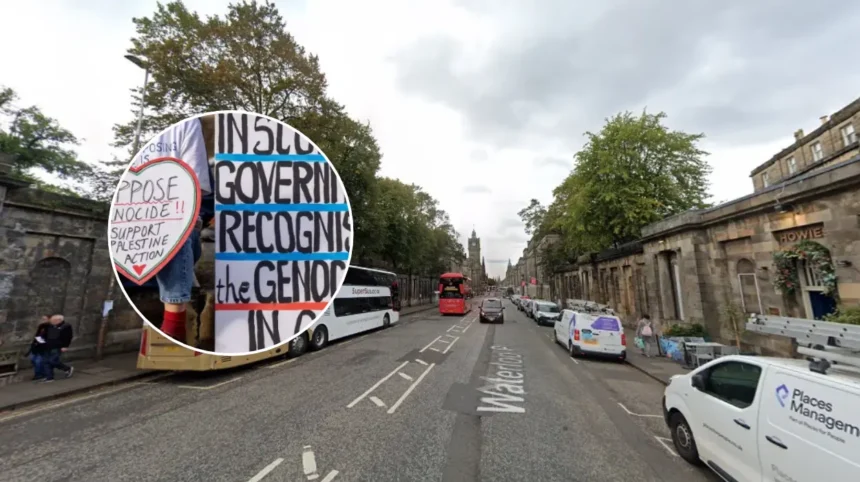
- Police Scotland are working to identify demonstrators who wore T-shirts and held banners supporting Palestine Action at a protest in Edinburgh.
- No arrests were made during the demonstration, which took place near the US Consulate.
- Publicly expressing support for a proscribed organisation became an offence under the Terrorism Act after the group was banned in June 2025.
- Activist group Defend Our Juries Scotland organised the rally alongside parallel protests in London.
- The Supreme Court is scheduled to hear an appeal regarding the group’s proscription on 4 November.
Edinburgh (Edinburgh Daily) October 31, 2026 — Police Scotland have commenced formal enquiries to identify demonstrators who attended a rally in the nation’s capital wearing T-shirts and carrying banners in support of the proscribed organisation Palestine Action.
The public gathering took place near the United States Consulate close to Holyrood, drawing activists demonstrating against the official proscription of the group.
Although law enforcement confirmed that no arrests were made on-site during the demonstration, video footage and photographic material gathered by officers are currently under detailed review.
As reported by political reporter Jacob Farr of the Daily Record, a spokesperson for Police Scotland stated that “enquiries are ongoing to identify people seen wearing t-shirts and holding banners showing support for a proscribed organisation”.
The police representative further emphasised that “evidence is being reviewed and further action will be taken as appropriate”.
Under current anti-terrorism statutes, wearing garments, displaying emblems, or carrying items that indicate explicit support for a proscribed entity remains an offense punishable by law.
Why did activists gather outside the US Consulate in Edinburgh?
The Edinburgh demonstration was formally coordinated by the activist collective Defend Our Juries Scotland.
Participants assembled for what organizers described as a peaceful vigil aimed at displaying solidarity with Palestinians and voicing opposition to the UK government’s prohibition of Palestine Action.
As reported by legal affairs correspondent Jonathan Brady of the Press Association, a spokesperson for Defend Our Juries Scotland stated that activists were sitting in “peaceful vigil today to show our solidarity with the Palestinian people” and in direct opposition to the “absurd ban” placed upon Palestine Action.
Organisers emphasized their intent to persist with public demonstrations despite current legislative restrictions.
“We will continue to defy this ban, and we will not be silenced,” stated the spokesperson for Defend Our Juries Scotland. “Whilst legal proceedings in Scotland have been delayed pending the hearings in the Supreme Court of England and Wales this coming week, we will continue to mount pressure from all angles. The ban must be lifted, and our Government must take meaningful action to end its complicity in genocide.”
Similar public assemblies were conducted concurrently in London, including gatherings outside the United States Embassy in Nine Elms.
What is the legal status of Palestine Action under UK law?
Palestine Action was officially designated as a proscribed terror organisation in June 2025 by the UK Home Office.
The legal ban was introduced under former Home Secretary Yvette Cooper, following sustained direct-action campaigns by the activist group against defence manufacturing facilities.
A legal challenge brought by Palestine Action co-founder Huda Ammori initially led to a High Court ruling in February that deemed the proscription decision unlawful.
However, that verdict was subsequently overturned in June by five judges at the Court of Appeal, who concluded that banning Palestine Action was a justified and proportionate measure.
Official Home Office data indicates that approximately 92 percent of all terrorism-related arrests recorded across the UK between March 31, 2025, and March 31, 2026, were directly connected to Palestine Action activity.
Furthermore, the United States government aligned its official stance with the UK by imposing international sanctions against Palestine Action and classifying it as a terror group.
Background of the particular development
The proscription of Palestine Action represents one of the most controversial legal developments surrounding public protest and anti-terrorism legislation in recent United Kingdom history.
Originally established as a direct-action network targeting British factories and offices associated with international defence contractors, the group’s tactics frequently involved blockades, property damage, and occupations of corporate premises.
The Home Office’s decision in June 2025 to proscribe the movement under the Terrorism Act 2000 elevated participation, fundraising, and public displays of support for the group to serious criminal offenses.
The legal battle over the ban has caused significant judicial debate regarding the boundary between civil disobedience and domestic terrorism.
While three High Court judges initially agreed that proscribing the group infringed disproportionately on democratic protest rights, the Court of Appeal reinstated the ban, citing public security concerns and the severity of non-violent property disruption.
The upcoming hearing before the Supreme Court on November 4 serves as the final judicial review on whether the executive branch exceeded its authority in designating the protest network as a terrorist organization.
Prediction: How this development can affect activist groups and public demonstrators
The ongoing police investigation in Edinburgh and the impending Supreme Court judgment are expected to have immediate repercussions for grassroots activists, human rights campaigners, and public demonstrators across Scotland and the wider UK.
Should Police Scotland proceed with retrospective arrests and criminal charges against individuals wearing T-shirts or carrying banners, it will reinforce a legal precedent where expressing symbolic support for banned direct-action groups carries severe penal consequences.
This outcome may create a chilling effect among broader civil society organizations, deterring casual supporters from attending public vigils or engaging in solidarity protests due to the risk of acquiring terrorism-related criminal records.
Conversely, if the Supreme Court rules in favour of the appellants on November 4, the legal foundation for police interventions regarding Palestine Action symbols would be dismantled, potentially triggering retrospective reviews of charges brought against protesters.
Until the judiciary delivers its definitive ruling, law enforcement agencies are anticipated to maintain a strict zero-tolerance approach toward public displays of support for proscribed entities.