The term Athens of the North originated during the eighteenth century Scottish Enlightenment when global scholars recognized Edinburgh as a major intellectual hub, drawing explicit parallels to classical ancient Athens through shared philosophy, topographical landforms, and Neoclassical public architecture.
- How did the Scottish Enlightenment transform Edinburgh into an intellectual center?
- Why did Neoclassical architecture dominate the urban development of Edinburgh?
- How does the topography of Edinburgh compare directly to ancient Athens?
- What key monuments in Edinburgh explicitly copy classical Greek structures?
- Who were the primary historical figures behind the Athenian transformation of Edinburgh?
- How did publishing and education sustain the reputation of the city?
- What role did the Scottish diaspora play in exporting this classical identity?
- How does the Athenian legacy impact modern Edinburgh today?
The moniker emerged during a period of massive intellectual growth in Scotland. In 1762, the writer Tobias Smollett noted the geographical and cultural comparisons between the two capitals. Scholars in 1780 routinely referenced the intellectual density of the University of Edinburgh alongside classical Greek academies.
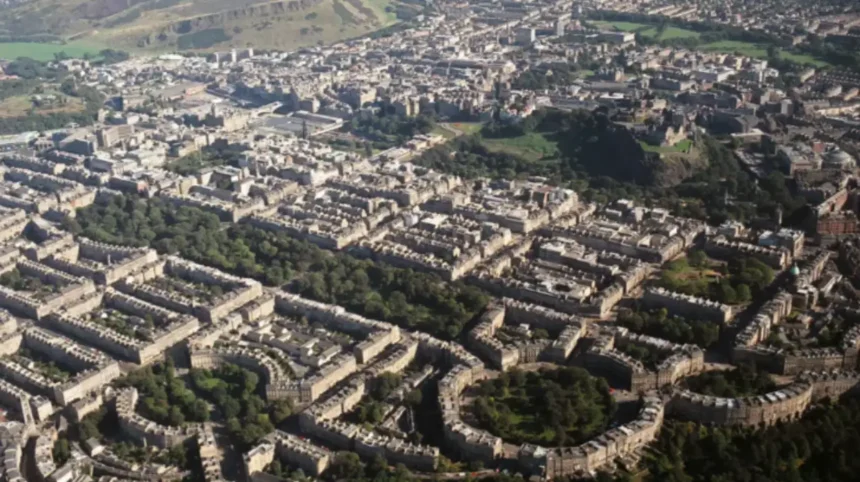
The natural topography of the Scottish capital closely resembled the landscape of Attica in Greece. Both cities possessed a prominent central castle rock rising above surrounding fertile plains near a coastal port. Edinburgh featured Castle Rock and Calton Hill, which mirrored the Acropolis and Lycabettus Hill in Greece.
Philosophers across Europe embraced the title as Scottish thinkers reshaped modern human knowledge. By 1820, the intellectual reputation was solidified across major European academic circles and publishing houses.
The term represented a deliberate urban branding movement led by elite civic planners and civic leaders. The Scottish Enlightenment transformed the city into an intellectual engine equal to ancient literary centers. The comparison highlighted rapid advancements in political economy, medicine, chemistry, and moral philosophy across Scotland.
How did the Scottish Enlightenment transform Edinburgh into an intellectual center?
The Scottish Enlightenment transformed Edinburgh by establishing world class university faculties, professional societies, and publishing houses that produced revolutionary ideas in philosophy, economics, chemistry, and geology, directly competing with ancient academic centers in rigorous intellectual output.
During the eighteenth century, the University of Edinburgh became a premier academic center in Western Europe. Intellectual leaders such as David Hume, Adam Smith, William Robertson, and Adam Ferguson established foundational principles of modern social science.
In 1707, the Act of Union shifted political power to London, prompting local elites to focus on cultural dominance. The city established influential institutions including the Royal Society of Edinburgh in 1783 to foster advanced scientific research.
Literary journals such as the Edinburgh Review distributed critical essays to an international reading audience. Medical training at the Royal College of Physicians set global benchmarks for clinical research and anatomical study.
Scholars met regularly in professional societies like the Select Society and the Poker Club to debate governance. The rapid concentration of published treatises earned the city an international reputation for academic rigor. These developments established an intellectual infrastructure that paralleled classical Athenian schools of philosophy.
Why did Neoclassical architecture dominate the urban development of Edinburgh?
Neoclassical architecture dominated Edinburgh urban development because civic architects systematically adopted Greek Revival designs to physically manifest the intellectual values of the Enlightenment through monumental stone buildings across the newly planned Georgian New Town.
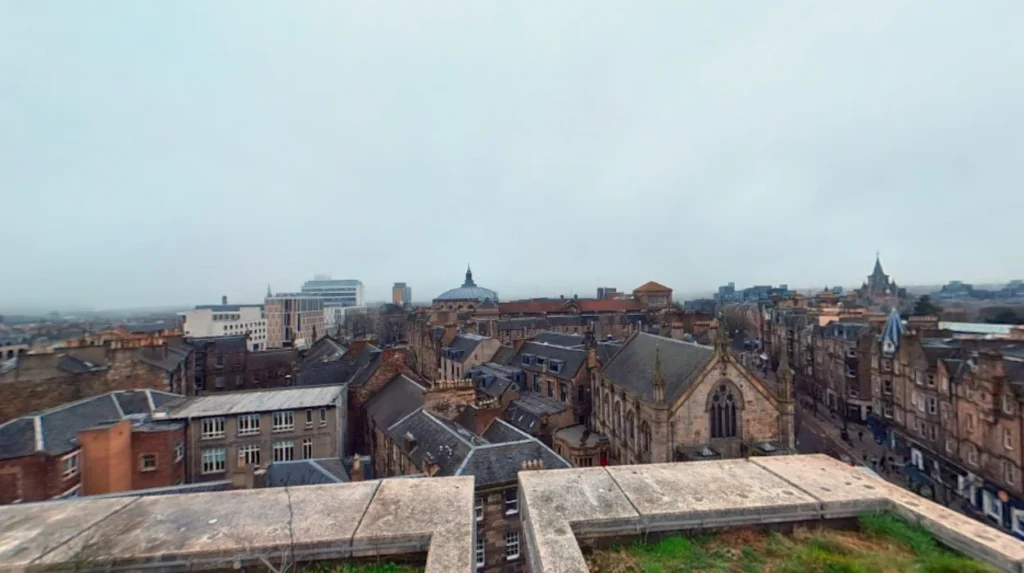
In 1766, architect James Craig won the design competition for the initial master plan of the New Town. Architects William Henry Playfair, Thomas Hamilton, and Robert Smirke deliberately selected Classical Greek orders for major public structures. The Royal High School on Calton Hill, built in 1826, directly copied the Temple of Hephaestus in Athens. The National Monument of Scotland, commissioned in 1826, was modeled after the Parthenon on the Athenian Acropolis.
The building materials utilized local Craigleith sandstone, providing a uniform, pale, stone aesthetic across new streets. Monumental columns, triangular pediments, and symmetrical facades transformed public spaces into classical vistas.
Buildings like the Royal Scottish Academy and the National Gallery of Scotland reinforced classical visual harmony. The architectural shift rejected traditional medieval tenement design in favor of open, ordered urban spaces. This physical transformation permanently aligned the visual landscape of Scotland with classical antiquity.
How does the topography of Edinburgh compare directly to ancient Athens?
The topography of Edinburgh mirrors ancient Athens through volcanic ridges, elevated central hills, and proximity to major maritime ports, creating distinct physical landforms that naturally evoke the geographical structure of classical Greek city states.
The physical landscape of Edinburgh features extinct volcanic formations sculpted by glacial erosion over millions of years. Castle Rock rises 130 meters above the surrounding terrain, serving the same defensive purpose as the Athenian Acropolis. Calton Hill forms a second elevated plateau that mirrors the position of Lycabettus Hill in Greece. Arthur’s Seat provides a dramatic mountainous backdrop similar to Mount Hymettus framing the Athenian plain.
The Firth of Forth located three miles north acts as a maritime connection equivalent to the Aegean Sea port of Piraeus. The historic port district of Leith served the same trade functions as Piraeus for classical goods and travel. The surrounding valleys, including the former Nor Loch basin, mirrored the low-lying plains of the Attic peninsula.
This topographical layout allowed architects to place Neoclassical monuments along high ridges visible from great distances. Visitors in the nineteenth century frequently remarked on these natural landscape similarities upon arrival.
What key monuments in Edinburgh explicitly copy classical Greek structures?
Key monuments in Edinburgh explicitly copy classical Greek structures by replicating famous buildings from Athens, including the Parthenon, the Choragic Monument of Lysicrates, and the Temple of Hephaestus, using precise Greek Revival architectural measurements.
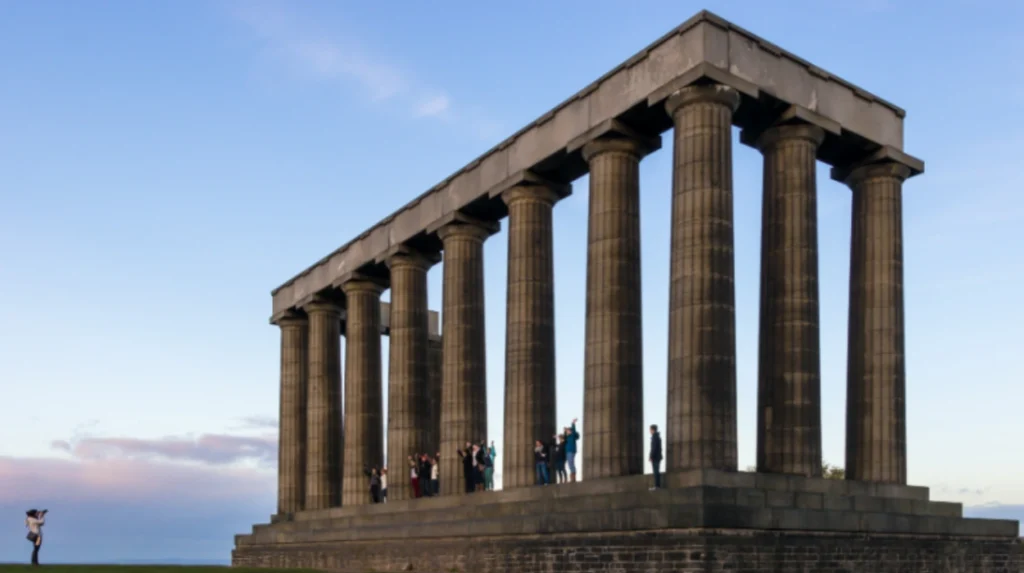
The National Monument of Scotland on Calton Hill represents the most direct attempt to duplicate the Athenian Parthenon. Designed by William Henry Playfair and Charles Robert Cockerell in 1822, construction halted in 1829 due to lack of funds. The twelve standing Doric columns reproduce the dimensions of the original Parthenon pillars in Greece. The Dugald Stewart Monument, constructed in 1831, copies the circular Choragic Monument of Lysicrates in Athens.
The Burns Monument near Calton Hill also utilizes the Choragic Lysicrates design with Corinthian columns and decorative stone carvings. The Royal High School, completed in 1829 by Thomas Hamilton, utilizes pure Doric porticos modeled after the Temple of Hephaestus.
The Royal Scottish Academy building on Princes Street incorporates hexastyle Doric porticos based on classical Greek templates. These structures were commissioned to create an explicit visual tribute to classical Greek civilization. Each building utilized detailed architectural drawings brought back from British excavations in Greece.
Who were the primary historical figures behind the Athenian transformation of Edinburgh?
The primary historical figures behind the Athenian transformation were Scottish Enlightenment philosophers, civic leaders, and Neoclassical architects who intentionally elevated the academic prestige and architectural landscape of the city during the eighteenth and nineteenth centuries.
Philosopher David Hume established early empirical philosophy, challenging traditional medieval scholasticism through published texts between 1739 and 1776. Economist Adam Smith published The Wealth of Nations in 1776, establishing modern economic theory from his base in Edinburgh.
Architect William Henry Playfair designed major public monuments, university buildings, and museum structures in the Greek Revival style. Architect Thomas Hamilton designed landmark Neoclassical buildings including the Royal High School and the Physicians Hall.
Lord Provost George Drummond initiated the construction of the New Town in 1767 to modernize living conditions. Painter Allan Ramsay founded the Select Society in 1754 to gather prominent thinkers for structured intellectual debate. Publisher William Blackwood established Blackwood’s Magazine in 1817, spreading Enlightenment critiques throughout the British Empire.
Geologist James Hutton discovered fundamental principles of deep geological time while researching near Arthur’s Seat. Together, these figures laid the academic, cultural, and physical foundation for the city’s classical moniker.
How did publishing and education sustain the reputation of the city?
Publishing and education sustained the city reputation by producing globally distributed encyclopedias, influential academic journals, and world renowned university medical faculties that continuously exported Scottish Enlightenment thought across the globe.
The University of Edinburgh created specialized academic chairs in rhetoric, natural history, chemistry, and medicine throughout the eighteenth century. In 1768, printmakers Colin Macfarquhar and Andrew Bell published the first edition of the Encyclopædia Britannica in Edinburgh.
The publishing firm Archibald Constable and Company expanded the distribution of major scientific treatises during the early nineteenth century. The Edinburgh Medical Journal circulated breakthroughs in surgical procedures and pharmacology to international practitioners.
Printing houses operated along the Royal Mile, making the city a global center for bookselling and typography. The university attracted thousands of international students, including young scholars from the American colonies and continental Europe.
Literary figures like Sir Walter Scott popularized Scottish historical narratives through mass produced novels printed locally. The high literacy rate across Scotland provided a strong domestic market for academic books and newspapers. This massive literary output secured the status of the city as a northern capital of human knowledge.
What role did the Scottish diaspora play in exporting this classical identity?
The Scottish diaspora exported this classical identity by establishing universities, legal systems, government institutions, and scientific societies modeled directly after Edinburgh structures across North America, Australia, and the British Empire.
Emigrants educated in Scotland established higher education institutions across the Atlantic during the eighteenth and nineteenth centuries. Princeton University, originally the College of New Jersey, was shaped by Edinburgh graduate John Witherspoon in 1768.
Scottish educators brought rigorous medical, legal, and philosophical curricula to universities in Canada, Australia, and New Zealand. Engineers trained in Scottish technical academies designed global infrastructure projects using precise Enlightenment principles.
Diplomats and colonial administrators applied Scottish legal frameworks and economic theories across British territories. Scottish medical professionals established early public health agencies and hospital systems across foreign settlements.
International alumni networks maintained active communication channels with academic societies based in the Scottish capital. This continuous movement of educated citizens spread the reputation of the city as a primary source of modern knowledge. Consequently, international institutions explicitly referenced Edinburgh when founding new academic centers worldwide.
How does the Athenian legacy impact modern Edinburgh today?
The Athenian legacy impacts modern Edinburgh today by preserving its UNESCO World Heritage urban sites, driving international cultural tourism, supporting world class arts festivals, and maintaining its identity as a global university center.
In 1995, UNESCO designated the Old and New Towns of Edinburgh as a protected World Heritage Site. The designation explicitly cites the dual medieval and Neoclassical architectural layouts as an urban achievement of global significance.
The annual Edinburgh Festival Fringe and Edinburgh International Festival draw millions of visitors, continuing the tradition of creative exchange. The University of Edinburgh remains ranked among the top global academic research institutions.
Conservation bodies strictly regulate modern property development to preserve historic classical street views and Craigleith sandstone facades. Calton Hill remains a major public park and cultural landmark visited by tourists from across the world.
The preserved Georgian streets of the New Town command some of the highest residential real estate values in Scotland. The civic identity of the city continues to draw directly from its Enlightenment achievements and classical design choices. This historic legacy ensures the city retains its cultural prominence on the international stage.
Why is the National Monument on Calton Hill unfinished?
Construction of the National Monument stopped in 1829 because the building committee ran out of public subscriptions and construction funds. The project was meant to replicate the Athenian Parthenon as a memorial for Scottish soldiers lost in the Napoleonic Wars. Only twelve Doric columns were built, earning it the local nickname of Edinburgh’s Disgrace.
Did ancient Greeks ever settle in Scotland?
No ancient Greeks ever settled in Scotland or built monuments in Edinburgh. The Neoclassical architecture across the city was designed exclusively by nineteenth-century Scottish architects during the Greek Revival movement. The classical name comes entirely from geographical similarities, intellectual advancements, and intentional architectural copying.
What is the difference between the Old Town and the New Town?
The Old Town features a dense medieval street layout built along a volcanic ridge leading down from Edinburgh Castle. The New Town was built between 1767 and 1850 using a grid plan lined with Georgian Neoclassical architecture. Together, both contrasting urban layouts form a unified UNESCO World Heritage site.
Is Edinburgh the only city called the Athens of the North?
Several northern European cities have claimed the nickname over time, including Lexington in Kentucky and Vilnius in Lithuania. However, Edinburgh holds the strongest historic claim due to its combination of Greek Revival architecture, Enlightenment philosophy, and natural volcanic topography. It remains the most widely recognized city associated with the title.
Where can you see the best Neoclassical architecture in Edinburgh?
The best Neoclassical architecture is located on Calton Hill, Waterloo Place, and throughout the Georgian New Town streets. Notable individual structures include the Royal High School, the Royal Scottish Academy, and the National Gallery of Scotland on Princes Street. Walking along Charlotte Square provides complete views of preserved Georgian townhouses.