

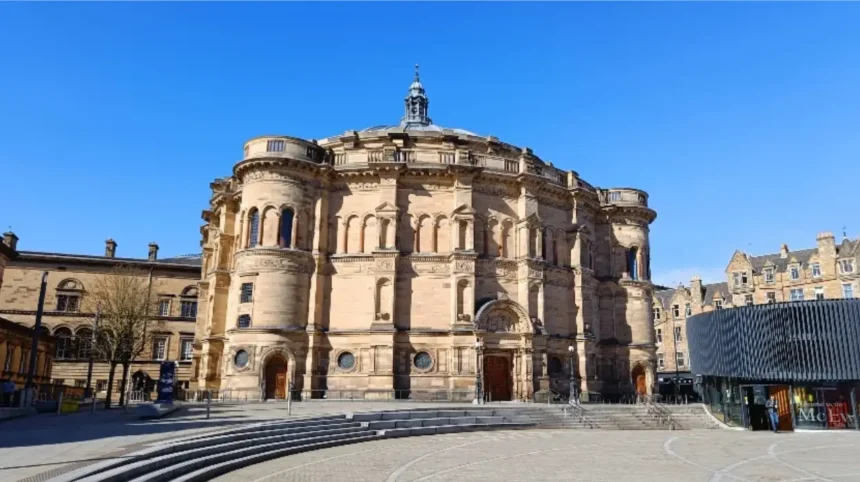
Education in medieval Edinburgh began in 1128 when King David I founded Holyrood Abbey, establishing monastic schools that taught Latin grammar, theology, and basic literacy to clergy and noble boys alongside early parish song schools across the Scottish capital.
- Why Was the University of Edinburgh Founded in 1582?
- How Did the Scottish Enlightenment Shape Edinburgh’s Academic Reputation?
- What Role Did Women Play in the History of Edinburgh Universities?
- How Did Technical and Modern Universities Develop in Edinburgh?
- What Was the Impact of the Education (Scotland) Act 1872 on Edinburgh Schools?
- What Is the Structure and Global Impact of Higher Education in Edinburgh Today?
Monastic institutions controlled formal learning in Edinburgh during the twelfth century. Augustinian canons at Holyrood Abbey operated a structured school that trained future church administrators and royal clerks. The Burgh School of Edinburgh, later renamed the Royal High School, emerged around 1128 under royal patronage.
Early curricula focused strictly on the medieval trivium, comprising grammar, logic, and rhetoric, alongside sacred music. Teachers instructed students exclusively in Latin, which served as the universal language of European scholarship and diplomacy.
The Scottish Parliament passed the Education Act of 1496 to expand literacy among the landed gentry. King James IV mandated that barons and freeholders send their eldest sons to grammar schools from age eight or nine. These young men studied Latin until they acquired competency, after which they spent three years studying arts and law. This statute created a secular demand for higher learning in Edinburgh, shifting educational control away from purely ecclesiastical monopolies.
By the early sixteenth century, Edinburgh maintained multiple educational tiers, including song schools, grammar schools, and private dame schools. Merchants and burgesses funded local schoolmasters through the Town Council to ensure their sons understood accounting and legal documentation.
Records from 1519 show the Town Council asserting direct authority over teacher appointments and school fees. This municipal involvement laid the administrative foundation for Scotland’s first civic university later in the same century.
Why Was the University of Edinburgh Founded in 1582?
The University of Edinburgh was founded in 1582 by King James VI through a Royal Charter, making it Scotland’s fourth university and the first civic institution established by a town council rather than a papal bull.
Following the Scottish Reformation of 1560, Protestant reformers sought to establish a university in the capital to train Presbyterian ministers and civil servants. Bishop Robert Reid of Orkney bequeathed 8,000 merks in 1558 specifically to fund a college in Edinburgh. The Town Council battled legal delays from the three older Scottish universities, St Andrews, Glasgow, and Aberdeen, which opposed a rival institution. On 14 April 1582, King James VI granted the Royal Charter empowering the Town Council to build and govern the college.
Classes commenced in October 1583 under the leadership of Robert Rollock, a scholar recruited from St Andrews University. Rollock served as the sole regent, teaching the entire four-year arts curriculum to the inaugural cohort of eighty students.
The institution opened inside modest buildings on the site of the former Kirk o’ Field church. Unlike older European universities governed by church hierarchies, the Tounis College operated under direct municipal supervision until the Universities (Scotland) Act 1858.
Enrollment expanded rapidly during the seventeenth century, requiring the appointment of additional regents and specialized professors. In 1620, the Town Council established a dedicated chair of divinity, followed by chairs in humanity and mathematics.
By 1685, the university supported a principal, a professor of divinity, four regents of philosophy, and one regent of humanity. This civic governance model allowed Edinburgh to adapt its curriculum quickly to emerging scientific and commercial demands.
How Did the Scottish Enlightenment Shape Edinburgh’s Academic Reputation?

During the eighteenth-century Scottish Enlightenment, Edinburgh’s universities became global centers of philosophy, economics, and medicine, attracting thinkers like David Hume and Adam Smith while earning the city its famous title as the Athens of the North.
In 1708, Principal William Carstares abolished the regenting system at the University of Edinburgh, introducing specialized professorships modeled on Dutch universities like Leiden.
Faculty members now taught single disciplines rather than guiding one cohort through every subject. This structural reform elevated academic standards and attracted prominent scholars across Europe. Enrollment surged from roughly 400 students in 1700 to over 1,000 by the end of the century.
The Faculty of Medicine, formally organized in 1726 by Alexander Monro primus, transformed Edinburgh into the premier medical training hub in the English-speaking world. Monro and his colleagues integrated clinical instruction at the newly established Royal Infirmary of Edinburgh in 1729.
Between 1765 and 1825, more than 10,000 students attended medical lectures in Edinburgh, including Benjamin Rush, who later founded the first American medical school in Philadelphia.
Intellectual societies operated alongside formal university lectures to accelerate scientific and philosophical discovery. Organizations such as the Select Society, founded in 1754, and the Royal Society of Edinburgh, chartered in 1783, united university professors with lawyers, clergy, and landowners.
Key figures including chemist Joseph Black, geologist James Hutton, and philosopher Dugald Stewart published foundational texts that reshaped modern science and moral philosophy.
What Role Did Women Play in the History of Edinburgh Universities?
Women fought a landmark legal and public campaign in Edinburgh starting in 1869, led by Sophia Jex-Blake and the Edinburgh Seven, which eventually secured women the right to graduate from Scottish universities in 1892.
In March 1869, Sophia Jex-Blake applied to study medicine at the University of Edinburgh, becoming the first woman to seek admission to a British university. The University Court initially rejected her application, arguing that administrative arrangements could not be made for a single woman.
Jex-Blake recruited six additional women—Isabel Thorne, Edith Pechey, Matilda Chaplin, Helen Evans, Mary Anderson, and Emily Bovell—forming the group known as the Edinburgh Seven.
The University of Edinburgh matriculated the Edinburgh Seven in October 1869, making it the first British university to admit women. However, male medical students and conservative faculty members fiercely resisted their presence.
On 18 November 1870, a violent mob blocked the women from entering Surgeons’ Hall for an anatomy examination, an event documented globally as the Surgeons’ Hall Riot. In 1873, the Court of Session ruled that the university had acted illegally in admitting women and barred them from graduating.
Public outrage over the court ruling prompted Parliament to pass the UK Medical Act 1876, enabling medical licensing bodies to examine candidates regardless of gender. Jex-Blake returned to Edinburgh and founded the Edinburgh School of Medicine for Women in 1886. Following the Universities (Scotland) Act 1889, Scottish universities formally admitted women on equal terms in 1892, with the first eight female graduates receiving degrees in 1893.
How Did Technical and Modern Universities Develop in Edinburgh?

Technical and modern universities in Edinburgh developed from nineteenth-century vocational institutes, notably the School of Arts of Edinburgh founded in 1821, which evolved into Heriot-Watt University, alongside Edinburgh Napier University and Queen Margaret University.
Industrialization created an urgent need for technical training among Edinburgh’s working artisans and engineers. In October 1821, merchant Leonard Horner founded the School of Arts of Edinburgh, the world’s first mechanics’ institute, to teach chemistry, mechanics, and mathematics in evening classes.
In 1852, the institution renamed itself the Watt Institution and School of Arts to honor Scottish inventor James Watt. Following a merger with George Heriot’s Trust in 1885, it became Heriot-Watt College and received its Royal Charter as Heriot-Watt University in 1966.
Queen Margaret University originated in 1875 as the Edinburgh School of Cookery and Domestic Economy, founded by Christian Guthrie Wright and Louisa Stevenson. The founders aimed to improve women’s access to higher education and elevate public health standards through scientific nutrition training.
The college relocated to Corstorphine in 1970, gained university college status in 1999, and achieved full university title as Queen Margaret University in 2007 before moving to its modern Musselburgh campus in 2008.
Edinburgh Napier University began as Napier Technical College in 1964, named after sixteenth-century Edinburgh mathematician John Napier, the inventor of logarithms. The college expanded rapidly by merging with local nursing, midwifery, and commerce institutions during the 1980s.
Under the Further and Higher Education (Scotland) Act 1992, the institution gained university status as Napier University, adopting its current name, Edinburgh Napier University, in 2009.
What Was the Impact of the Education (Scotland) Act 1872 on Edinburgh Schools?
The Education (Scotland) Act 1872 transferred school governance from churches to elected local school boards, establishing mandatory elementary education for all Edinburgh children aged five to thirteen and expanding literacy across working-class neighborhoods.
Before 1872, parish churches, charitable trusts, and private academies managed primary education in Edinburgh unevenly. Wealthy families enrolled sons at the Edinburgh Academy, founded in 1824, or Fettes College, opened in 1870, while impoverished children relied on ragged schools established by social reformer Thomas Guthrie in 1847.
Rapid urban population growth overwhelmed these voluntary schools, leaving thousands of working-class children without basic literacy instruction.
The 1872 Act created the Edinburgh School Board, empowering locally elected officials to levy taxes, construct new school buildings, and enforce attendance. Between 1873 and 1900, the board built more than twenty large stone board schools across Edinburgh, including Causewayside, Stockbridge, and Bruntsfield.
These buildings featured segregated entrances for boys and girls, large classrooms accommodating up to sixty pupils, and standardized curricula.
Secondary education expanded significantly following the Education (Scotland) Act 1918, which abolished secondary school fees and integrated Catholic schools into the state system. The school leaving age rose to fourteen in 1918, fifteen in 1947, and sixteen in 1972. Today, the City of Edinburgh Council oversees over 100 primary, secondary, and special schools serving more than 53,000 pupils across the capital.
What Is the Structure and Global Impact of Higher Education in Edinburgh Today?
Higher education in Edinburgh today comprises four major universities—the University of Edinburgh, Heriot-Watt University, Edinburgh Napier University, and Queen Margaret University—educating over 65,000 students from 180 countries and contributing billions of pounds annually to the Scottish economy.
Edinburgh maintains one of the highest concentrations of university students per capita in the United Kingdom. Students represent more than twelve percent of the city’s total population of approximately 525,000 residents. Each of the four institutions occupies a distinct academic and research niche, supported by international campuses in Dubai, Malaysia, and China.
Research output from Edinburgh’s universities drives regional innovation in artificial intelligence, renewable energy, and life sciences. The University of Edinburgh established Europe’s first Department of Artificial Intelligence in 1965 and currently houses the Bayes Centre for data science. In 1996, researchers at the university’s Roslin Institute cloned Dolly the sheep, marking the first mammal cloned from an adult somatic cell.
International partnerships and post-study work opportunities sustain Edinburgh’s global educational appeal.
According to Higher Education Statistics Agency (HESA) data, over 25,000 international students study across Edinburgh’s four universities each academic year. Economic impact assessments indicate that higher education institutions generate over £3 billion annually for the Edinburgh and South East Scotland city region while supporting more than 30,000 local jobs.
Why is Edinburgh called the Athens of the North?
Edinburgh earned the title Athens of the North during the eighteenth-century Scottish Enlightenment due to its concentration of influential philosophers, scientists, and writers, including David Hume and Adam Smith. The city’s neoclassical architecture on Calton Hill also mirrored ancient Greek temples, reinforcing its reputation as a center of democratic learning and intellect.
What is the oldest university in Edinburgh?
The University of Edinburgh is the oldest university in Edinburgh, established in 1582 by a Royal Charter from King James VI. It is the sixth-oldest university in the English-speaking world and the first civic university founded by a town council rather than the Catholic Church.
How many universities are there in Edinburgh?
Edinburgh has four universities: the University of Edinburgh, Heriot-Watt University, Edinburgh Napier University, and Queen Margaret University. Together, these institutions enroll over 65,000 students annually across campuses in central Edinburgh, Riccarton, Sighthill, Craiglockhart, and neighboring Musselburgh.
Who were the Edinburgh Seven and why are they famous?
The Edinburgh Seven were the first group of matriculated undergraduate female students at any British university, enrolling to study medicine at the University of Edinburgh in 1869. Led by Sophia Jex-Blake, their legal battles and survival of the 1870 Surgeons’ Hall Riot paved the way for legislation granting women equal access to medical degrees in the United Kingdom.
Is the University of Edinburgh public or private?
The University of Edinburgh is a public research university funded primarily through government grants, research councils, and student tuition fees. Like all Scottish universities, it operates as an autonomous charitable body governed by its University Court rather than a for-profit private corporation.


