The Edinburgh Festival Fringe is the world’s largest arts festival, taking place every August in Scotland’s capital city. Operating on an open-access policy, it allows any performer with a venue to stage a show without a selection committee.
- When should visitors book tickets and accommodation for the Edinburgh Fringe?
- How do audiences navigate geography, transportation, and venue hubs in Edinburgh?
- What strategies optimize show selection, ticketing costs, and daily itineraries?
- How can attendees manage physical stamina, weather, and venue entry rules?
- What is the average cost of attending the Edinburgh Fringe for three days?
- Can you buy Edinburgh Fringe tickets at the door on the day of the show?
- Is the Edinburgh Fringe suitable for children and families?
- How do performative donations work at Free Fringe shows?
- What should I pack for a day out at the Edinburgh Fringe?
The festival originated in 1947 when eight uninvited theatre companies arrived to perform at the official Edinburgh International Festival. Over decades, this movement grew into an unjuried global cultural celebration managed operationally by the Edinburgh Festival Fringe Society. The Society coordinates the central ticketing infrastructure, publishes the official programme, and provides support services for artists and attendees alike.
In recent iterations, the event features more than three thousand unique shows spanning comedy, theatre, dance, circus, spoken word, and physical performance. The open-access framework means traditional theatres, makeshift rooms, and public squares host non-stop acts across twenty-five continuous days in August.
The scale of the festival requires a structured approach to navigation and audience logistics. Over three hundred distinct venues register to host events annually, ranging from permanent arts centres to temporary pop-up structures. Performance spaces activate across every sector of the city, creating high pedestrian density in central historic zones. Spectators select performances using paper guides, mobile platforms, and physical box offices distributed throughout the municipality.
The financial system relies on a mix of paid ticketed entries, unticketed donation models, and street-based busking schemes. Understanding these operational foundations enables visitors to parse thousands of choices efficiently and build a functional daily itinerary without encountering logistical barriers.
When should visitors book tickets and accommodation for the Edinburgh Fringe?
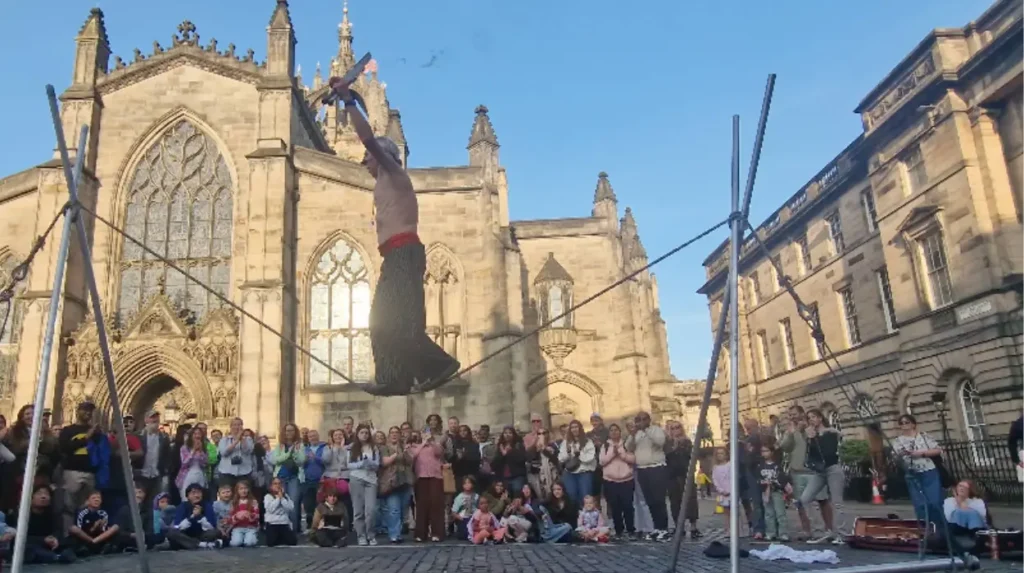
Visitors should book accommodation six to nine months in advance and ticket reservations six weeks before arrival. Securing lodgings early avoids steep seasonal rate spikes, while advance ticket purchases ensure access to popular high-demand scheduled performances.
Accommodation pricing across Lothian experiences substantial inflation as August approaches due to extreme demand surges. Standard hotels, guesthouses, and short-term rentals double or triple their typical nightly rates by late spring. Booking early guarantees proximity to central hubs and protects travelers from sudden availability deficits. University student accommodation complexes unlock thousands of rooms for seasonal visitors starting every January.
Travelers seeking budget alternatives reserve space in surrounding outer regions like East Lothian or West Lothian six months prior. Early accommodation planning provides a stable base from which to construct daily performance itineraries without incurring exorbitant costs.
Ticket releases occur in phased batches starting as early as February and continuing through June. Major comedy acts and limited-run theatrical productions routinely sell out within days of public availability. Purchasing priority performances early safeguards access to must-see artistic talent before arrival in Scotland. However, reserving flexible empty slots in a personal schedule remains essential for spontaneous show choices.
The official Fringe website and mobile app maintain live inventory updates, allowing instant bookings throughout the month. Balancing advance reservations for top-tier shows with open daytime hours maximizes both schedule certainty and artistic exploration during the event.
How do audiences navigate geography, transportation, and venue hubs in Edinburgh?

Audiences navigate Edinburgh by walking primary pedestrian routes, using Lothian Buses, riding Edinburgh Trams, and clustering show choices by geographic hub. Grouping show selections within specific neighborhoods minimizes travel delays between back-to-back timed performances.
Edinburgh features distinct geographic topographies, including steep hills, cobblestone paths, and historic staircase shortcuts called closes. Central festival activity concentrates around Old Town, New Town, Southside, and the West End. Walk times between venues often exceed initial spatial distance estimates due to dense pedestrian crowds along the Royal Mile.
The central festival geography divides into major venue hubs operated by established production brands. The Big Four operators—Assembly, Gilded Balloon, Pleasance, and Underbelly—maintain multi-stage hubs around Bristo Square, George Square, and Teviot. Independent venue clusters operate nearby in areas like the Cowgate, Summerhall, and the Space @ Surgeons’ Hall.
Public transit offers dependable connections between outer accommodation areas and central performance zones. Lothian Buses run extensive 24-hour service networks, while Edinburgh Trams link the airport directly to York Place and Leith. Tap-to-pay contactless ticketing operates across public transit networks, simplifying daily commutes.
Navigating effectively requires budgeting a minimum of forty-five minutes between shows situated in separate hubs. Physical distance and venue entry queues make tight timing schedules impractical for visitors. Focusing on one geographical cluster per afternoon allows attendees to consume multiple performances efficiently while eliminating unnecessary transit stress.
What strategies optimize show selection, ticketing costs, and daily itineraries?
Optimizing show selection requires balancing high-profile productions with budget-friendly options like the Half Price Hut, Free Fringe shows, and early previews. Constructing daily itineraries around geographic clusters ensures low expenses and seamless performance transitions.
Ticket prices range from free admission up to twenty-five pounds for premier headlining acts. The Half Price Hut, situated centrally at the Fringe Box Office, distributes half-price tickets daily for select same-day and next-day performances. Free Fringe models, operated by networks like PBH’s Free Fringe and Laughing Horse, allow audiences to attend performances without upfront fees.
Attendees leave cash or digital donations upon exiting based on performance quality. Taking advantage of preview performances during the first week provides substantial discount rates before official reviews launch. Combining diverse pricing structures allows visitors to see multiple daily productions without exceeding overall budget limits.
Constructing a daily itinerary involves selecting two anchor shows per day and filling remaining gaps with spontaneous choices. Discovering emerging talent relies on reading independent review publications like The Scotsman, Broadway Baby, and ThreeWeeks. Street flyers distributed along the High Street offer direct insights into small-scale productions seeking audience growth.
Word-of-mouth recommendations from fellow attendees often highlight unexpected top-rated performances. Maintaining flexibility within a structured geographic schedule prevents fatigue while encouraging artistic discovery across lesser-known genres. Planning meal breaks and rest periods between shows ensures sustained energy levels throughout long festival days.
How can attendees manage physical stamina, weather, and venue entry rules?
Managing stamina requires wearing water-resistant footwear, dressing in adaptable layers, carrying hydration, and respecting strict venue entry rules. Venues strictly enforce latecomer policies, meaning late arrivals lose access without receiving ticket refunds.
August weather in Scotland fluctuates rapidly, bringing sudden rain, cool winds, and warm sunshine within a single afternoon. Wearing comfortable, flat walking shoes prevents foot strain on medieval cobblestones and concrete steps. Layered clothing allows smooth transitions between cool outdoors and warm, crowded indoor venue spaces.
Lightweight waterproof jackets fit easily inside daypacks alongside water bottles and portable phone chargers. Staying hydrated and scheduling seated food breaks protects long-term physical endurance over multi-day visits. Preparing physically for variable weather conditions ensures uninterrupted enjoyment across indoor and outdoor festival spaces.
Venue regulations require strict adherence to timing protocols to maintain show schedules. Most temporary venues enforce absolute no-latecomer policies to avoid disrupting live theatrical and comedic acts. Arriving at venue queuing areas fifteen to twenty minutes prior to curtain time guarantees smooth entry.
Many historic venues lack air conditioning and feature narrow stairwells or limited seating configurations. Attendees should check accessibility specifications on the official Fringe app prior to ticket purchases if mobility accommodations are required. Respecting venue guidelines, security procedures, and artist safety protocols ensures an efficient and pleasant viewing experience for all event participants.
What is the average cost of attending the Edinburgh Fringe for three days?
An average three-day visit costs between £350 and £700 per person, depending heavily on accommodation choices and show volume. Budget travelers using shared lodgings and attending Free Fringe shows spend significantly less than those booking central hotels and headliner tickets.
Can you buy Edinburgh Fringe tickets at the door on the day of the show?
Yes, tickets can be purchased at the venue door if the performance is not sold out. However, buying via the official EdFringe mobile app or website right before showtime is faster and avoids physical box office queues.
Is the Edinburgh Fringe suitable for children and families?
The festival features a dedicated children’s category with hundreds of family-friendly theatre, circus, and comedy shows. Age ratings are clearly listed in the programme, making it easy to identify suitable age-appropriate performances.
How do performative donations work at Free Fringe shows?
Free Fringe shows do not require an upfront ticket purchase, but audience members are expected to contribute a voluntary donation at the end. Cash or contactless card payments are accepted by artists as you exit the venue space.
What should I pack for a day out at the Edinburgh Fringe?
Pack a compact umbrella, a light waterproof rain jacket, reusable water bottle, portable battery bank, and comfortable walking shoes. Weather conditions shift rapidly, and daily itineraries involve walking several miles across uneven stone surfaces.