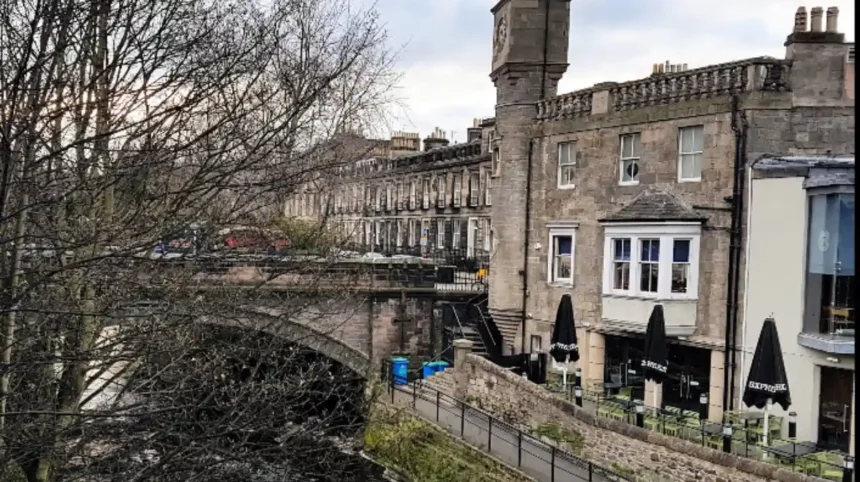
Stockbridge is a historic urban village located north of Edinburgh city centre, situated along the Water of Leith river. The district borders the New Town, Comely Bank, and Inverleith within the EH3 postcode district of Scotland.
- How Did Stockbridge Develop From a Rural Settlement into an Urban District?
- What Architectural Styles Define the Character of Stockbridge?
- What Key Historical Landmarks Are Situated Within Stockbridge?
- How Does the Water of Leith Shape the Environment and Lifestyle of Stockbridge?
- What Commercial and Social Experience Does Stockbridge Offer Visitors and Residents?
Stockbridge lies approximately 0.5 miles north of Princes Street, placing it within short walking distance of the central city. The geographical layout centres on Raeburn Place, Deanhaugh Street, and Kerr Street. The settlement originated around a natural river crossing over the Water of Leith.
Modern boundaries place the neighbourhood in the Edinburgh North and Leith parliamentary constituency. The topographical elevation slopes downward from the Georgian New Town toward the river valley, creating a defined spatial transition between urban grand blocks and village streets. Public bus routes including services 24, 29, and 42 connect the district directly to the wider municipal transport network.
The area maintains a compact footprint spanning approximately 0.5 square miles, housing a population of roughly 7000 residents. The spatial orientation makes it accessible via pedestrian bridges, cobbled lanes, and riverside paths.
How Did Stockbridge Develop From a Rural Settlement into an Urban District?
Stockbridge developed from a rural agricultural hamlet into an urban suburb through nineteenth-century architectural expansion led by painter Sir Henry Raeburn and architect James Milne, integrating the village into Edinburgh’s New Town grid while retaining its core footprint.
The name Stockbridge derives from the Scots term stocc brycg, meaning timber bridge, referencing the original wooden footbridge spanning the river. Early historical records identify the location as an outlying mill village, housing grain mills powered by the Water of Leith. Construction of a stone bridge in 1801 replaced the timber structure, stabilizing transport links into the city.
Portrait painter Sir Henry Raeburn inherited the Deanhaugh and St Bernard estates in the late eighteenth century and planned residential streets across his land holdings. Architect James Milne designed classical housing layouts including Ann Street, which opened in 1814 featuring rare front gardens unusual for Georgian street planning.
Civic expansion continued through the Victorian era with commercial developments lining Raeburn Place. Municipal boundary changes in the nineteenth century officially incorporated the independent village into the City of Edinburgh.
What Architectural Styles Define the Character of Stockbridge?
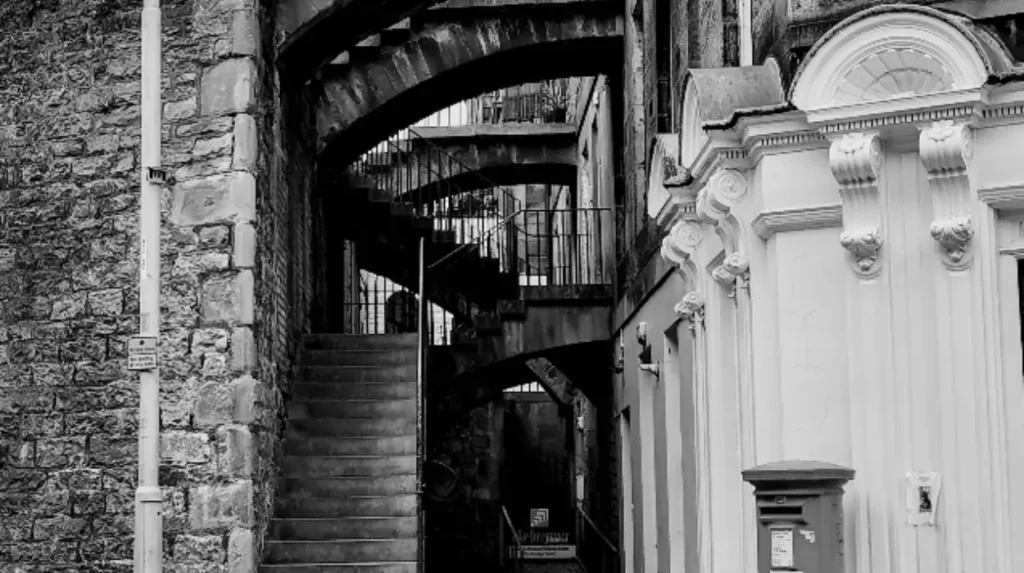
Stockbridge features a distinct mix of Georgian townhouses, Victorian tenements, and stone worker cottages, highlighted by the planned residential layout of Ann Street and the experimental industrial housing of the Stockbridge Colonies.
Georgian architecture dominates the southern sections, characterized by ashlar sandstone facades, classical proportions, and multi-pane sash windows. Ann Street displays two-story Georgian houses set behind manicured front gardens, contrasting with the flush facades of the primary New Town.
Victorian tenements line commercial thoroughfares such as Raeburn Place and Hamilton Place, featuring four-story stone structures with ground-floor shopfronts. The Stockbridge Colonies comprise eleven parallel stone terraces constructed between 1861 and 1911 by the Edinburgh Co-operative Building Company.
These two-story artisan houses feature external stone staircases, private garden plots, and decorative stone crests representing historic trade guilds. Classical civic architecture includes St Stephen Church, built in 1827 by architect William Playfair, featuring a 162-foot tower housing Europe longest clock pendulum.
What Key Historical Landmarks Are Situated Within Stockbridge?
Key historical landmarks in Stockbridge include St Bernard Well, St Stephen Church, the Stockbridge Market Archway, and the historic stone bridge spanning the Water of Leith at Deanhaugh Street.
St Bernard Well stands along the Water of Leith, built in 1789 over a natural mineral spring discovered in 1760. Designed by painter Alexander Nasmyth, the structure is modeled after the Roman Temple of Vesta at Tivoli, featuring ten Doric columns supporting a dome and a statue of Hygieia.
St Stephen Church marks the eastern entry point on St Vincent Street, constructed in neoclassical style with an elevated main hall accessed by external stone stairs. The original entrance archway to the 1825 Stockbridge Market remains standing on St Stephen Street, displaying carved stone lettering above its pediment.
The stone Stock Bridge itself, completed in 1801, serves as the central crossing point and structural anchor of the neighborhood. The former Stockbridge Free Church tower, built in 1868, stands preserved along Hamilton Place after the main hall demolition in 1980.
How Does the Water of Leith Shape the Environment and Lifestyle of Stockbridge?
The Water of Leith shapes Stockbridge by creating a natural green corridor through the urban landscape, providing pedestrian connectivity, ecological habitats, and outdoor recreation along its designated riverside walkway.
The river flows from the Pentland Hills through the heart of Stockbridge before emptying into the Firth of Forth at Leith. The Water of Leith Walkway offers a 12-mile continuous pedestrian path, connecting Stockbridge to Dean Village upstream and Royal Botanic Garden downstream.
Urban wildlife inhabits the river banks, including brown trout, grey herons, kingfishers, and Eurasian otters. Historical mill lades and stone weirs alter river flow along Saunders Street and Glenogle Road, preserving remnants of eighteenth-century water-powered industries.
Environmental management programs maintain flood defenses and riverbank vegetation along the basin. Residents utilize the river path for daily commuting, walking, and exercise away from vehicular traffic. The river valley acts as a natural buffer, insulating inner residential streets from surrounding urban congestion.
What Commercial and Social Experience Does Stockbridge Offer Visitors and Residents?
Stockbridge offers an independent retail economy, specialized culinary establishments, Sunday street markets, and community cultural events, creating a localized village environment within a capital city.
Commercial activity concentrates on Raeburn Place, St Stephen Street, and Kerr Street. The district hosts independent businesses including cheesemongers, antiquarian bookshops, vintage clothing boutiques, and art galleries.
The weekly Stockbridge Market operates every Sunday at Saunders Street, featuring local food producers, street food vendors, and craft artisans. Public amenities include the Glenogle Swim Centre, a restored Victorian bathhouse operating since 1889.
The annual Stockbridge Duck Race takes place on the river each spring, releasing rubber ducks to raise funds for local charities. Nearby green spaces include Inverleith Park, spanning 54 acres with sports pitches, allotments, and views of Edinburgh Castle. The Royal Botanic Garden Edinburgh borders the district to the north across 70 acres of living plant collections.
What is Stockbridge in Edinburgh famous for?
Stockbridge is famous for its independent shops, Sunday market, Georgian architecture, and village atmosphere. It features historic sites like St Bernard Well, Circus Lane, and the Stockbridge Colonies along the Water of Leith.
How far is Stockbridge from Edinburgh city centre?
Stockbridge is approximately 0.5 miles north of Edinburgh city centre. Visitors can reach the area on foot within a 15-minute walk from Princes Street or George Street through the New Town.
What day is the Stockbridge Market open?
The Stockbridge Market operates every Sunday from 10:00 AM to 4:00 PM at Jubilee Gardens on Saunders Street. It offers street food, fresh local produce, bakery goods, and artisan crafts.
Why are the Stockbridge Colonies famous?
The Stockbridge Colonies are famous as an early example of working-class cooperative housing built between 1861 and 1911. The eleven stone terraces feature double front doors, private gardens, and trade guild crests.
How do you get to Stockbridge by public transport?
Stockbridge is served by Edinburgh Bus routes 24, 29, and 42, which stop along Raeburn Place and Hamilton Place. It is also easily accessible by walking along the Water of Leith Walkway from Dean Village or Leith.